Algeria
 Egypt
 Libya
 Morocco
 Sudan
 Tunisia
 Benin
 Burkina Faso
 Cabo Verde
 Côte d'Ivoire
 Ghana
 Guinea
 Guinea-Bissau
 Liberia
 Mali
 Mauritania
 Niger
 Nigeria
 Senegal
 Sierra Leone
 The Gambia
 Togo
 Central African Republic
 Chad
 DR Congo
 Equatorial Guinea
 Gabon
 Republic of the Congo
 São Tomé and Príncipe
 Burundi
 Comoros
 Djibouti
 Eritrea
 Ethiopia
 Kenya
 Madagascar
 Malawi
 Mauritius
 Mozambique
 Rwanda
 Seychelles
 Somalia
 South Sudan
 Tanzania
 Uganda
 Angola
 Botswana
 Eswatini
 Lesotho
 Namibia
 South Africa
 Zambia
 Zimbabwe
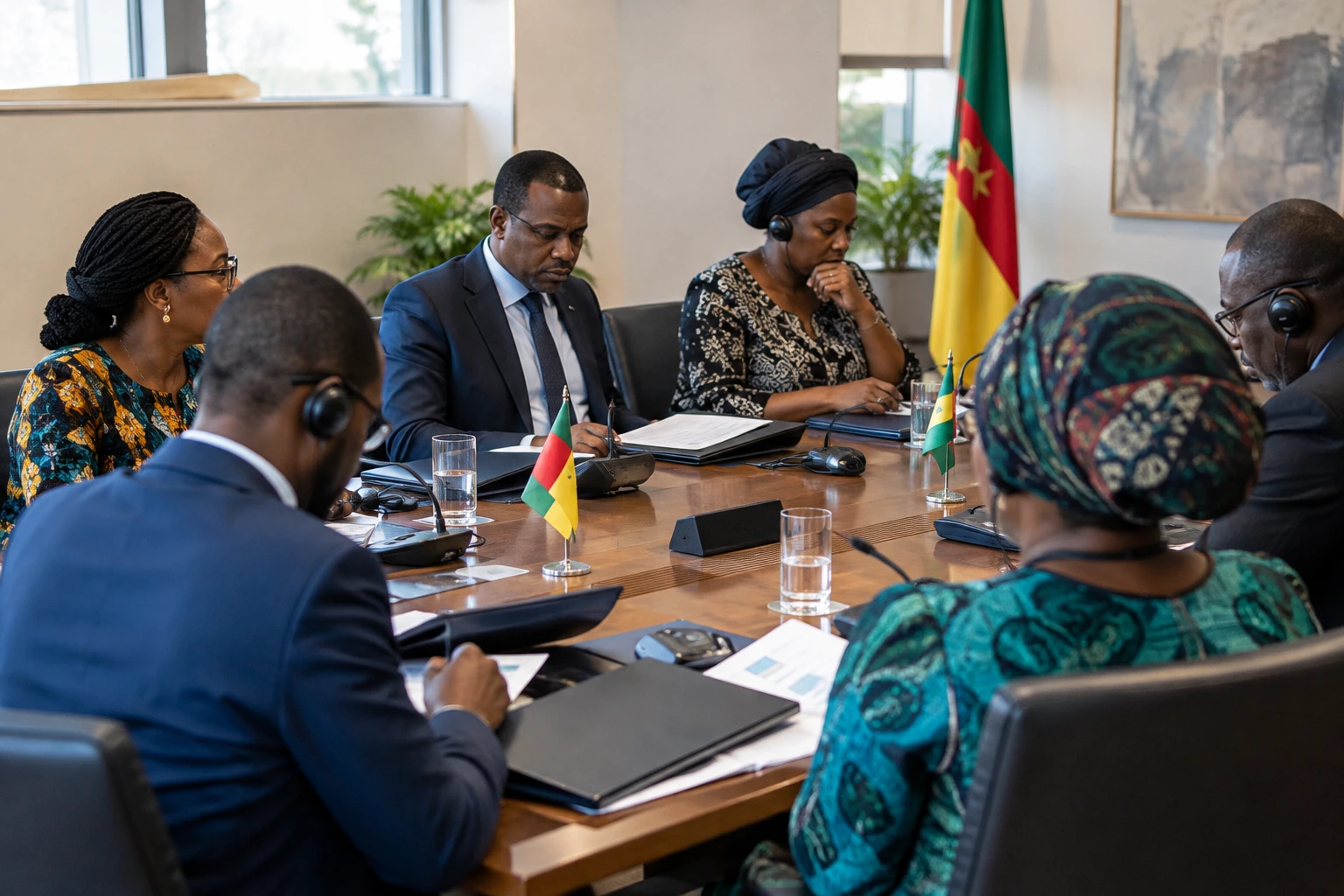
For Cameroonian families who have heard nothing from a relative who left to work in Russia, the uncertainty does not stop at the border. It centres on an essential question: did the promised job lead their relative into the Russian army and then to the front in Ukraine? In Yaoundé, a march brought these demands for answers and a return home into the public eye.
Families faced with a lack of answers
On Wednesday 28 October 2026, members of the collective “Bring Back Our Sons and Brothers” marched to the Russian embassy in Cameroon. They are calling on the Cameroonian and Russian authorities to act against what they describe as clandestine recruitment networks. Their demand also concerns the fate of missing people and the repatriation of those who may have died.
Testimonies gathered during the demonstration give a concrete sense of this waiting. One father says he is seeking news of his son, without having been able to see his body or grieve. Catherine Djock says she has had no news of her husband for several months. She says he was supposed to leave for a job as a cook and then apparently found himself at the front. These accounts remain those of relatives: the circumstances of each departure and the individual situation of those concerned must be established on a case-by-case basis.
The collective, founded by civil society figures, wants to bring families together and urge the two states to exchange information. The march does not, in itself, constitute official confirmation of the cases cited. It does, however, highlight questions that families cannot resolve alone: who organised the departures, under what contract, and which authority can confirm where the recruits are?
Figures to be treated with caution
The investigative collective All Eyes on Wagner, which draws on named data compiled in several countries, recorded 1,417 African nationals recruited by Russia and 316 confirmed deaths in its data. For Cameroon, it identified 335 recruits and 94 confirmed deaths. These figures are a documented count, not a comprehensive tally: the collective says the information available remains partial and that losses may be underestimated. Nor do they make it possible to conclude that every person enlisted was deceived. All Eyes on Wagner’s data on African recruits have been cited by independent media, while separate information has been reported by the Associated Press.
In April 2026, Cameroon’s Ministry of External Relations acknowledged that Moscow had reported the deaths of 16 Cameroonian nationals in the area of military operations in Ukraine. This official notification does not resolve all the situations reported by families: it does not provide an overall tally of Cameroonians recruited and does not, on its own, confirm the circumstances of each person’s involvement. The Associated Press reports on the Russian notification and Yaoundé’s response.
An issue already flagged by Yaoundé
The demonstration is part of an institutional concern that predates it. In March 2025, the minister delegate to the Ministry of Defence, Joseph Beti Assomo, had asked military officials to take measures against clandestine departures by members of the defence and security forces for the Russia-Ukraine conflict. The directive was aimed in particular at desertions. It does not, however, in itself address the cases of civilians who left with promises of a job or training. Cameroonian media reported on this March 2025 instruction.
This distinction matters. The authorities must be able to investigate possible deceptive recruitment while checking contracts and departure routes. Families, meanwhile, are first seeking reliable news, proof of death when one is reported, and clear procedures for repatriation. Without coordination between diplomatic services, local authorities and Russian counterparts, these requests risk remaining fragmented.
The situation also affects ties between Yaoundé and Moscow. Cameroon has diplomatic and military relations with Russia, but these do not absolve the two governments of clarifying the status of their nationals. In March 2025, the Cameroonian authorities had already expressed concern about military personnel leaving. In April 2026, the death notification sent by Moscow made the human cost more tangible. The march has now turned this issue into a public demand led by relatives.
An issue that extends beyond Cameroon
The problem is not limited to Central Africa. All Eyes on Wagner’s data records nationals from dozens of African countries. In South Africa, the government announced in February 2026 the return of 17 men who had asked for help after finding themselves on the front lines between Russia and Ukraine. This precedent shows that diplomacy can help secure returns, without resolving the responsibility of recruiters or the fate of those still reported missing. The South African government confirmed the men’s return.
For Yaoundé, the immediate challenge is therefore twofold: to verify individual cases and prevent further departures under false promises, if these are established. Regional cooperation could also facilitate the sharing of information on intermediaries, job offers and recruitment routes. CEMAC, an economic community of six Central African countries, is a possible forum for dialogue, although no joint initiative on these recruitment efforts has been announced at this stage.
The next steps will depend on concrete responses from the authorities: publication of verifiable information, contact with families, investigations into job offers and approaches to Moscow concerning missing people or remains. Until these are forthcoming, collective figures describe the possible scale of the phenomenon, but do not replace the truth each family is waiting for.