Algeria
 Egypt
 Libya
 Morocco
 Sudan
 Tunisia
 Benin
 Burkina Faso
 Cabo Verde
 Côte d'Ivoire
 Ghana
 Guinea
 Guinea-Bissau
 Liberia
 Mali
 Mauritania
 Niger
 Nigeria
 Senegal
 Sierra Leone
 The Gambia
 Togo
 Central African Republic
 Chad
 DR Congo
 Equatorial Guinea
 Gabon
 Republic of the Congo
 São Tomé and Príncipe
 Burundi
 Comoros
 Djibouti
 Eritrea
 Ethiopia
 Kenya
 Madagascar
 Malawi
 Mauritius
 Mozambique
 Rwanda
 Seychelles
 Somalia
 South Sudan
 Tanzania
 Uganda
 Angola
 Botswana
 Eswatini
 Lesotho
 Namibia
 South Africa
 Zambia
 Zimbabwe
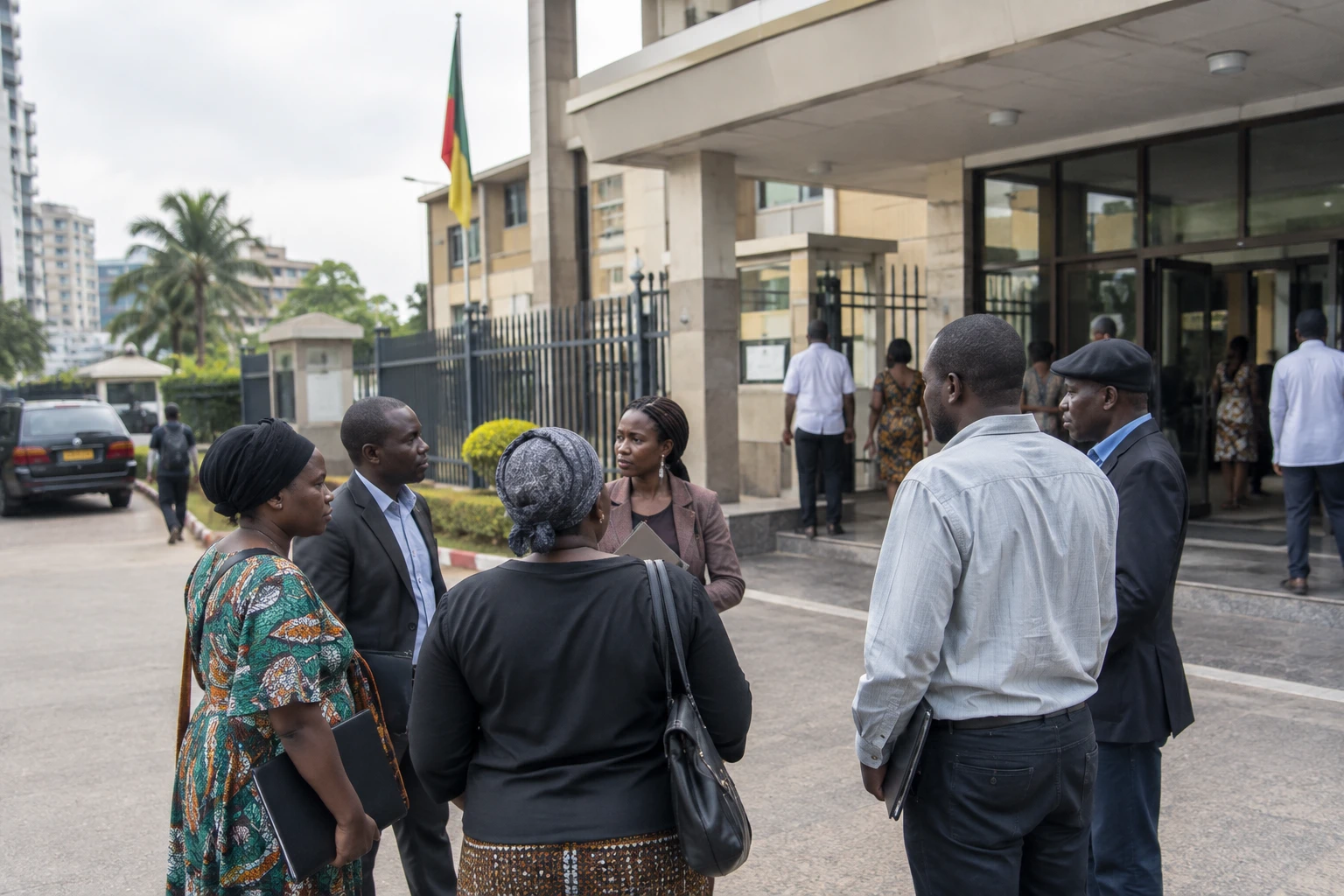
A departure presented as a promise of a job can turn into military service far from home. In Cameroon, families are now demanding answers about the fate of relatives who left for Russia and were found in the ranks of the army fighting in Ukraine.
Families face silence and uncertainty
On Wednesday 28 October 2026, the « Bring Our Sons and Brothers Home » collective marched to the Russian embassy in Yaoundé. Participants called on the Cameroonian and Russian authorities to work together to identify and dismantle clandestine recruitment networks.
Their demands are specific: to find out where the missing are, receive verifiable news and arrange the return of survivors or remains. For some families, the lack of proof of death makes it impossible to grieve. The father of a young man reported missing asked for his son to be returned to him, whatever his condition. A wife who has heard nothing for several months says she fears that her husband, who left hoping to work as a cook, may have been sent to the front.
These accounts describe individual situations. On their own, they do not establish how many Cameroonians were recruited or the circumstances in which each person signed a contract. The collective accuses recruitment networks of deception; individual journeys and responsibilities need to be documented on a case-by-case basis.
Official figures and broader estimates
The debate, however, is not based solely on relatives’ accounts. On 6 April 2026, Cameroon’s Ministry of External Relations confirmed that it had received a note from the Russian embassy reporting the deaths of 16 Cameroonian nationals described as contract soldiers. The ministry said arrangements had been made to inform their families. The circumstances and dates of the deaths were not specified in the communication reported by several media outlets.
A separate tally by All Eyes on Wagner, an investigative group that analysed recruitment data, counted 1,417 nationals of African countries recruited by Russia between 2023 and mid-2025. The organisation identified more than 300 deaths in this dataset. These figures are not an exhaustive official tally: they depend on the data available and do not necessarily cover every case.
In a more detailed publication, the investigation attributed 335 recruits and 94 recorded deaths to Cameroon. These estimates should remain attributed to the organisation. They differ from the official figure of 16 deaths reported by Yaoundé, which corresponds to the people mentioned in the Russian diplomatic note, rather than a complete publicly released count.
Diplomatic and protection concerns
For Yaoundé, the case concerns consular protection, oversight of departures and bilateral relations with Moscow. The Ministry of External Relations has acknowledged deaths reported by Russia, but families and the collective are seeking more information about recruitment, contracts, places of death and the repatriation of bodies.
The problem extends beyond Cameroon. In South Africa, the return of nationals recruited under false promises and investigations into intermediaries have shown that African authorities may have to negotiate directly with Moscow. This comparison does not prove that the same networks operate in both countries; rather, it highlights the shared difficulty of verifying cross-border job offers and protecting people who have already left.
The consequences are not limited to combatants. Relatives bear the cost of waiting, administrative procedures and, sometimes, uncertainty over whether someone has died. Prospective recruits, meanwhile, may struggle to assess the risk when offers circulate on social media or through private intermediaries. The challenge is therefore also to make recruitment channels subject to oversight and enable families to contact the authorities promptly.
A regional issue, with follow-up still to be developed
Cameroon is a member of CEMAC, the Economic and Monetary Community of Central Africa. The organisation is not an authority responsible for conducting consular operations, but the movement of people and cross-border recruitment give the issue a regional dimension. Cooperation between Central African states could help share alerts about suspect agencies and assist nationals, without prejudging responsibility in any individual case.
At the pan-African level, the available data suggest that the phenomenon affects several countries, not just one nationality. Follow-up will depend in particular on governments’ ability to verify contracts, investigate intermediaries and request named information from the Russian authorities. For Cameroonian families, the immediate priority remains obtaining a reliable answer about each missing person and finding out what steps will secure the return of survivors or remains.
The 28 October march has thus put a humanitarian issue at the heart of relations between Yaoundé and Moscow. It does not settle questions of legal responsibility. But it is a reminder that behind the figures are people whose departure, service and fate must be established precisely.