Algeria
 Egypt
 Libya
 Morocco
 Sudan
 Tunisia
 Benin
 Burkina Faso
 Cabo Verde
 Côte d'Ivoire
 Ghana
 Guinea
 Guinea-Bissau
 Liberia
 Mali
 Mauritania
 Niger
 Nigeria
 Senegal
 Sierra Leone
 The Gambia
 Togo
 Cameroon
 Central African Republic
 Chad
 DR Congo
 Equatorial Guinea
 Gabon
 Republic of the Congo
 São Tomé and Príncipe
 Burundi
 Comoros
 Djibouti
 Eritrea
 Ethiopia
 Kenya
 Madagascar
 Malawi
 Mauritius
 Mozambique
 Rwanda
 Seychelles
 Somalia
 South Sudan
 Tanzania
 Uganda
 Angola
 Botswana
 Eswatini
 Lesotho
 Namibia
 South Africa
 Zimbabwe
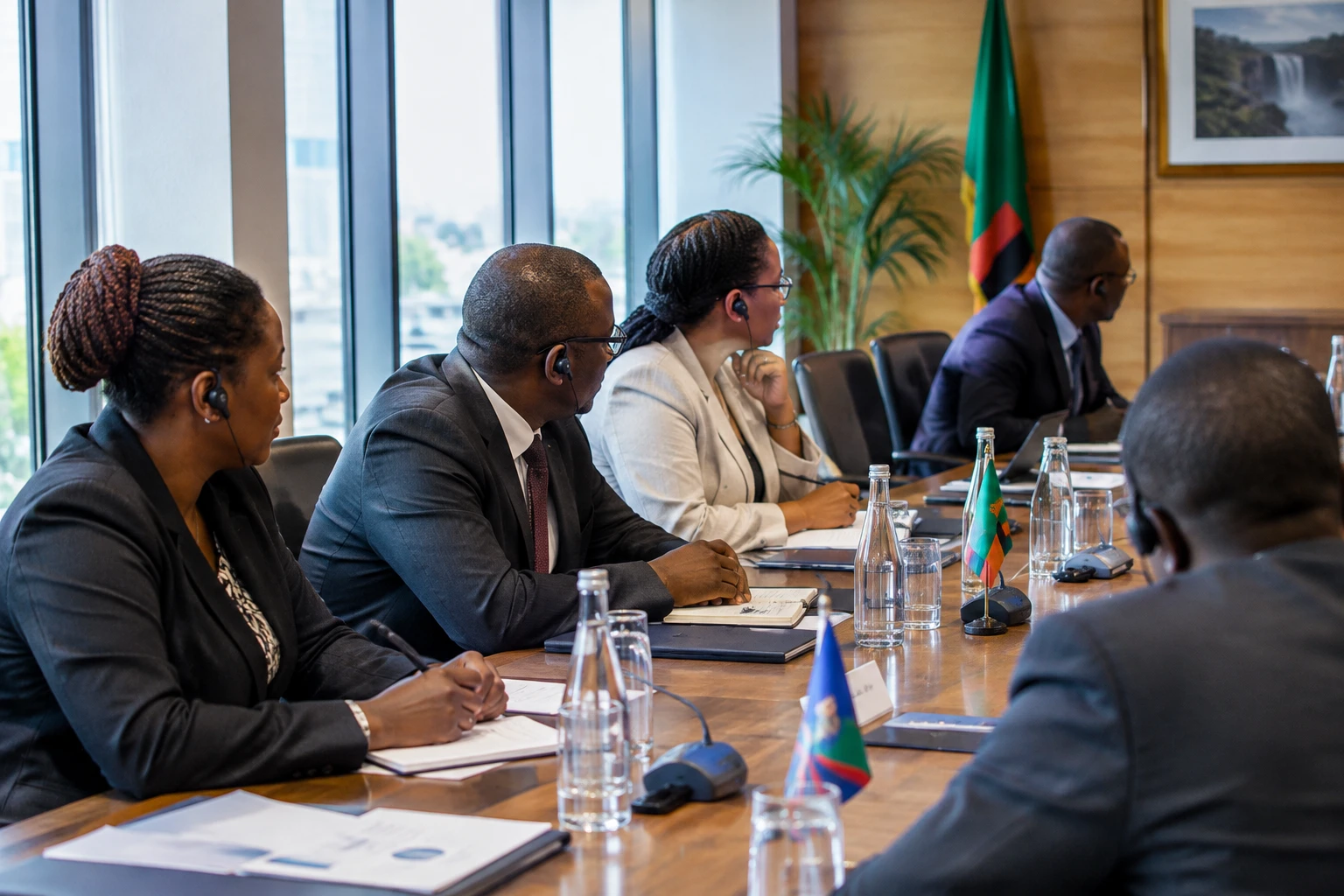
In Lusaka and across the mining and farming regions, Hakainde Hichilema’s new team will be judged less by the number of portfolios than by its results: more electricity, accessible public services and a fairer distribution of income. By expanding the government to 30 ministries, the Zambian president is betting on a more specialised administration. The move also prompts debate about its cost and effectiveness.
A second term, a reshaped administration
The reorganisation follows Hichilema’s re-election in August 2026 and his inauguration on 1 September. On 27 October, the National Assembly approved the dissolution, merger and creation of ministries. The following day, the president appointed 24 ministers and 10 provincial officials at State House in Lusaka. Four ministers had been appointed in September, including those for Finance, Foreign Affairs, Health and Green Economy. The details have been reported by Zambia’s presidency, local media and the Anadolu news agency.
The new structure separates several responsibilities that were previously grouped together. The former Ministry of Energy has been split into Electricity, entrusted to Peter Kapala, and Petroleum, headed by Makozo Chikote. Trade and Exports has gone to Caroline Katotobwe, while Noel Nkoma takes Industry. Harry Kamboni has been appointed to Education and Douglas Syakalima to Skills and Higher Education.
Among the other appointments, Brenda Tambatamba takes charge of Mines and Mineral Development. Zambian media and Anadolu describe her as the first woman to hold the portfolio. Culture and Arts, as well as Youth and Sports, also have separate ministries. Collins Nzovu is responsible for Infrastructure and Urban Development, Patrick Mucheleka for Lands, and Gift Sialubalo for Local Government and Rural Development.
The case for specialisation and the question of resources
The government presents the separation as a way to target priorities more effectively and clarify responsibilities. Vice-President Mutale Nalumango has, in particular, justified the creation of a Ministry of Electricity by pointing to the need to generate and transmit power. The Ministry of Petroleum, meanwhile, will be able to monitor fuel supplies and issues related to the TAZAMA pipeline more directly.
These issues affect very different activities. Mines need a reliable electricity supply. Households, shops and small businesses also depend on power for their expenses and income. Shortages or outages can therefore weigh on both mining output and informal economic activity. Separating the portfolios may make it easier to monitor these issues, but does not in itself create new generation or network capacity.
The same question applies to Industry and Exports. A specialised administration could better support the local processing of copper and other products. But that will depend on infrastructure, access to energy, business financing and coordination between ministries. Economic actors will want to know whether the new structures shorten procedures or add more points of contact.
Outside government, critics have also questioned whether increasing the number of ministries is appropriate when public programmes are under pressure. Zambian activist Laura Miti and opposition leader Fred M’membe have voiced reservations, the local outlet Lusaka Times reports. The Citizens First party has also questioned the expansion. By contrast, Highvie Hamududu, leader of the Party of National Unity and Progress, has argued that the additional cost would be limited. These views illustrate the debate; on their own, they are not enough to establish the reform’s actual cost.
The budget and energy are the first practical tests
The timetable will quickly put the new team to a measurable test. The government is due to present the 2027 national budget on 6 November. The new ministries’ running costs, staffing and results can then be compared with the funding allocated to local services and social programmes. This matters for rural communities, whose access to agricultural support or administrative services often depends on decisions made in the capital.
The reform is also part of the “Grow Zambia” agenda, which sets production targets for 2031. Hichilema has cited, among other goals, annual copper production of three million tonnes and electricity capacity of 10 gigawatts. These are targets announced by the president, not results already achieved. The challenge will be to connect these national ambitions to the needs of the provinces: connections to services, transport, jobs and benefits for Zambian businesses.
The financial climate makes this equation tighter still. On 9 October, the International Monetary Fund and Zambian authorities reached a preliminary agreement on a 36-month programme worth up to $1.472 billion. It remains subject to approval by the Fund’s Executive Board and the completion of prior actions. The programme aims, among other things, to support economic stability and debt sustainability. In this context, the new structure will have to show that it improves policy implementation without unnecessarily increasing public spending.
A stake for southern Africa
Zambia is a member of the Southern African Development Community, SADC, which brings together countries in the region and works on, among other things, economic integration and infrastructure. Zambia’s choices on electricity, transport and mineral processing therefore matter to its neighbours too: supply chains and energy networks extend beyond national borders.
For now, creating ministries guarantees neither better coordination nor more inclusive growth. The next developments to watch are the 6 November budget, the resources actually allocated to the new structures and their first results in energy, industry and local services. The reform’s impact will depend on its ability to turn decisions made in Lusaka into tangible improvements in the provinces.