Algeria
 Egypt
 Libya
 Morocco
 Sudan
 Tunisia
 Benin
 Burkina Faso
 Cabo Verde
 Côte d'Ivoire
 Ghana
 Guinea
 Guinea-Bissau
 Liberia
 Mali
 Mauritania
 Niger
 Nigeria
 Senegal
 Sierra Leone
 The Gambia
 Togo
 Cameroon
 Central African Republic
 Chad
 DR Congo
 Equatorial Guinea
 Gabon
 Republic of the Congo
 São Tomé and Príncipe
 Burundi
 Comoros
 Djibouti
 Eritrea
 Ethiopia
 Madagascar
 Malawi
 Mauritius
 Mozambique
 Rwanda
 Seychelles
 Somalia
 South Sudan
 Tanzania
 Uganda
 Angola
 Botswana
 Eswatini
 Lesotho
 Namibia
 South Africa
 Zambia
 Zimbabwe
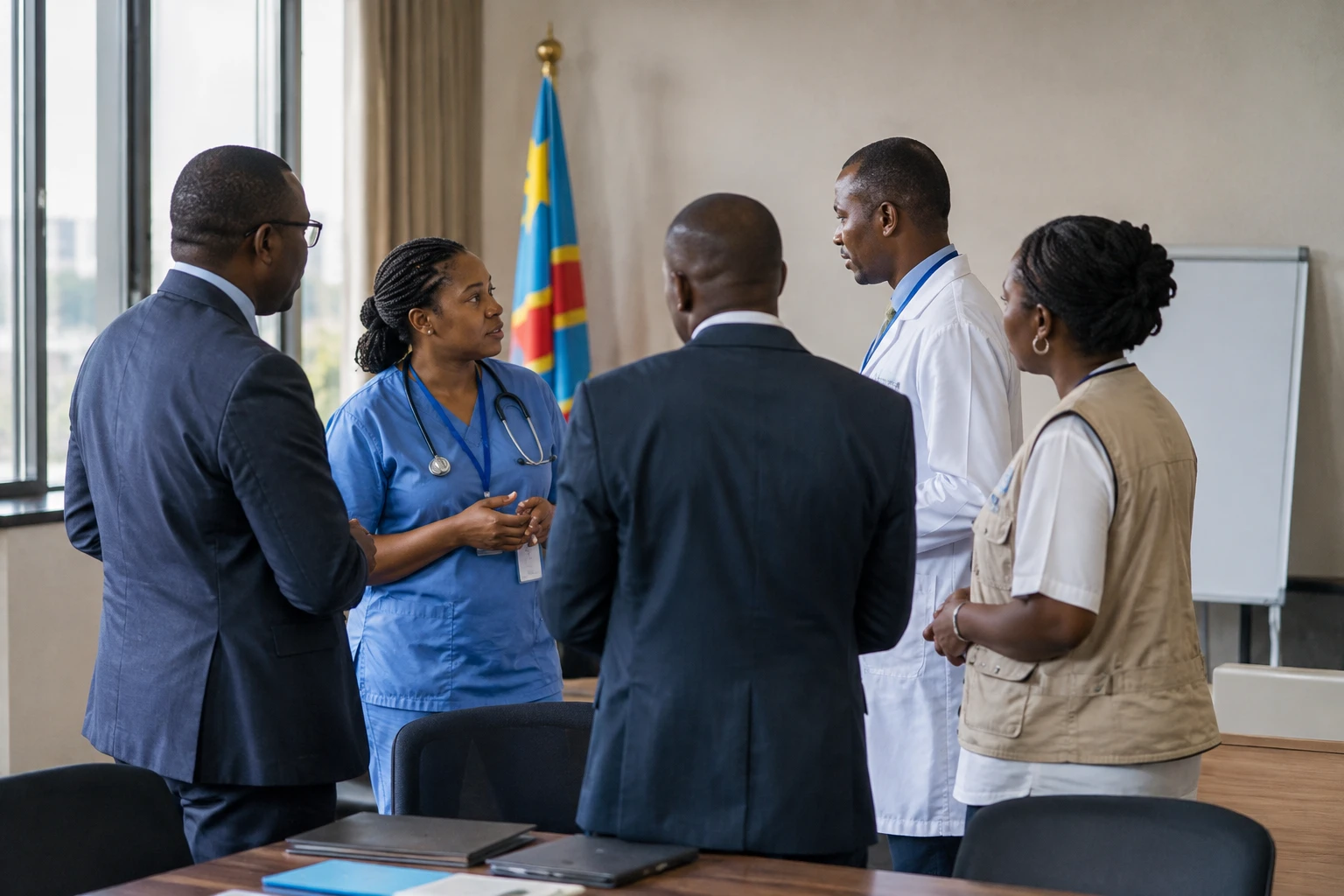
When an infected person crosses several borders before being diagnosed, the response can no longer stop at checkpoints. In Central and East Africa, the Ebola outbreak linked to the Bundibugyo virus is testing states’ ability to share information rapidly and trace chains of transmission.
An emergency that began in eastern DRC
In the Democratic Republic of the Congo (DRC), the outbreak is spreading in a region where insecurity, population movements and difficulties accessing healthcare are complicating the public health response. Declared on 15 May 2026 in Ituri province, it is the country’s 17th recorded Ebola outbreak since 1976. The World Health Organization (WHO) has classified it as a public health emergency of international concern, a status that calls for coordination between states.
Bundibugyo virus is a rare species of Ebola virus. Unlike some other forms, there is currently neither an approved vaccine nor a specific treatment for the disease. Supportive care, rapid testing, isolation of patients and monitoring of exposed people therefore remain essential. However, a clinical trial of vaccine candidates began in Bunia on 23 October, according to the WHO.
The figures show the scale of the challenge. As of 20 October, the WHO reported 9,704 confirmed cases and 4,687 deaths in the DRC, across 66 health zones and eight provinces. On 27 October, figures from the Congolese authorities reported by the Associated Press passed the 10,000 mark for confirmed cases. These totals do not necessarily cover the same reporting period: they indicate an increase, but are not directly comparable as daily figures.
Imported cases, investigations still under way
The spread is no longer confined to the DRC. Uganda reported 20 confirmed cases and two deaths during its outbreak, before declaring it over after 42 days with no new cases detected. Kenya subsequently recorded nine cases, including one death, as of 20 October. According to the WHO, they were linked to the first imported case, a man who had travelled from the DRC via Uganda.
Nigeria confirmed an imported case in Abuja, in the Federal Capital Territory, on 20 October. The investigation still had to establish the full travel history and possible source of exposure. A person’s passage through an airport or country is not, by itself, enough to establish where transmission took place. Genetic sequencing and comparison of travel routes can help clarify links between cases.
The emergency virtual meeting of African health ministers, convened on Wednesday 28 October by the African Union’s health authorities, took place against this backdrop. Officials emphasised screening at points of entry, information-sharing and cross-border surveillance. Jide Idris, director of the Nigeria Centre for Disease Control, described the online health forms completed by passengers arriving in Nigeria, as well as coordination between health services, customs and immigration.
Invisible chains complicate the response
Contact tracing remains a weak point. Around 80% of new cases reported are said not to appear on known contact lists, according to figures discussed during regional exchanges and reported by the Associated Press. The WHO also said that, between 8 and 20 October, 307 of the 482 newly reported deaths in the DRC had occurred in communities rather than treatment centres. This gap may reflect late diagnosis, difficulty accessing healthcare or cases not yet captured by surveillance systems.
For health teams, the challenge is therefore to reconstruct people’s movements and the dates when symptoms began, then check whether the routes of people diagnosed in Kenya and Nigeria crossed. In the DRC, sequencing must also cover more provinces, while checks are being stepped up at land borders. In Uganda, border districts and travellers remain under surveillance, even after the official end of its outbreak.
Ugandan Health Minister Chris Baryomunsi called for local realities to be taken into account rather than mechanically applying his country’s experience elsewhere. In eastern DRC, insecurity and poor roads make it harder to reach communities and health facilities. His call for more support underlined that the response also depends on available resources and trust between residents and medical teams.
Coordinating without isolating affected countries
The crisis involves several regional blocs. The DRC belongs to the Southern African Development Community (SADC) and the East African Community (EAC), while Uganda and Kenya are EAC members. Nigeria, meanwhile, is part of the Economic Community of West African States (ECOWAS). Movement between these areas makes health alerts and common protocols useful, without removing the responsibilities of national authorities.
Border surveillance does not necessarily mean closing borders. The WHO advises against general travel or trade restrictions and favours proportionate measures: appropriate screening, rapid investigation, data-sharing and accessible care. For traders, travellers and families who regularly cross borders, this distinction matters: prevention must reduce risks without needlessly disrupting trade and movement.
The response also depends on relations with communities. Deaths outside treatment centres, diagnostic delays and distrust of response teams can hamper case identification. Providing information without stigmatising people, listening to residents and protecting health workers are therefore practical elements of surveillance, not secondary considerations.
The next test will be whether the countries concerned can link their laboratory and travel data quickly enough to identify an untraced transmission. The vaccine trial launched in Bunia opens a scientific avenue, but it does not replace immediate measures. For the DRC and its neighbours, the challenge is now to turn the continental alert into day-to-day cooperation, while adapting the response to the realities of each territory.