Algeria
 Egypt
 Libya
 Morocco
 Sudan
 Tunisia
 Benin
 Burkina Faso
 Cabo Verde
 Côte d'Ivoire
 Ghana
 Guinea
 Guinea-Bissau
 Liberia
 Mali
 Mauritania
 Niger
 Nigeria
 Senegal
 Sierra Leone
 The Gambia
 Togo
 Cameroon
 Central African Republic
 Chad
 DR Congo
 Equatorial Guinea
 Gabon
 Republic of the Congo
 São Tomé and Príncipe
 Comoros
 Djibouti
 Eritrea
 Ethiopia
 Kenya
 Madagascar
 Malawi
 Mauritius
 Mozambique
 Rwanda
 Seychelles
 Somalia
 South Sudan
 Tanzania
 Uganda
 Angola
 Botswana
 Eswatini
 Lesotho
 Namibia
 South Africa
 Zambia
 Zimbabwe
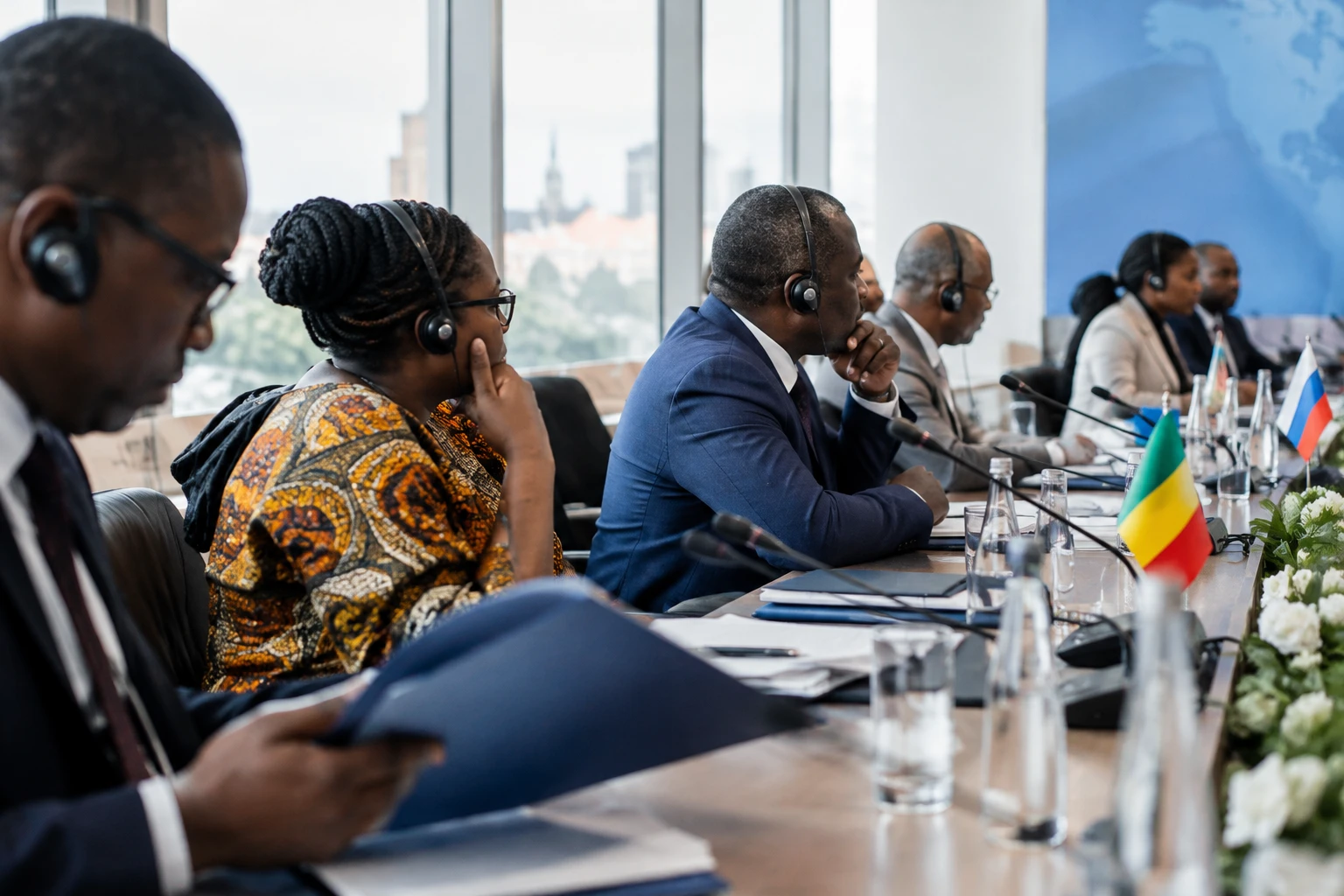
A summit can bring together dozens of delegations without changing everyday trade. In Moscow, African and Russian leaders are signalling their willingness to strengthen economic ties. The test will be less the number of meetings than whether contracts, investments and skills transfers are delivered.
Strong African representation, but diverse interests
The third Russia-Africa summit is being held in Moscow on 28 and 29 October 2026. According to figures announced by the Kremlin before the meeting, 48 of Africa’s 54 countries are represented, 22 of them by a head of state. Russian President Vladimir Putin is co-chairing the proceedings with Évariste Ndayishimiye, President of Burundi and the African Union’s (AU) current chair, the organisation that brings together the continent’s states.
This participation gives the gathering genuine diplomatic weight. It does not, however, mean that the governments attending share a common position on their relations with Moscow. Priorities differ from country to country: security, cereals and fertilisers, energy, training, technology or investment. Each capital’s choices also depend on its relations with other partners.
The summit is part of a process that began in Sochi in 2019 and continued in St Petersburg in 2023. It comes as several dialogue formats between Africa and external powers are multiplying. For African states, the challenge is to negotiate partnerships that meet their national plans and regional priorities, rather than confusing diplomatic presence with economic benefit.
Trade promises face the test of measurable results
At the opening of the proceedings, Vladimir Putin highlighted trade, cooperation in health and food security, and the sharing of digital skills. The Russian president also said that trade between Russia and African countries had exceeded $27bn in 2025. This figure, released by the Russian authorities and reported by Egyptian outlet Ahram Online, should be understood as data announced by Moscow.
The volume has increased compared with previous years, but remains modest given the size of the economies concerned and the trade many other partners conduct with the continent. Above all, an aggregate figure alone does not show what countries buy and sell, where value is created, or whether local businesses are gaining production capacity.
Évariste Ndayishimiye stressed this distinction between announcements and benefits. He called for the forum to become a platform for decisions, contracts and projects with a tangible impact on people. He also invited Russian companies to invest in Africa’s productive capacity. The request concerns the nature of the partnerships: beyond selling products, countries want to develop local processing, skills and employment.
The trade imbalance is another point to watch. Trade can grow without becoming more balanced if Russian exports increase faster than purchases of African goods. Investment, contracts actually carried out and the share of local suppliers will therefore provide a better measure of results than growth statements alone.
Benefits will vary by sector and region
The prospects discussed in Moscow will not have the same effects everywhere. An agreement on fertilisers or cereals directly concerns farmers and the authorities responsible for supplies. A digital project may initially benefit government agencies, telecoms operators or urban businesses. To reach small businesses and rural areas too, accessible infrastructure, training and clearly established implementation rules are needed.
Similarly, setting up a commercial presence does not automatically guarantee a transfer of know-how. Governments may seek to negotiate vocational training, partnerships with local businesses and the processing of raw materials locally. Benefits will depend in particular on available financing, timelines, target markets and the ability of public administrations to monitor commitments.
A platform to support projects by Russian investors was raised in discussions. Its usefulness will depend on its resources and how it operates: which projects will be selected, who will assess their results, and how will African businesses be able to access it? Without detailed information on these points, it is too early to assess what difference it will make.
The African Union’s role and regional balances
The presence of the AU’s current chair gives the dialogue a continental dimension, but the organisation does not replace states in negotiating their contracts. It can nevertheless help frame discussions around shared priorities, such as increasing trade between African countries and creating regional value chains.
This matters in particular for the African Continental Free Trade Area (AfCFTA), which aims to facilitate trade between countries on the continent. Foreign investment can support this ambition if it boosts local production and regional trade. Conversely, isolated projects focused mainly on exporting raw materials risk generating fewer knock-on effects.
Russia presents the partnership as cooperation between sovereign states and highlights its willingness to contribute to a multipolar international order. African governments, for their part, must be able to assess each proposal against their economic priorities and regional commitments. The diversity of the delegations present underlines this freedom of choice: taking part in the summit does not mean adopting a single foreign policy.
Indicators to watch after the speeches
What happens next will be determined by the documents and projects announced during the two days of proceedings, and then by their implementation. It will be important to distinguish statements of intent from funded contracts, protocols from projects under way, and training promises from skills actually acquired. Publishing detailed data on the sectors involved would also help assess how trade is changing.
For the public, results will be measured in tangible terms: jobs, the price and availability of agricultural inputs, access to services, new industrial capacity and the participation of African businesses. For governments, the challenge will also be to preserve their ability to diversify partnerships and negotiate terms that are consistent with their national strategies.
The Moscow summit confirms that Russia is seeking to strengthen its ties with African countries. It also highlights a demand voiced by the AU: economic diplomacy must deliver verifiable benefits. The next steps — financing, signing and implementing projects — will show whether the announced increase in trade translates into more value being created on the continent.