Algeria
 Egypt
 Libya
 Morocco
 Sudan
 Tunisia
 Benin
 Burkina Faso
 Cabo Verde
 Côte d'Ivoire
 Ghana
 Guinea
 Guinea-Bissau
 Liberia
 Mali
 Mauritania
 Niger
 Nigeria
 Senegal
 Sierra Leone
 The Gambia
 Togo
 Cameroon
 Central African Republic
 Chad
 DR Congo
 Equatorial Guinea
 Gabon
 São Tomé and Príncipe
 Burundi
 Comoros
 Djibouti
 Eritrea
 Ethiopia
 Kenya
 Madagascar
 Malawi
 Mauritius
 Mozambique
 Rwanda
 Seychelles
 Somalia
 South Sudan
 Tanzania
 Uganda
 Angola
 Botswana
 Eswatini
 Lesotho
 Namibia
 South Africa
 Zambia
 Zimbabwe
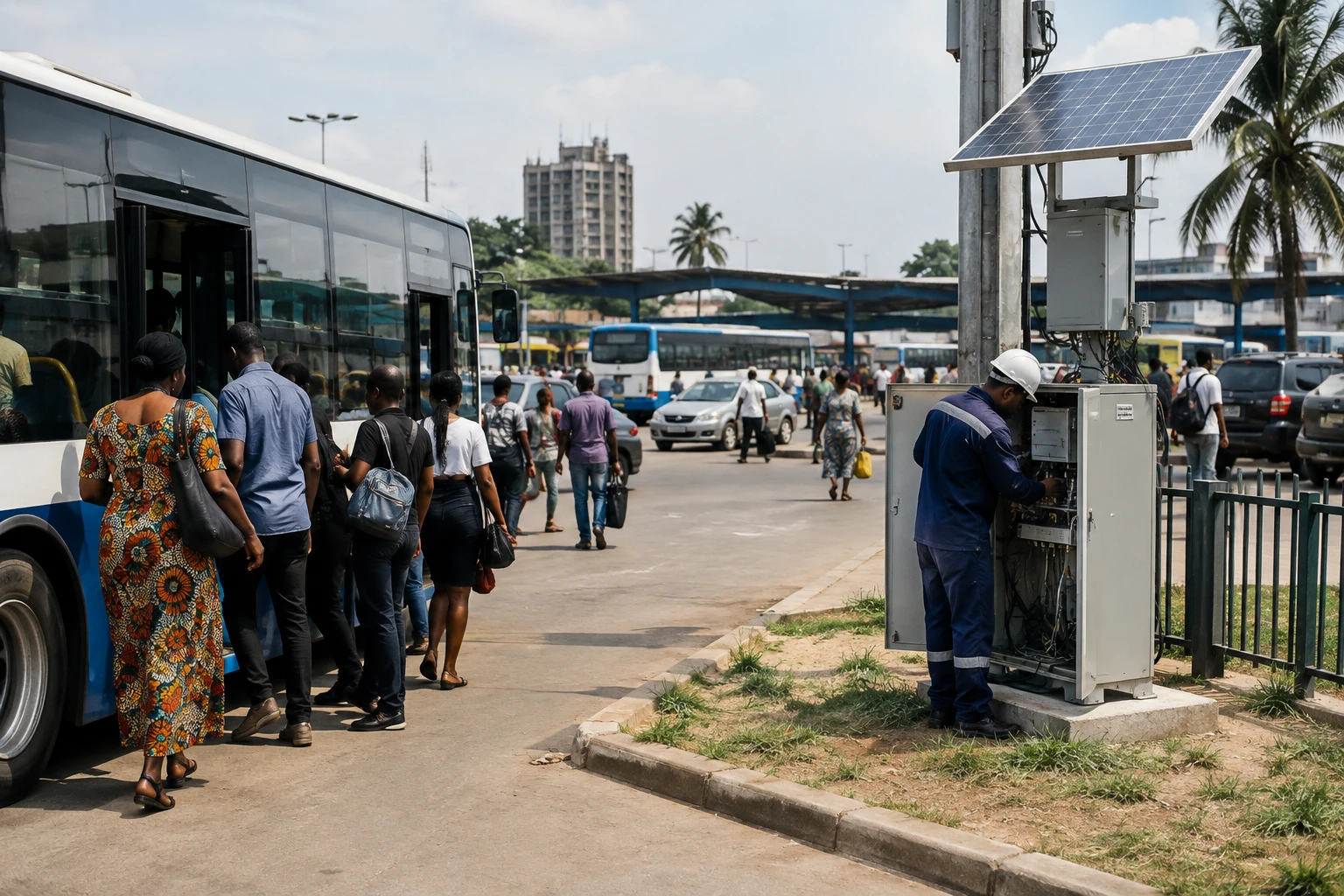
When a mobile payment fails or a call drops, the fault does not always lie with the phone. In the Republic of the Congo, disruptions reported in late October show how heavily digital services depend on a steady electricity supply and fuel for backup equipment.
A network squeezed by power cuts and fuel shortages
On 27 October 2026, the Regulatory Authority for Posts and Electronic Communications (ARPCE) said networks had been experiencing disruptions for several days across all or part of the Republic of the Congo. The regulator reported interruptions or degradation affecting calls, internet access and Mobile Money. Users may also experience calls dropping mid-conversation and slower data speeds.
Checks carried out with operators give an indication of the constraints: the electricity grid reportedly supplies an average of nine hours of power a day, while backup batteries provide around six hours of autonomy. After that, generators have to take over. Their operation, however, depends on diesel, supplies of which are currently difficult to secure, according to the ARPCE.
The regulator cites the example of Helios Towers, which manages 550 mobile base stations in the Republic of the Congo. Its requirements to power generators are estimated at around 100,000 litres a week, or nearly 400,000 litres a month. These figures were provided to the ARPCE; they illustrate the amount of fuel needed to keep infrastructure running.
The problem extends beyond the masts visible in cities. Transmission equipment, technical centres and network cores — the central installations that route communications — also need power. The ARPCE warns that the failure of central sites can trigger a cascade effect, shutting down rural equipment that depends on them.
In its statement, the regulator said it was working with the National Petroleum Company of the Congo (SNPC) to optimise fuel supplies. It also said the situation had been brought to the attention of the Prime Minister’s Office. This response aims to limit interruptions in the short term, but does not resolve the networks’ structural dependence on diesel.
A vulnerability affecting households and businesses
The consequences are not the same for everyone. An interrupted Mobile Money transaction complicates payments for small businesses and customers who use their phones to transfer money. An unstable connection also penalises businesses, online services and people who rely on the network to work or communicate.
Rural areas are particularly exposed when their mobile base stations depend on technical sites in major cities. But subscribers in Brazzaville and other urban centres are not immune: central installations and local equipment are interconnected. A power failure at one point in the network can therefore affect services far beyond the site concerned.
The cost of fuel also weighs on operators and companies that run telecoms towers. In an analysis published in 2024, industry association GSMA estimates that buying and transporting diesel can account for between 30 and 60% of operators’ total operating expenditure in many African countries. It also puts the cost of electricity generated by diesel generators at three or four times that of grid electricity in the region. These regional estimates are not specific to the Republic of the Congo.
Over time, these costs can weigh on investment in network expansion or upgrades. Remote sites, where fuel transport and maintenance are more complex, risk becoming less profitable. The energy outage thus also becomes an issue of access: service continuity and the rollout of new mobile base stations depend on the same infrastructure.
Solar power and batteries: an option to adapt
Hybrid systems generally combine solar panels, batteries and a backup generator. Solar power can reduce the number of hours diesel generators run and therefore cut fuel consumption. Batteries store electricity for periods without sunshine or when the public grid is down. This is not a one-size-fits-all solution for every mobile base station: available space, upfront costs, equipment security and maintenance capacity all influence the choice.
GSMA lists these systems among the options being considered to power telecoms towers in Africa. It also describes models in which a specialist company takes responsibility for installing and maintaining the power supply, rather than leaving each operator to manage the equipment alone. Using such a provider can share responsibilities, but requires suitable contracts and reliable oversight.
The ARPCE statement does not specify whether operators in the Republic of the Congo already have solar-powered sites or conversion projects. It therefore does not make it possible to assess what proportion of the network could be equipped, or how quickly. Diversifying energy sources can improve resilience, but does not replace the investment needed in the electricity grid, batteries and maintenance.
A national and regional issue
The Republic of the Congo is a member of CEMAC, the Economic and Monetary Community of Central Africa, which brings six countries together around economic policies and a regional market. The difficulties observed in Brazzaville and elsewhere in the country are a reminder that digital transformation also depends on reliable energy services. Connectivity supports trade, payments and business activity, including across borders.
Across Africa, the challenge is to strengthen networks able to keep operating despite power cuts and supply pressures. In the Republic of the Congo, the immediate priority remains service continuity, which the authorities are seeking to support through coordination with the SNPC. What happens next will also depend on how long the disruptions last, whether fuel is actually available and the operators’ energy investment choices.
The ARPCE statement of 27 October 2026 reports national data on electricity supplies, batteries and Helios Towers’ requirements. The Central African Information Agency has also reported on the disruptions. For regional context, CEMAC lists its six member states. The cost estimates and energy options discussed here draw on GSMA analysis of telecommunications and sustainable energy in Africa.