Algeria
 Egypt
 Libya
 Morocco
 Sudan
 Tunisia
 Benin
 Burkina Faso
 Cabo Verde
 Côte d'Ivoire
 Ghana
 Guinea
 Guinea-Bissau
 Liberia
 Mali
 Mauritania
 Niger
 Nigeria
 Senegal
 Sierra Leone
 The Gambia
 Togo
 Cameroon
 Central African Republic
 Chad
 DR Congo
 Equatorial Guinea
 Gabon
 Republic of the Congo
 São Tomé and Príncipe
 Burundi
 Comoros
 Eritrea
 Ethiopia
 Kenya
 Madagascar
 Malawi
 Mauritius
 Mozambique
 Rwanda
 Seychelles
 Somalia
 South Sudan
 Tanzania
 Uganda
 Angola
 Botswana
 Eswatini
 Lesotho
 Namibia
 South Africa
 Zambia
 Zimbabwe
Laying a cable, installing a mobile site or completing a training course is not enough to transform digital use. For Djibouti’s residents and businesses, the issue is more concrete: access to a reliable connection, including far from the capital, and the ability to use it to work, study or complete a public-sector procedure.
Two World Bank-supported programmes, with a total announced budget of $30 million, are intended to contribute to this effort. Their progress, however, shows that the funding committed has not yet translated everywhere into operational infrastructure.
Two projects, two scales of intervention
The Djibouti Digital Foundations project (DFN), approved in December 2021, has $10 million in funding. It aims to improve internet access, gradually promote competition in telecommunications, and develop digital skills and services. The World Bank presents these objectives as ways to widen access to quality connectivity and support private investment.
The second component, EARDIP — the Eastern Africa Regional Digital Integration Program — mobilises $20 million for Djibouti. It is part of a regional initiative intended to strengthen broadband connections between countries and cross-border digital exchanges. The World Bank describes the programme as involving Djibouti and Ethiopia, among others, while IGAD, the intergovernmental cooperation organisation for the Horn of Africa, brought several participating countries together in September 2026 to coordinate regional projects.
This dimension matters for Djibouti, whose economy and infrastructure are closely tied to regional flows. Digital connectivity complements transport and trade corridors: it can facilitate services, data exchanges and business activity, but it cannot replace physical investment or, on its own, guarantee affordable access.
Progress reported, results to be consolidated
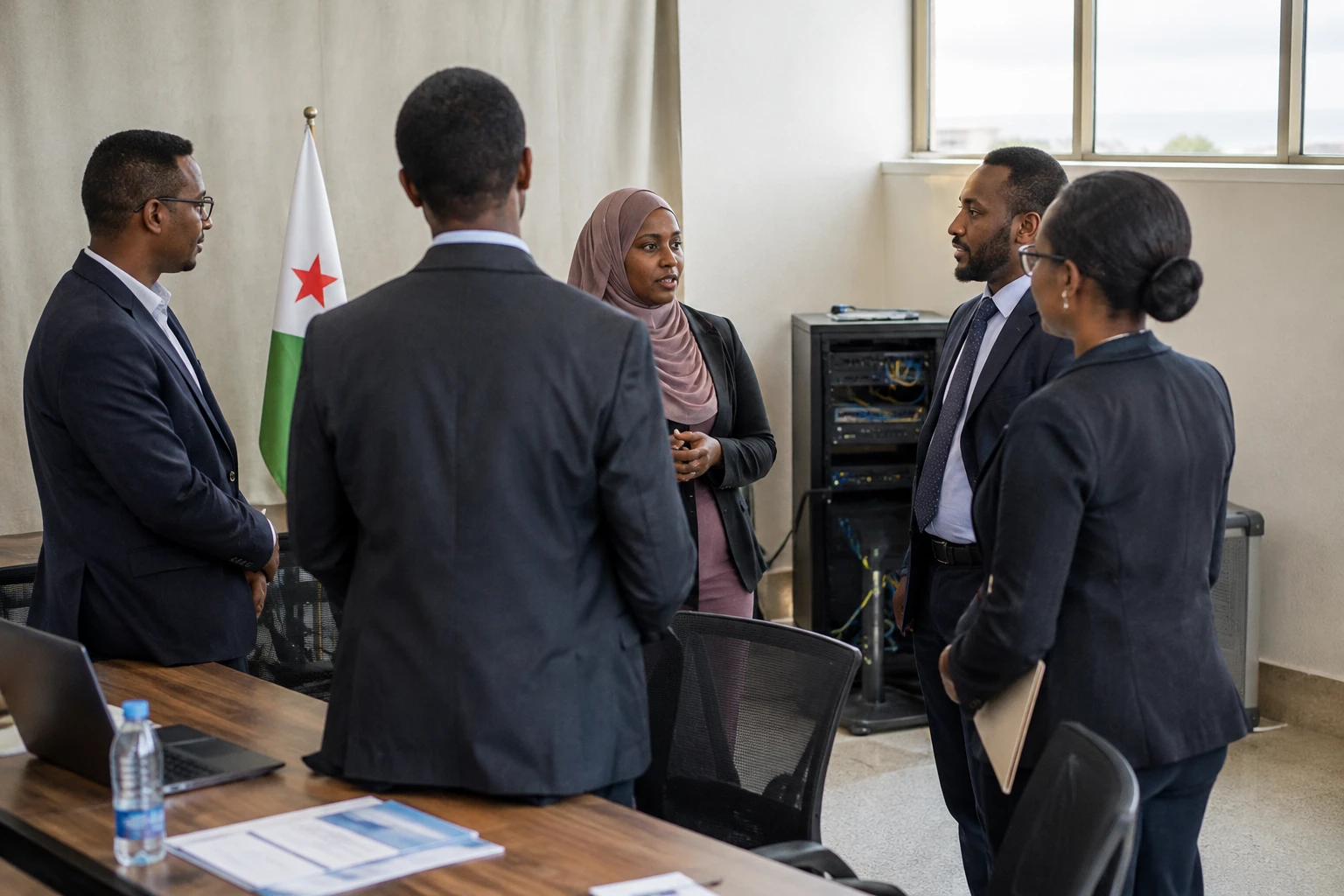
On 25 October 2026 in Djibouti, the Minister of Communication in charge of Posts and Telecommunications, Mohamed Abdoulkader Moussa Helem, chaired a meeting of the steering committees for the two projects. Participants reviewed completed activities and those still to be undertaken. The meeting highlighted, in particular, the need to speed up pending operations.
For the DFN, project coordinator Hawa Youssouf Kayad said that 26 of the 35 planned activities had been completed. Nearly 80% of resources had been committed, with a disbursement rate of 56%. Nine activities therefore remain to be completed before the scheduled closure on 30 June 2027. These figures were reported at the meeting; they describe administrative and financial progress, but do not, on their own, measure the quality or use of services by the population.
A World Bank monitoring report published in February 2026, cited in information made public in Djibouti, reported that 29 public and private sites had improved internet access as of 30 September 2025, against a target of 60. It also counted 6,275 users reached, compared with a target of 20,000 by closure. By contrast, 316 people had already received training to strengthen their digital skills, exceeding the target of 300. The indicators for sites and users therefore remain below the stated targets, while the training indicator has surpassed its target.
Data published by the World Bank in June 2025 had already flagged delays in some activities related to digital skills, notably the establishment of a coding academy and the integration of training into curricula. This progress report is a reminder that training people, connecting buildings and providing usable services are separate undertakings. Their coordination will determine the project’s tangible benefits.
Infrastructure still awaits certain approvals
EARDIP plans to extend cross-border terrestrial links, build 12 4G mobile sites and lay fibre-optic loops to Dikhil, Tadjourah and Obock. This equipment could improve coverage in regions far from the capital. But implementation remains conditional on the approval of commercial, environmental and social studies. Funding, therefore, does not mean that works have been completed, or even that every route or installation is ready to begin.
A Djiboutian public tender published in May 2025 to recruit a firm to conduct environmental and social impact studies for fibre infrastructure and mobile sites in the northern regions confirms that some of the preparatory work is following the required procedures. This step is intended to assess local effects and the conditions for installation. It is also crucial to ensure that the needs of the communities concerned are not treated as a mere technical detail.
National governance arrangements provide for a steering committee and an implementation unit under the ministry responsible for telecommunications. A decree published in the Official Gazette in January 2025 sets out this framework for EARDIP and gives the committee responsibility for supervising, monitoring and approving implementation plans. The challenge now is whether these institutions can address delays, coordinate studies and monitor results through to operational launch.
The next milestone will be actual use
For administrations and businesses in the capital, better connectivity can make procedures and business exchanges easier. In the regions, the impact will first depend on the network actually reaching them, then on its cost and reliability and on the availability of equipment. Small businesses and workers in the informal economy will not automatically benefit from infrastructure if services remain expensive or difficult to access.
At regional level, EARDIP forms part of cooperation efforts on digital integration in East Africa, involving IGAD and the East African Community (EAC). More diversified links can support data exchanges between countries. But the benefits will also depend on compatible rules, well-maintained networks and services that users can access.
The next milestones are therefore clear: approval of the studies required for the planned infrastructure, the effective launch of works and achievement of the DFN’s targets before 30 June 2027. For Djibouti, the results will not be measured solely by the amounts committed or the kilometres of fibre announced. They will be measured by the connectivity actually available to administrations, businesses and residents, in the capital and in the regions.