Algeria
 Egypt
 Libya
 Morocco
 Sudan
 Tunisia
 Benin
 Burkina Faso
 Cabo Verde
 Côte d'Ivoire
 Ghana
 Guinea
 Guinea-Bissau
 Liberia
 Mali
 Niger
 Nigeria
 Senegal
 Sierra Leone
 The Gambia
 Togo
 Cameroon
 Central African Republic
 Chad
 DR Congo
 Equatorial Guinea
 Gabon
 Republic of the Congo
 São Tomé and Príncipe
 Burundi
 Comoros
 Djibouti
 Eritrea
 Ethiopia
 Kenya
 Madagascar
 Malawi
 Mauritius
 Mozambique
 Rwanda
 Seychelles
 Somalia
 South Sudan
 Tanzania
 Uganda
 Angola
 Botswana
 Eswatini
 Lesotho
 Namibia
 South Africa
 Zambia
 Zimbabwe
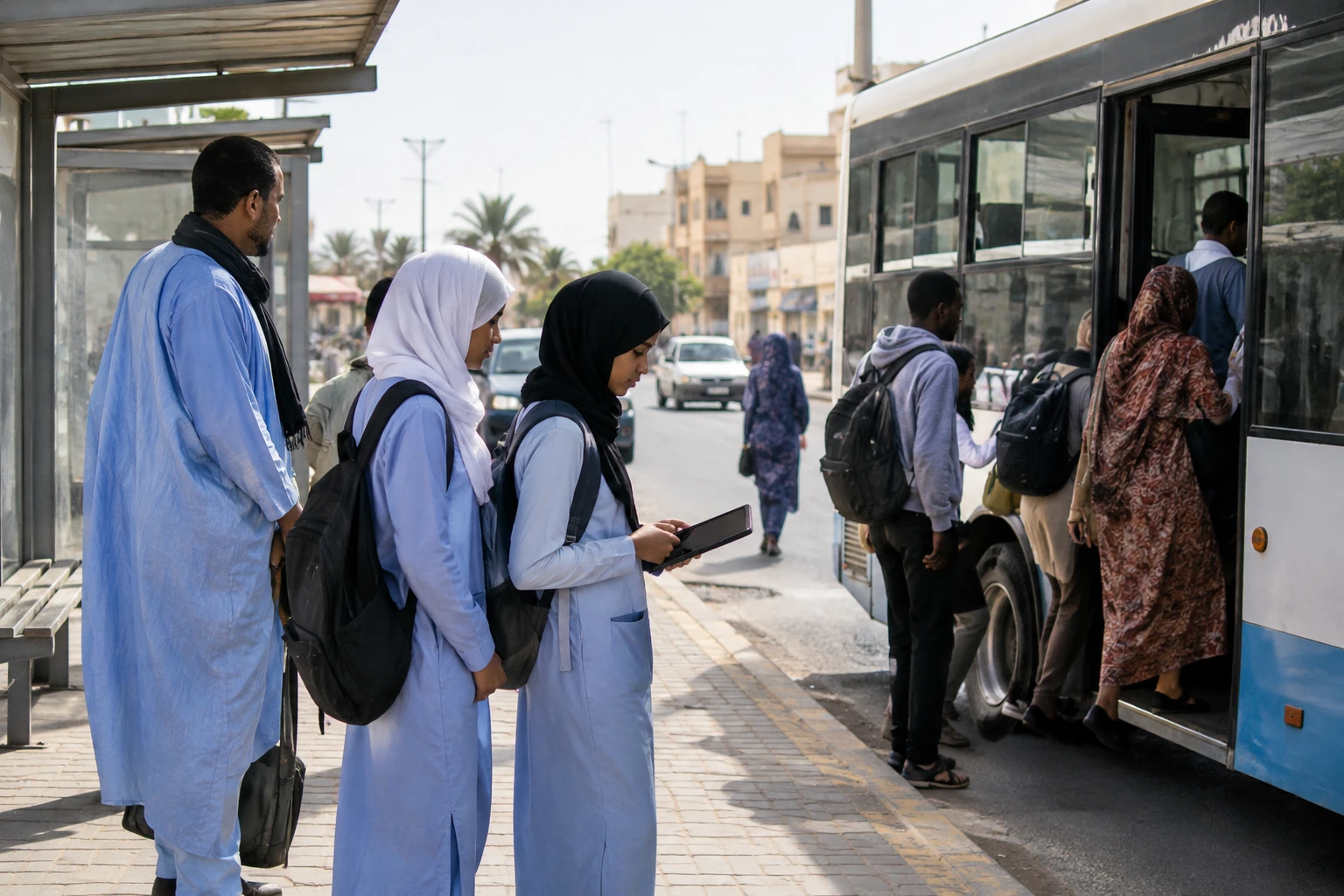
In Nouakchott, connecting a handful of schools to the internet is not enough to bring artificial intelligence into learning. For Mauritanian pupils, the decisive issue will be less the technology being announced than actual access to electricity, tools and trained teachers.
The challenge is tangible. AI can help prepare lessons or adapt exercises, but it cannot replace a teacher or the foundations needed for learning. And without a reliable connection, these tools risk benefiting first the schools that are already best equipped.
From exam administration to classroom practice
Mauritania is moving in stages. On 20 January 2026, First Lady Mariem Mohamed Fadel Dah launched a national framework dedicated to artificial intelligence in support of republican schooling. The initiative aims to coordinate the stakeholders involved, according to the announcement reported by the Mauritanian Information Agency.
An initial application is already being considered in exam administration. On 1 April, Education Minister Houda Babah discussed digitising exam administration with the ministry responsible for digital affairs. Then, on 11 April, the authorities launched a field trial of the system in the wilaya of Nouakchott-Nord. The aim is to digitise organisational and marking procedures, not yet to demonstrate an effect of AI on school results.
The discussion broadened on 19 October in Milan. At a ministerial meeting dedicated to AI and education, Houda Babah argued for the gradual and considered integration of these technologies. She spoke of their potential to better meet children’s needs and improve the quality of teaching. Her participation in the Next Gen AI 2026 conference was also reported by Mauritanian outlet Sahara Médias.
Infrastructure remains uneven
The shift from digital exams to educational uses will depend on conditions in schools. In November 2024, Mauritania’s ministry responsible for digital transformation said that 20 public schools in the three wilayas of Nouakchott had been connected to fibre-optic broadband. The programme had also trained more than 160 digital technology teachers. These figures appear in the project presentation published by the Ministry of Digital Transformation.
These advances remain limited to a small number of schools. A World Bank analysis published in February 2025 estimated that only 19% of primary schools had access to electricity. It also noted that reliable internet access was even less widespread. The gap between connected schools in the capital and those in less well-served regions will therefore affect the rollout. Families and pupils also do not all have the same equipment at home.
Other indicators underline that needs extend beyond digital technology. UNICEF’s 2025 education budget analysis estimates that 23.5% of pupils drop out of primary school. It also says that 35% progress to lower secondary education, while 85% of children aged three to five do not receive pre-primary education. These figures describe challenges around access to and continuity of schooling that digital tools alone cannot solve.
Measure the effects before promising transformation
Baccalaureate results also need to be interpreted with caution. For 2024, the Higher Council of Education reports an overall pass rate of 39.28%. Mauritanian media subsequently reported a rate of 20.8% in the 2025 regular session, followed by 13.56% in 2026, citing results announced by the authorities. The calculation methods and sessions covered are not always presented in the same way. These figures alone are therefore not enough to explain changes in pupils’ attainment or establish the causes of a result.
For AI to be useful in the classroom, the intended applications will need to be specified: help with lesson preparation, resources in the languages of instruction, adapted exercises or support for teachers. The budget, schools covered and a timetable will also need to be published. So far, public announcements about the national framework have not set out these details or the indicators that would make it possible to assess effects on learning.
Training will matter as much as software. Teachers will need to be able to check generated answers, identify errors and protect pupils’ data. Without support, the tool could add to their workload or spread inaccurate content. And if access depends on an expensive connection, it could widen the gap between urban and rural schools.
A Mauritanian challenge, a regional question
Mauritania belongs to the Arab Maghreb Union (AMU), a regional organisation distinct from ECOWAS. Its school initiative is also part of wider debates about the role of digital technology in education and reducing inequalities in access. But solutions will need to take account of the Mauritanian context: the distribution of schools, the languages used in the classroom, teacher training and the availability of infrastructure.
The next step will be to see whether the administrative trial launched in Nouakchott-Nord is extended, and whether announcements on AI in education translate into resources and verifiable targets. The test will not be limited to installing equipment. It will be necessary to establish whether pupils learn better, in which schools and with what measurable results.