Algeria
 Egypt
 Libya
 Morocco
 Sudan
 Tunisia
 Benin
 Burkina Faso
 Cabo Verde
 Côte d'Ivoire
 Ghana
 Guinea
 Guinea-Bissau
 Liberia
 Mali
 Mauritania
 Niger
 Senegal
 Sierra Leone
 The Gambia
 Togo
 Cameroon
 Central African Republic
 Chad
 DR Congo
 Equatorial Guinea
 Gabon
 Republic of the Congo
 São Tomé and Príncipe
 Burundi
 Comoros
 Djibouti
 Eritrea
 Ethiopia
 Kenya
 Madagascar
 Malawi
 Mauritius
 Mozambique
 Rwanda
 Seychelles
 Somalia
 South Sudan
 Tanzania
 Uganda
 Angola
 Botswana
 Eswatini
 Lesotho
 Namibia
 South Africa
 Zambia
 Zimbabwe
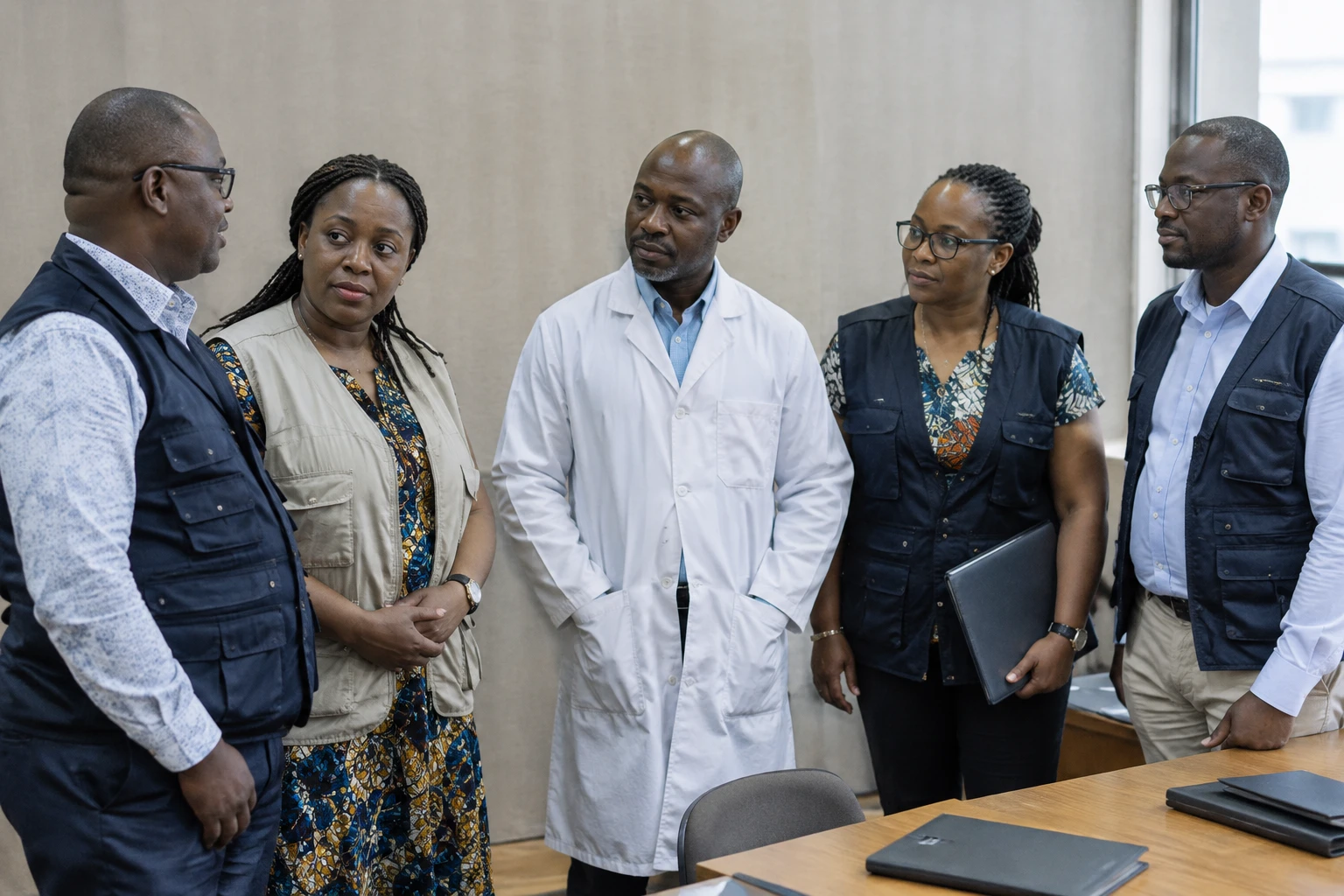
A virus can cross several borders before health systems have time to link the cases. The Bundibugyo outbreak is now testing health surveillance between Central, East and West Africa.
Travel routes complicate contact tracing
Declared on 15 May 2026 in the Democratic Republic of the Congo (DRC), the outbreak now affects several countries. Nigeria confirmed an imported case on 20 October. Kenya reported nine cases, according to information published on 22 October. France has also treated an imported case. Uganda, where 20 cases had been recorded before the outbreak was declared over in August, remains linked to cross-border transmission investigations.
The spread involves several regional blocs. The DRC belongs to the Southern African Development Community (SADC) and the East African Community (EAC), two regional organisations. Kenya and Uganda are EAC members, while Nigeria is part of the Economic Community of West African States (ECOWAS). The response therefore requires exchanges between health networks that do not fall under a single organisation.
The World Health Organization (WHO) has classified the outbreak as a public health emergency of international concern. This designation calls for coordination between countries, but does not mean that all face the same level of risk. WHO distinguishes between a very high risk in the DRC, a high risk for its land neighbours and a low risk for the rest of the African region, according to its assessment published in October.
Investigations into transmission chains continue
In Nigeria, the confirmed case concerns a woman who had travelled to Uganda. Nigerian authorities said her symptoms began on 7 October and that her diagnosis was confirmed in a laboratory on 20 October. She was in isolation and receiving care, according to WHO. Investigators are searching for people she had been in contact with.
The virus’s exact route is still being investigated. African health officials are examining the possibility that the first cases detected in Kenya and Nigeria passed through Entebbe airport in Uganda on 3 October. This hypothesis does not prove that they met or that transmission took place at the airport. Ugandan authorities also dispute some details of the Nigerian patient’s travel account.
In Kenya, the reported cases have been linked to the first confirmed patient, a man who arrived from the DRC via Uganda and died on 5 October. Members of his family and healthcare workers are among those infected. The total of nine cases reported on 22 October is more recent than the European tally, which recorded eight as of 20 October. The figures reflect different update dates and may change as analyses are completed.
The DRC remains by far the main outbreak hotspot. As of 19 October, Congolese authorities had reported 9,552 confirmed cases and 4,602 deaths, according to the European Centre for Disease Prevention and Control, which says its data run to 18 October. The virus had been detected in 66 health zones across eight provinces. The figures remain subject to revision as data are verified and harmonised.
The response depends on the field as much as on laboratories
Distances between outbreak hotspots, travel for trade or work, and border crossings make contact tracing more demanding. In the DRC, the outbreak is unfolding in a context where insecurity and population movements complicate health teams’ access to some areas. In Kinshasa, the authorities must coordinate the national response; in affected provinces, immediate needs include testing, isolation and care.
The consequences are not the same for everyone. People living near outbreak hotspots and healthcare workers are more exposed to contact with cases. Travellers and border communities need accurate information, as well as accessible services. For healthcare workers, workplace protection and the ability to identify symptoms quickly are essential. For families, rapidly identifying contacts can prevent transmission chains from going undetected.
Contact tracing remains a weak point. Africa CDC data reported on 22 October indicate that about 20% of confirmed cases were then identified as known contacts. This suggests that several transmissions have not yet been linked to a monitored chain. It underlines the importance of community surveillance and clear communication, particularly to encourage early symptom reporting and prompt medical care.
The Bundibugyo variant also complicates medical prevention. No vaccine or specific treatment is currently licensed against this strain. Vaccines developed against the Zaire strain are not considered established protection against Bundibugyo. The response therefore relies mainly on early detection, supportive care, infection prevention, contact tracing and safe burials, carried out with community involvement.
Continental coordination put to the test
The presence of cases in countries far from the Congolese outbreak hotspot does not mean that the outbreak is spreading across the continent. It does, however, show how regional travel can link distinct health situations. The DRC, Uganda, Kenya and Nigeria must rapidly share alerts, laboratory information and data useful for contact tracing, while adapting their measures to their own circumstances.
What happens next will depend on the ability to trace contacts of recent cases and interrupt transmission without unnecessarily disrupting travel or stigmatising travellers. The next decisive indicator will be the proportion of new cases linked to chains that are already known. As long as that share remains low, authorities will need to maintain heightened vigilance, particularly at borders and in areas where access to healthcare remains difficult.