Algeria
 Egypt
 Libya
 Morocco
 Sudan
 Tunisia
 Benin
 Burkina Faso
 Cabo Verde
 Côte d'Ivoire
 Ghana
 Guinea
 Guinea-Bissau
 Liberia
 Mali
 Mauritania
 Niger
 Nigeria
 Senegal
 Sierra Leone
 The Gambia
 Togo
 Central African Republic
 Chad
 DR Congo
 Equatorial Guinea
 Gabon
 Republic of the Congo
 São Tomé and Príncipe
 Burundi
 Comoros
 Djibouti
 Eritrea
 Ethiopia
 Kenya
 Madagascar
 Malawi
 Mauritius
 Mozambique
 Rwanda
 Seychelles
 Somalia
 South Sudan
 Tanzania
 Uganda
 Angola
 Botswana
 Eswatini
 Lesotho
 Namibia
 South Africa
 Zambia
 Zimbabwe
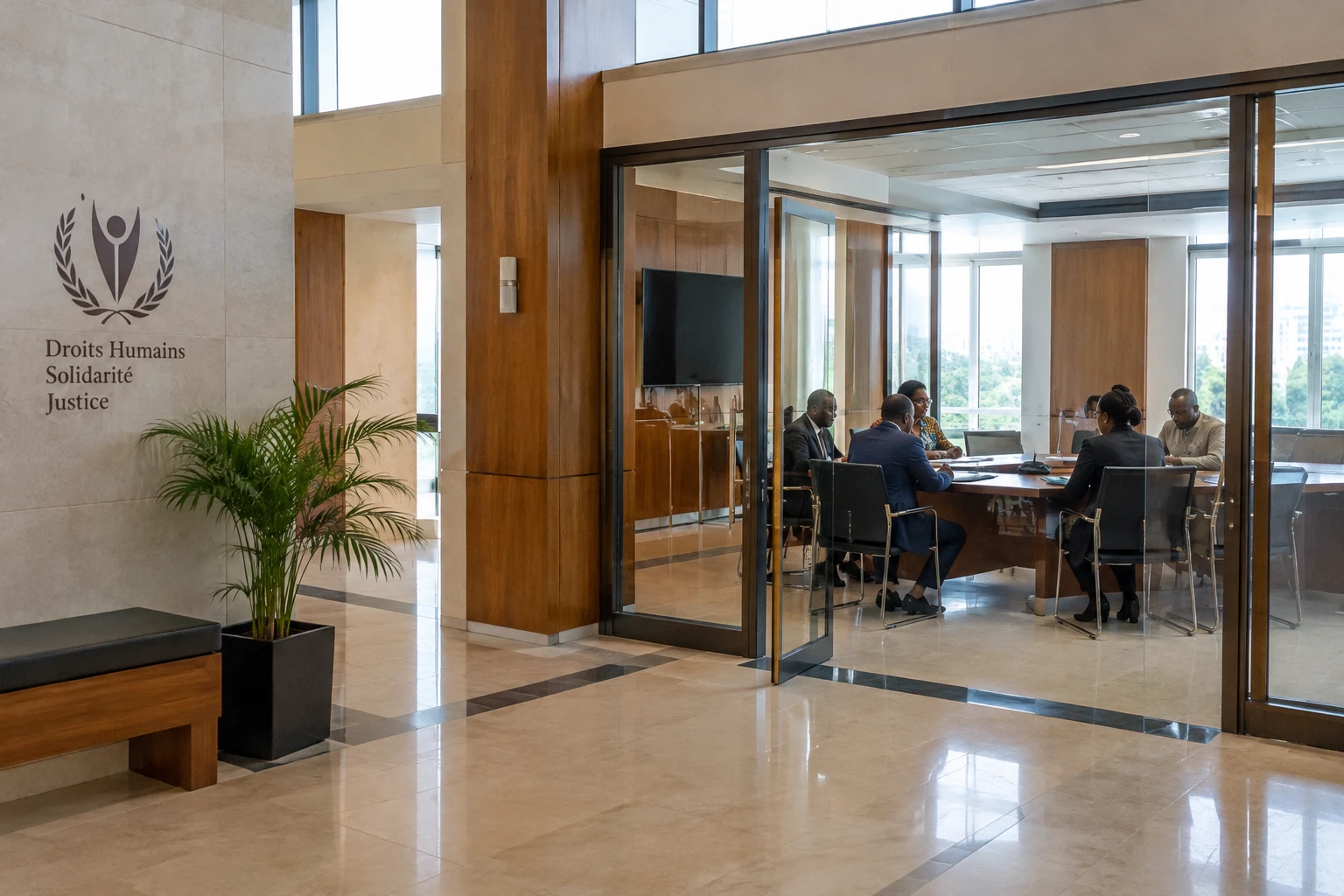
A law can promise rights. The decisive question is often whether it is enforced: are abuses investigated, are civilians tried by the competent courts, and are people exposed to discrimination protected? In Geneva, these gaps were at the heart of exchanges between Cameroon and the UN Human Rights Committee.
International scrutiny after several years without a review
The Committee monitors implementation of the International Covenant on Civil and Political Rights. The treaty commits states that have ratified it to guaranteeing, among other things, the right to life, liberty, equality before the law and freedom of expression. Cameroon ratified it in 1984. This periodic review is not a trial: experts assess the measures taken by the state and make recommendations.
The Committee’s previous review of Cameroon took place on 24 and 25 October 2017. The new dialogue, listed on the agenda for 22 and 23 October 2026, therefore comes after several years of monitoring and reporting. The dossier submitted by Yaoundé covers the period from November 2016 to September 2025. Civil society has also submitted contributions to the Committee, including through Cameroonian human rights organisations.
These exchanges are part of a broader framework. Cameroon is a member of the Economic and Monetary Community of Central Africa (CEMAC), but the review concerns its national obligations under a United Nations treaty. It complements African mechanisms, including the African Commission on Human and Peoples’ Rights. It does not replace them.
Yaoundé’s responses to experts’ questions
The Cameroonian delegation, led by the country’s permanent representative to the UN, highlighted the existence of a legal framework for protecting rights. It nevertheless acknowledged a possible gap between the law and its implementation. It is precisely this transition from written law to the practices of public authorities, security forces and courts that is drawing the Committee’s attention.
Questions focused in particular on the fight against corruption, arbitrary detention and the prosecution of civilians in military courts. Experts also addressed violence in the North-West and South-West regions, affected by the armed conflict linked to the Anglophone crisis, as well as in the Far North, where armed groups, including Boko Haram, have carried out attacks.
On military courts, the delegation defended their legality. It explained that civilians may be tried there when, according to the authorities, the facts involve members of the defence and security forces or the use of firearms. It cited the Martinez Zogo case. The Cameroonian journalist was killed in January 2023, and the case is under investigation by the Yaoundé military court. The proceedings raise a sensitive institutional question: how can independence and impartiality be guaranteed when a case concerns state agents?
Discussions also covered gay people and discrimination based on sexual orientation or gender identity. The delegation invoked social rejection of these practices and said that those concerned were not being hunted down. It argued that the law applies in cases of flagrante delicto or indecent exposure. These remarks lay bare the disagreement between the justification put forward by the authorities and the questions raised about guarantees of equality and protection from discrimination.
The session was due to continue on Friday 23 October. The delegation’s remaining responses and the Committee’s concluding observations are the next steps on the schedule. At the time of writing, it is therefore important to distinguish the questions already raised from the conclusions the experts may publish later.
Different concerns across regions and communities
The concerns raised in Geneva are not experienced in the same way everywhere. In the Anglophone regions, civilians are caught up in a conflict between government forces and armed separatist groups. In the Far North, security operations and attacks by armed groups weigh on daily life. UN and partner protection analyses report risks of arbitrary arrest, kidnapping and other rights violations in these areas. These findings do not automatically attribute every abuse to one side: responsibility must be established case by case.
Procedural issues also have tangible consequences. Detention without sufficient safeguards can deny a person prompt access to a lawyer or an effective remedy. The use of military courts to try civilians fuels debate about the right to a fair trial and the separation of military and ordinary justice. For families, journalists and human rights defenders, transparency in investigations matters as much as the existence of protective laws.
The Martinez Zogo case gives this debate particular significance. It concerns the safety of journalists, the fight against impunity and trust in institutions. The fact that a trial is under way does not, in itself, establish the guilt of those charged. It does, however, make scrutiny of judicial safeguards and the establishment of responsibility legitimate.
The Committee cannot overturn a Cameroonian court ruling or directly impose reform. Its observations can nevertheless clarify the country’s obligations and serve as a reference for national institutions, civil society organisations and regional partners. Cameroon is part of a region where judicial cooperation and African human rights mechanisms also play a role in monitoring public commitments.
What the review will assess
The central issue will be less a catalogue of laws than verifiable answers: what safeguards govern arrests and detentions? How are allegations of abuse investigated? Which courts have jurisdiction when civilians are prosecuted? And what measures protect people facing discrimination? The answers may shed light on the gap between Cameroon’s international commitments and their implementation.
The expected conclusions will also be followed beyond Yaoundé. They will be of interest to Cameroonian institutions, human rights defenders and African bodies responsible for safeguarding fundamental freedoms. The impact of this review will depend above all on what happens to the recommendations: whether they are translated into practice, and whether their effects can then be measured at the next review.
Documents: Human Rights Committee programme for Cameroon ; Cameroon’s sixth periodic report ; contribution on Cameroonian civil society participation.