Algeria
 Egypt
 Libya
 Morocco
 Sudan
 Tunisia
 Benin
 Burkina Faso
 Cabo Verde
 Ghana
 Guinea
 Guinea-Bissau
 Liberia
 Mali
 Mauritania
 Niger
 Nigeria
 Senegal
 Sierra Leone
 The Gambia
 Togo
 Cameroon
 Central African Republic
 Chad
 DR Congo
 Equatorial Guinea
 Gabon
 Republic of the Congo
 São Tomé and Príncipe
 Burundi
 Comoros
 Djibouti
 Eritrea
 Ethiopia
 Kenya
 Madagascar
 Malawi
 Mauritius
 Mozambique
 Rwanda
 Seychelles
 Somalia
 South Sudan
 Tanzania
 Uganda
 Angola
 Botswana
 Eswatini
 Lesotho
 Namibia
 South Africa
 Zambia
 Zimbabwe
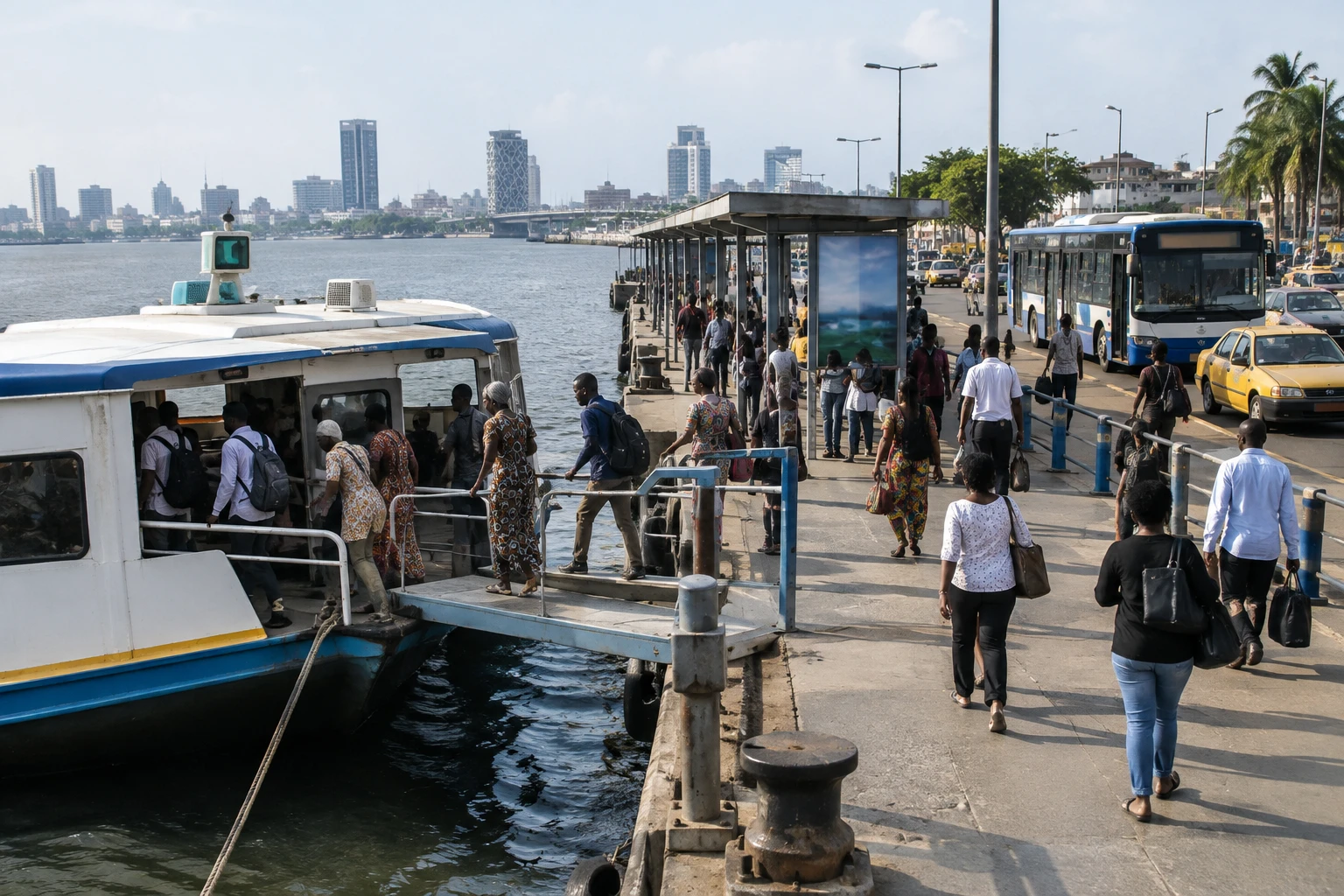
In Abidjan, the lagoon is already part of the daily journeys of many residents. Yet its potential is still constrained by incomplete infrastructure and operational difficulties. New European funding aims to help expand the service as Côte d’Ivoire seeks to better connect the different modes of transport across Greater Abidjan.
Mobility to be planned across Greater Abidjan
Yamoussoukro is the political capital of Côte d’Ivoire, but Abidjan accounts for a major share of economic activity and urban travel. In a sprawling metropolitan area, road congestion weighs on journeys between municipalities, workplaces and services. The proposed solutions bring together several networks: buses, a metro, bus rapid transit (BRT) and water buses.
BRT, or “bus rapid transit”, refers to a bus service operating mainly on dedicated lanes. The authorities’ stated aim is to make these modes work as a connected system rather than as separate solutions. For passengers, this integration will also depend on connections, fares, timetables and access to stations.
The International Conference on Sustainable Mobility and Climate, held in Abidjan on 20 and 21 October 2026, put these issues at the centre of discussions. Its second edition forms part of a broader debate: how to develop public transport while limiting emissions and keeping travel affordable for households.
Grant announced for water buses
At the opening of the conference on 21 October, the European Union announced a grant of €3 million, presented as support for the revival of lagoon transport. The project provides for the construction of 13 stations and the purchase of 25 water buses. The amount and these components were reported in the initial funding announcement; the public information consulted does not yet specify a detailed timetable for the works or operating arrangements.
Ivorian authorities present the project as one element of their multimodal ambitions. It complements investments under way or in preparation in the metro and BRT lines. The government’s official portal also confirmed the announcement of the 13 stations and 25 water buses at the conference, without publicly detailing the implementation timetable at this stage.
Transport on Ébrié Lagoon is not new. The state opened the sector to new operators from 2015, and the activities of SOTRA, STL and CITRANS gathered pace in 2017. According to data from the Ivorian economic portal, their combined passenger traffic rose from 8.4 million in 2017 to 17.7 million in 2023. It then fell in 2024, notably after CITRANS ceased operations at the end of 2023.
Infrastructure alone is not enough
These figures shed light on what is at stake in the funding. New vessels and additional stations can strengthen the service, but they cannot, on their own, guarantee regular operations. Boat maintenance, safety, dredging and navigational markers, as well as land access to jetties, also matter. The Ivorian economic portal notes these constraints and highlights the significant role played by pinasses.
In 2024, pinasses carried more than 50 million passengers, according to data published by the same portal, which cites the Ministry of Transport and the Directorate-General for Maritime Affairs. They serve several municipalities and meet demand that licensed operators do not always cover. Their prominence is a reminder that network integration must take informal transport, its fares and routes into account, while also addressing safety and service quality.
The expected benefits will therefore not be the same for everyone. Residents of neighbourhoods near jetties could gain an alternative to road travel. Those living far from stations will need reliable and affordable connections. Workers in informal transport, meanwhile, will be affected by changes to routes and operating rules. Ultimately, results will depend on the ability of the authorities and operators to coordinate timetables and maintain infrastructure over the long term.
An urban and regional issue
For Côte d’Ivoire, improving mobility in Abidjan affects both daily life and the efficiency of the country’s main economic hub. The project also comes amid major investment, coordination of which will require cooperation between the state, the Greater Abidjan Urban Mobility Authority (AMUGA), local authorities and operators. The announced funding is a targeted contribution; on its own, it is not enough to conclude that the entire network will be integrated or financially sustainable.
Across West Africa, Abidjan’s experience is of interest to cities facing rapid urban growth and mounting pressure on transport. It could inform exchanges within ECOWAS, the regional economic community of West Africa, though the realities of each city are different. Climate concerns add to the importance of the issue: shifting some journeys to public transport can reduce reliance on private vehicles, provided the service is accessible and frequent enough.
The next step will be to track the completion of the 13 stations and the arrival of the 25 water buses: the timetable, detailed funding, selected operators and connections with land-based networks. Monitoring passenger numbers and safety data will also help assess whether the investment meets residents’ needs, including those who currently use pinasses. It is these results, rather than announcements, that will determine the lagoon’s real place in Abidjan’s transport system.