Algeria
 Egypt
 Libya
 Morocco
 Sudan
 Tunisia
 Benin
 Burkina Faso
 Cabo Verde
 Côte d'Ivoire
 Ghana
 Guinea
 Guinea-Bissau
 Liberia
 Mali
 Mauritania
 Niger
 Nigeria
 Senegal
 Sierra Leone
 The Gambia
 Togo
 Cameroon
 Central African Republic
 Chad
 DR Congo
 Equatorial Guinea
 Gabon
 Republic of the Congo
 São Tomé and Príncipe
 Burundi
 Comoros
 Djibouti
 Eritrea
 Ethiopia
 Kenya
 Madagascar
 Malawi
 Mauritius
 Mozambique
 Rwanda
 Seychelles
 Somalia
 South Sudan
 Tanzania
 Uganda
 Angola
 Botswana
 Eswatini
 Lesotho
 Namibia
 South Africa
 Zimbabwe
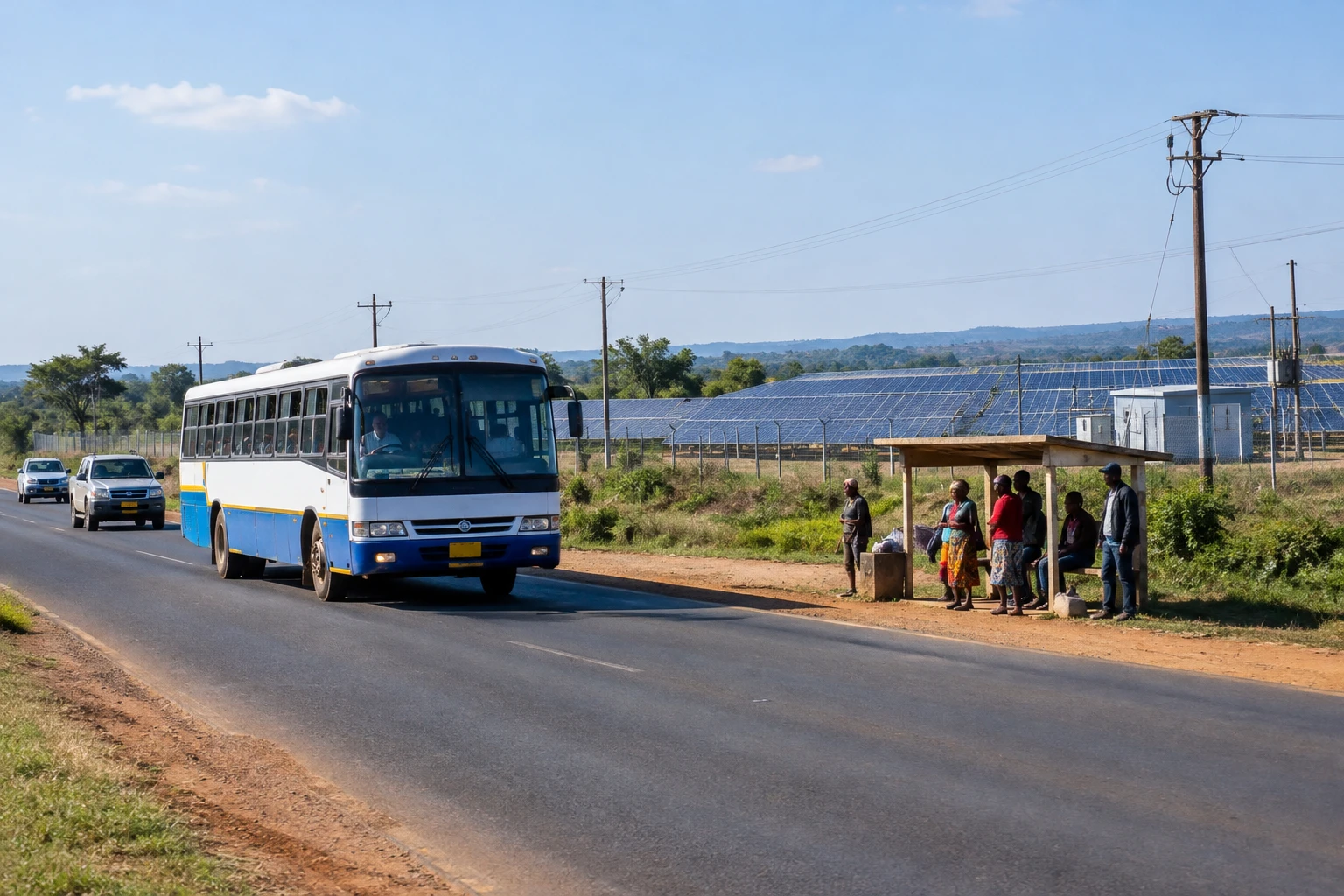
In Chitambo, Zambia, solar power is no longer used solely to supply the national grid. The Mailo plant also sells its output on the regional market, a model that opens up new opportunities for private producers but does not in itself guarantee a stable supply for every household.
A project aligned with Zambia’s energy shift
Zambia, whose capital is Lusaka, has long relied heavily on hydropower. The 2023–2024 drought, however, reduced dam output and led to load-shedding. Zambia’s Ministry of Energy says the nationwide power cuts lasted from March 2024 to November 2025. The crisis has increased interest in solar and other sources that can diversify supply.
This shift is also part of a regional trend. Zambia is a member of the Southern African Development Community (SADC), whose electricity utilities coordinate their exchanges through the Southern African Power Pool (SAPP). This regional market enables short-term transactions between countries, alongside bilateral contracts.
The SAPP operates a day-ahead market, where participants can buy or sell electricity for the following day. The platform does not replace national grids: it organises exchanges between interconnected systems, subject to transmission capacity and available supply.
Mailo adds a new tranche of generation
The second phase of the Mailo solar plant, in Chitambo District, entered commercial operation in October 2026. It adds 34.5 megawatt-peak (MWp) to the site, bringing its total operational capacity to 59.5 MWp. A megawatt-peak measures the maximum theoretical output of panels under standard conditions.
The first phase, with a capacity of 25 MWp, has been operating since July 2025. The company says construction of the second tranche took less than 12 months. Namibian company Alensy Energy Solutions carried out the construction. BB Energy, the parent company of Solarcentury Africa, invested equity, while Standard Bank South Africa provided debt financing.
The project uses a so-called “merchant” model: instead of relying solely on a long-term power purchase agreement with ZESCO, Zambia’s state-owned utility, the plant markets its electricity to industrial buyers and on the SAPP. Solarcentury Africa says the first phase is already selling its output under this model. Full details of the second phase’s commercial arrangements have not been made public.
Mailo is ultimately expected to reach 118 MWp, according to the developer. This announced final capacity is not the plant’s current operating output: only the first two phases, totalling 59.5 MWp, are operational so far.
Two ways to finance and sell electricity
The contrast with Kafue shows that private investment in Zambia is taking several routes. Solarcentury Africa and Alensy have also been selected to build the Kafue solar project, developed by Globeleq. The 56 MWp plant is expected to sell its output to ZESCO under a 25-year power purchase agreement. According to information published by Globeleq, it is due to begin operations in the third quarter of 2027.
The Kafue model gives the public buyer contractual visibility over supply. Mailo, by contrast, is banking on merchant sales, including regional ones. This approach can diversify sales outlets and reduce dependence on a single buyer. In return, the producer’s revenue may be more exposed to prices and market-access conditions. This is a difference in mechanism, not a guarantee that either model will always deliver cheaper electricity.
For ZESCO and the authorities, the challenge is to bring new capacity into a system that must both meet domestic demand and accommodate regional exchanges. For industrial users, access to a more diverse supply can help ensure business continuity. For households, the impact will depend in part on the grid’s ability to deliver electricity and on the rules governing sales: a plant being operational does not automatically mean fewer power cuts or lower bills.
The grid and market rules remain decisive
Solar output varies with sunlight. It can complement hydropower, but cannot by itself provide constant generation at all hours. Storage, grid management and regional interconnections are therefore just as important as the panels. SAPP exchanges can help balance supply between countries, but depend on available capacity and members’ simultaneous needs.
The commissioning of Mailo 2 thus marks a milestone for private financing and regional electricity trading in southern Africa. On its own, however, it does not show what share of the energy will be consumed in Zambia rather than exported, or what effect it will have on tariffs. These figures will be important in assessing the model’s impact beyond installed capacity.
What happens next will depend on progress towards Mailo’s announced 118 MWp, the development of Kafue and the integration of these projects into the grid. For Zambia and its SADC neighbours, the challenge is now to turn increased generation into a reliable, accessible supply that is better balanced between different users.