Algeria
 Egypt
 Libya
 Morocco
 Sudan
 Tunisia
 Benin
 Burkina Faso
 Cabo Verde
 Côte d'Ivoire
 Ghana
 Guinea
 Guinea-Bissau
 Liberia
 Mali
 Mauritania
 Niger
 Nigeria
 Senegal
 Sierra Leone
 The Gambia
 Togo
 Cameroon
 Central African Republic
 Chad
 DR Congo
 Equatorial Guinea
 Gabon
 São Tomé and Príncipe
 Burundi
 Comoros
 Djibouti
 Eritrea
 Ethiopia
 Kenya
 Madagascar
 Malawi
 Mauritius
 Mozambique
 Rwanda
 Seychelles
 Somalia
 South Sudan
 Tanzania
 Uganda
 Angola
 Botswana
 Eswatini
 Lesotho
 Namibia
 South Africa
 Zambia
 Zimbabwe
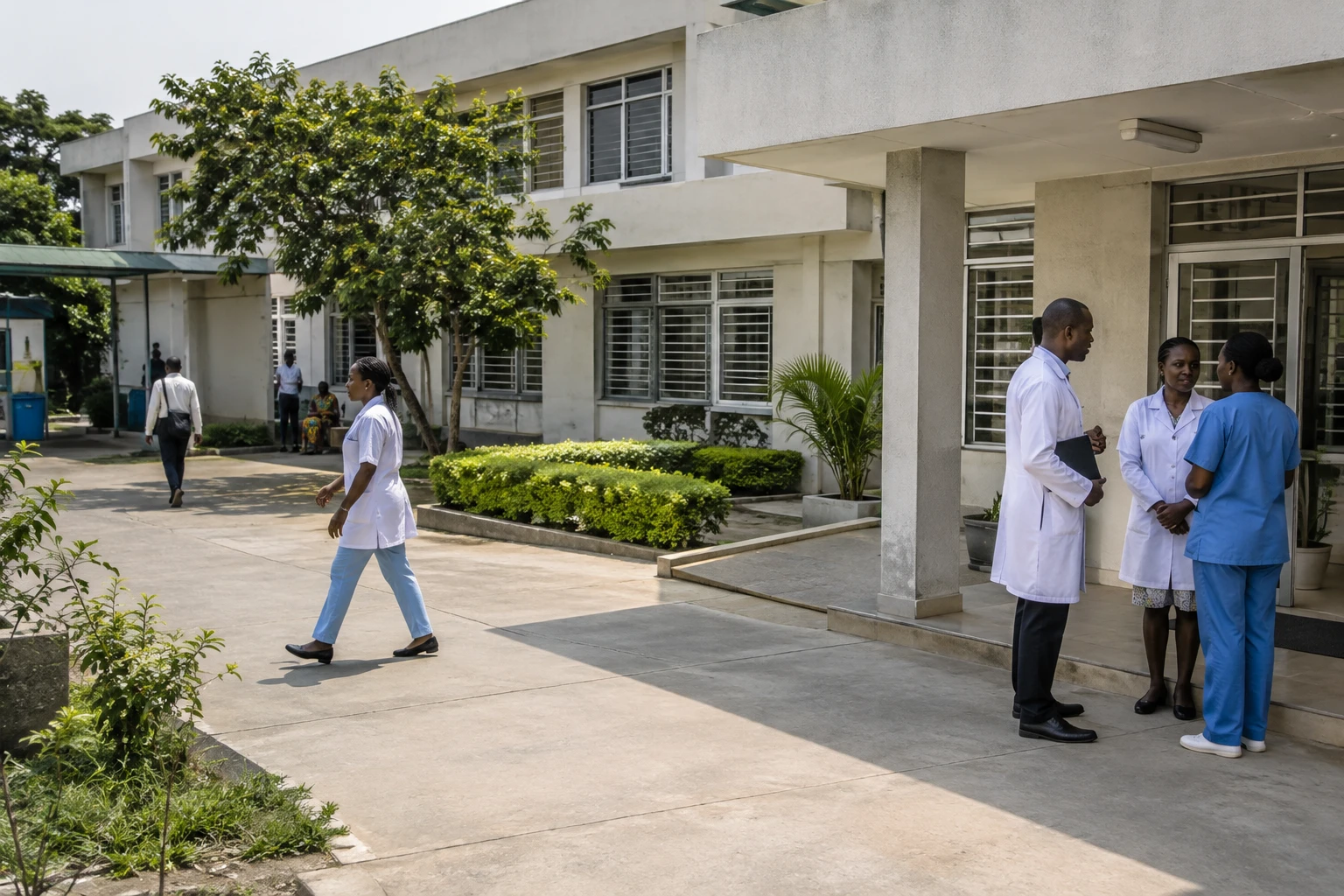
Can a case detected in Abuja be contained before it becomes a chain of transmission? The answer now depends on how quickly testing and contact tracing can be carried out, as the Bundibugyo outbreak spreads to several African regions.
An outbreak born in eastern DRC
A geographical clarification is needed: the outbreak described here is taking place in the Democratic Republic of the Congo (DRC), whose capital is Kinshasa. It is not occurring in the Republic of the Congo, the neighbouring country whose capital is Brazzaville. The two states are distinct.
The outbreak was declared in May 2026 in eastern DRC. It is caused by the Bundibugyo virus, a rare strain of Ebola. According to figures reported on 21 October, the DRC had more than 9,500 infections and at least 4,600 deaths. These totals, attributed to health authorities and carried by the Associated Press, illustrate the scale of the toll without summarising the very different situations from one province to another. The latest situation report on countries affected by Ebola.
The DRC has long experience of Ebola outbreaks. But experience is not enough when the virus circulates in areas marked by insecurity, population displacement and unequal access to care. In September, an independent scientific group convened by Africa CDC noted declines in some outbreak foci in Ituri, but also an increase in areas of North Kivu. It estimated that the data did not yet allow it to conclude that the outbreak had reached its peak. Africa CDC’s assessment of the outbreak’s evolution.
Cases in Nigeria and Kenya, with different trajectories
On 20 October, Nigerian authorities announced a first case in Abuja, the capital. The patient, a woman who had returned from a work trip to eastern DRC, developed symptoms on 7 October and was admitted to a private facility on 11 October. The exact place of her exposure remained to be determined. Health services have begun tracing 44 people who had been in contact with her.
Kenya, where nine infections had been confirmed as of 20 October, is following a different chain of contamination. The first known patient had arrived in Nairobi after travelling from the DRC via Uganda. Several relatives and health workers were among the subsequent cases. Kenyan authorities said at the time that they had detected no transmission outside the identified contacts. This tally and the number of people being followed were reported by the Associated Press, based on information from the relevant ministries. The latest cases reported in Kenya.
The link with Uganda calls for caution. The country recorded cases earlier in the year, then announced the end of its outbreak. Ugandan authorities have disputed the idea that the Nigerian case was contracted on their territory. Transit alone does not establish where a person was infected. The epidemiological investigation must determine this.
Surveillance, the first line of defence against spread
The Ebola virus is transmitted mainly through direct contact with the bodily fluids of a sick or deceased person, as well as through contaminated objects. The immediate priority is therefore to identify cases quickly, isolate them, protect medical teams and trace exposed people. The 21-day follow-up period makes it possible to detect any onset of symptoms after a risky contact.
For residents, these measures must go hand in hand with clear and accessible information. People placed in quarantine should not be treated as patients. In Kenya, the ministry has urged communities to welcome contacts who have been followed up once their quarantine ends, provided they show no symptoms. Local trust matters: without it, some people may avoid health centres or fail to report their contacts.
The Bundibugyo strain has no vaccine or treatment specifically approved, according to information available as of 21 October. Work and evaluations on vaccines are nonetheless under way. Africa CDC recommends continuing to produce data on their efficacy and safety, while clearly explaining to populations the uncertainties that remain.
The response therefore cannot rely solely on border controls. Movement between Central, East and West Africa makes coordinated alert systems, laboratories capable of rapidly confirming cases and teams ready to intervene necessary. General travel restrictions do not replace these capacities and can hamper essential exchanges.
Continental coordination under pressure
This outbreak links areas of the Great Lakes region with Abuja, in the heart of Nigeria. It is testing cooperation between health ministries, Africa CDC, the African Union’s public health agency, and the World Health Organization. On 21 October, Africa CDC convened African health ministers to an extraordinary virtual meeting scheduled for 28 October to coordinate the response.
For the Republic of the Congo, neighbour of the DRC in Central Africa, the outbreak underlines the importance of preparedness and information-sharing, but it does not mean the country is affected. For the continent, the decisive question will be the ability to interrupt chains of transmission without stigmatising the sick, travellers or affected communities. The next tallies of contacts followed in Nigeria and Kenya, along with the evolution of outbreak foci in eastern DRC, will show whether the coordination now under way is producing results. The continental meeting announced by Africa CDC.