Algeria
 Egypt
 Libya
 Morocco
 Tunisia
 Benin
 Burkina Faso
 Cabo Verde
 Côte d'Ivoire
 Ghana
 Guinea
 Guinea-Bissau
 Liberia
 Mali
 Mauritania
 Niger
 Nigeria
 Senegal
 Sierra Leone
 The Gambia
 Togo
 Cameroon
 Central African Republic
 Chad
 DR Congo
 Equatorial Guinea
 Gabon
 Republic of the Congo
 São Tomé and Príncipe
 Burundi
 Comoros
 Djibouti
 Eritrea
 Ethiopia
 Kenya
 Madagascar
 Malawi
 Mauritius
 Mozambique
 Rwanda
 Seychelles
 Somalia
 South Sudan
 Tanzania
 Uganda
 Angola
 Botswana
 Eswatini
 Lesotho
 Namibia
 South Africa
 Zambia
 Zimbabwe
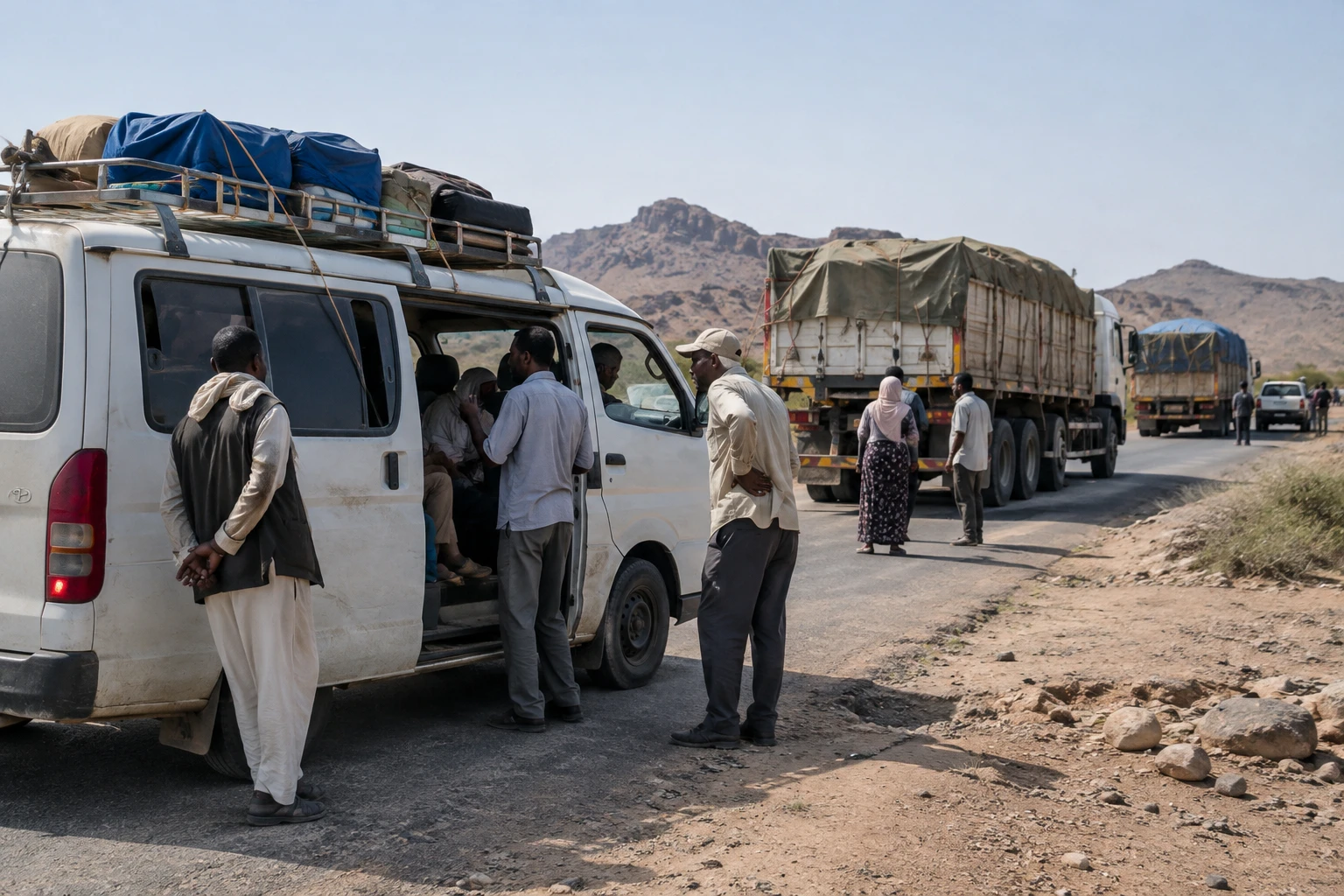
In the border desert between Sudan and Egypt, gold provides a livelihood for thousands of people and also finances opaque networks. A strike on a mining site, attributed by a Sudanese organisation to the Egyptian army, is now testing relations between Khartoum and Cairo. The circumstances and death toll remain disputed.
A border region at the heart of tensions
Jabal al-Uqaydat lies in a mountainous region where borders, mining activities and trade routes intersect. The area is close to the Halayeb Triangle, a territory claimed by both Sudan and Egypt. The two countries maintain close political ties, but this proximity does not erase their territorial disputes or border security concerns.
Since the start of the war between the Sudanese army and the Rapid Support Forces (RSF) in April 2023, revenues from gold have become increasingly important. The metal fuels both formal and informal trade, while smuggling networks evade state controls. A report by the United Nations Panel of Experts on Sudan estimated that a significant share of the gold extracted in the country was sold outside declared channels. Analyses by the Sudan Transparency and Policy Tracker also describe the role of these flows in financing the war economy.
For artisanal miners, mining provides a source of income in a country where the conflict has upended economic activity. But working at remote sites, often without protection or prompt access to medical care, exposes those present to security operations and violence. Egyptian authorities have recently carried out operations against illegal mining and smuggling near the border.
Conflicting death tolls, investigation announced
The strike was reported on Saturday 10 October 2026 at a gold-mining site in Jabal al-Uqaydat. The Sudanese legal collective Emergency Lawyers reported 72 deaths and accused Egypt of carrying out the attack. This attribution has not been independently established. The Egyptian government has not publicly claimed responsibility for the strike.
The Sudan Doctors Network reported a different initial toll: at least 13 dead and 28 injured. The medical network said the number of casualties could change, particularly because of the severity of some injuries and the distance from health facilities. A survivor interviewed by the Associated Press said he had seen an aircraft strike the area, but could not identify its origin. These accounts confirm that an attack was reported, but are not enough to determine who carried it out or the final death toll.
On Monday 12 October, the Transitional Sovereignty Council announced the creation of an inquiry commission bringing together prosecutors, judges and security force representatives. The body is to establish the circumstances of the incident and submit its findings. The Council also said that Sudanese and Egyptian authorities were in contact. Egyptian Foreign Minister Badr Abdelatty referred to respect for the sovereignty and territorial security of both countries during a discussion with his Sudanese counterpart.
A previous strike had already been reported at the same site in June. Miners interviewed at the time by the independent Egyptian outlet Mada Masr described air operations in the area. Egyptian authorities, for their part, announced an operation against illegal gold mining within their borders. These details provide context, but do not establish that the same forces carried out both incidents.
The human cost of a hard-to-control border
The gap between the reported death tolls makes the investigation particularly important. It will need to establish the number of casualties, the exact location of the site and the nature of the means used. The border question is also central: in this disputed area, the authorities of the two countries may describe the applicable jurisdiction differently. Without verifiable evidence, the accusation against Egypt must remain attributed to Emergency Lawyers.
The immediate consequences are borne first by miners and their families, who may lose an income, a loved one or access to their workplace. Small traders and transporters also depend on these activities. By contrast, the networks that control the purchase and transport of gold may continue to profit from trade that is difficult to monitor. Insecurity thus risks displacing workers without dismantling the networks that organise extraction and resale.
For Sudanese leaders, the incident raises a question of sovereignty at a time when the state is already at war with the RSF. For Cairo, the fight against smuggling and irregular crossings is a matter of national security. The investigation will therefore need to distinguish documented facts from the security arguments put forward by the states. Bilateral cooperation could shed light on the incident, but its credibility will depend on the publication of precise and accessible evidence.
A regional issue and a test for African mediation
Sudan is a member of the Intergovernmental Authority on Development (IGAD), a regional East African organisation involved in diplomatic efforts around the conflict. After a period of strained relations with the bloc, the country resumed full participation in February 2026, according to the organisation. IGAD and the African Union uphold the sovereignty and territorial integrity of member states, principles directly at stake in any allegation of a cross-border strike.
The case could complicate relations between two countries that must manage an extensive border, informal trade and a war whose effects extend beyond Sudanese territory. It also serves as a reminder that mineral resources are not merely a matter of revenue: when their trade escapes oversight mechanisms, they can support armed actors and increase risks for workers.
What happens next will depend on three concrete factors: the findings of the Sudanese commission, changes to the medical death toll and Egypt’s official response. Until this information is established, the 72 deaths cited by Emergency Lawyers and the attribution of the strike must be presented as unconfirmed claims. The transparency of the investigation will matter both for the protection of civilians and for trust between Khartoum and Cairo.