Algeria
 Egypt
 Libya
 Morocco
 Sudan
 Tunisia
 Benin
 Burkina Faso
 Cabo Verde
 Côte d'Ivoire
 Ghana
 Guinea
 Guinea-Bissau
 Liberia
 Mali
 Mauritania
 Niger
 Senegal
 Sierra Leone
 The Gambia
 Togo
 Cameroon
 Central African Republic
 Chad
 DR Congo
 Equatorial Guinea
 Gabon
 Republic of the Congo
 São Tomé and Príncipe
 Burundi
 Comoros
 Djibouti
 Eritrea
 Ethiopia
 Kenya
 Madagascar
 Malawi
 Mauritius
 Mozambique
 Rwanda
 Seychelles
 Somalia
 South Sudan
 Tanzania
 Uganda
 Angola
 Botswana
 Eswatini
 Lesotho
 Namibia
 South Africa
 Zambia
 Zimbabwe
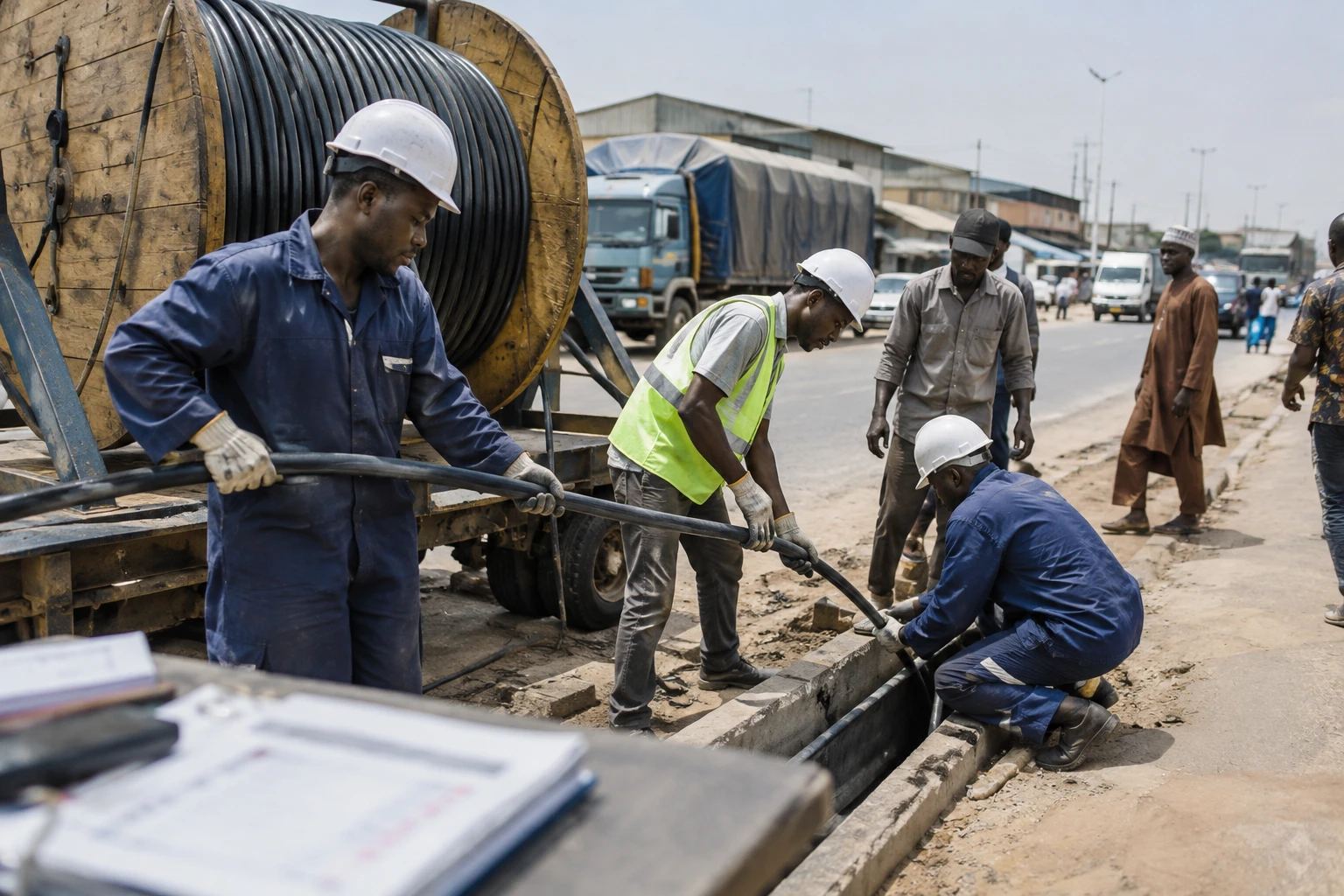
Fibre can bring a rural school, a health centre and a business closer to digital services. But connecting them across Nigeria requires more than a funding announcement: a network that is built, maintained and accessible to operators and users alike.
That is the challenge facing BRIDGE, a major federal programme to expand the country’s digital infrastructure. European support of €14 million, announced as funding to prepare for the rollout, would contribute to that ambition. However, it remains difficult to reconcile this specific amount with the European commitments made public so far.
A national network, with areas still underserved
The Nigerian government wants to expand the national fibre-optic network from about 35,000 to 125,000 kilometres. The programme aims to connect all 774 local government areas in the country. It is also intended to serve public institutions and areas where operators invest little because immediate returns are limited.
The World Bank approved $500 million for BRIDGE in October 2025. It estimates the project’s total cost at $1.6 billion, with $1.1 billion expected from the private sector. The fibre is intended to form a wholesale infrastructure that can be used by several internet service providers, rather than a network reserved for a single operator.
This approach matters in a federal country of more than 200 million people, where broadband access varies considerably between areas. The rollout covers all 36 states and the Federal Capital Territory, Abuja. Connecting urban hubs will not be enough: coverage in rural areas and less well-served communities will also determine the programme’s impact.
Support for preparation, not funding for 90,000 kilometres
The €14 million in European support mentioned in the announcement is for project preparation, not for building the entire network. It would fund technical studies, design and support for government bodies, among other things. These steps can help define routes, access rules and the monitoring of works.
However, this sum must be distinguished from European commitments already documented. In December 2025, the European Union announced a €45 million programme for Nigeria’s digital economy. A statement from the Federal Ministry of Communications says that €22 million of this amount is earmarked for BRIDGE.
The European Bank for Reconstruction and Development (EBRD), for its part, lists a sovereign loan of up to $100 million for the project. The African Development Bank announced a $200 million loan in April 2026, in addition to the World Bank’s $500 million and the EBRD’s $100 million. These are separate from a European grant for project preparation.
Publicly available information does not establish whether the €14 million announced in October 2026 is a new grant, a tranche of the €22 million already allocated to BRIDGE, or another form of support. The amount and how it relates to previous commitments therefore need clarification before it can be presented as confirmed additional funding.
How the network is shared will determine its impact on users
BRIDGE is designed as a public-private partnership. The Nigerian government plans to take a minority stake in a company responsible for the network, while private investors are expected to provide the remaining capital. A request for expressions of interest published by the ministry in April 2026 puts the estimated cost at $2 billion and says the public stake would be between 25% and 49%.
This model is intended to mobilise private capital while extending coverage beyond the most commercially attractive areas. It does not, by itself, guarantee affordable prices. The amount households pay will also depend on the terms of access to the network for providers, electricity and maintenance costs, and competition in the last mile — the link between the main network and a home or business.
A shared network can also provide alternative routes when cables are damaged. This would strengthen continuity of service for businesses, government bodies and digital platforms. But resilience will require prompt repairs, transparent rules and coordination between federal authorities, states and operators.
A West African reach to be built
BRIDGE is part of Nigeria’s digital transformation plans, which seek to expand online services and support its technology companies. The ministry describes the network as open infrastructure intended to connect local government areas, schools, health centres and economic activities.
The project also has a regional dimension. The African Development Bank says cross-border connections with Benin, Cameroon, Niger and Chad are planned. These links could strengthen data exchange and the flow of digital services. Their delivery will, however, depend on technical and regulatory coordination with each of the countries concerned.
For Nigerians, the test will therefore not simply be the number of kilometres laid. It will be whether communities are actually connected, and the quality and price of the service. For West Africa, the question is whether a national infrastructure can also link up with neighbouring networks. The next steps — finalising the financing, choosing investors and publishing rollout schedules — will show how far delivery matches ambition.