Algeria
 Egypt
 Libya
 Morocco
 Sudan
 Tunisia
 Benin
 Burkina Faso
 Cabo Verde
 Côte d'Ivoire
 Ghana
 Guinea
 Guinea-Bissau
 Liberia
 Mali
 Mauritania
 Niger
 Nigeria
 Senegal
 Sierra Leone
 The Gambia
 Togo
 Cameroon
 Central African Republic
 Chad
 DR Congo
 Equatorial Guinea
 Gabon
 Republic of the Congo
 São Tomé and Príncipe
 Burundi
 Comoros
 Djibouti
 Eritrea
 Kenya
 Madagascar
 Malawi
 Mauritius
 Mozambique
 Rwanda
 Seychelles
 Somalia
 South Sudan
 Tanzania
 Uganda
 Angola
 Botswana
 Eswatini
 Lesotho
 Namibia
 South Africa
 Zambia
 Zimbabwe
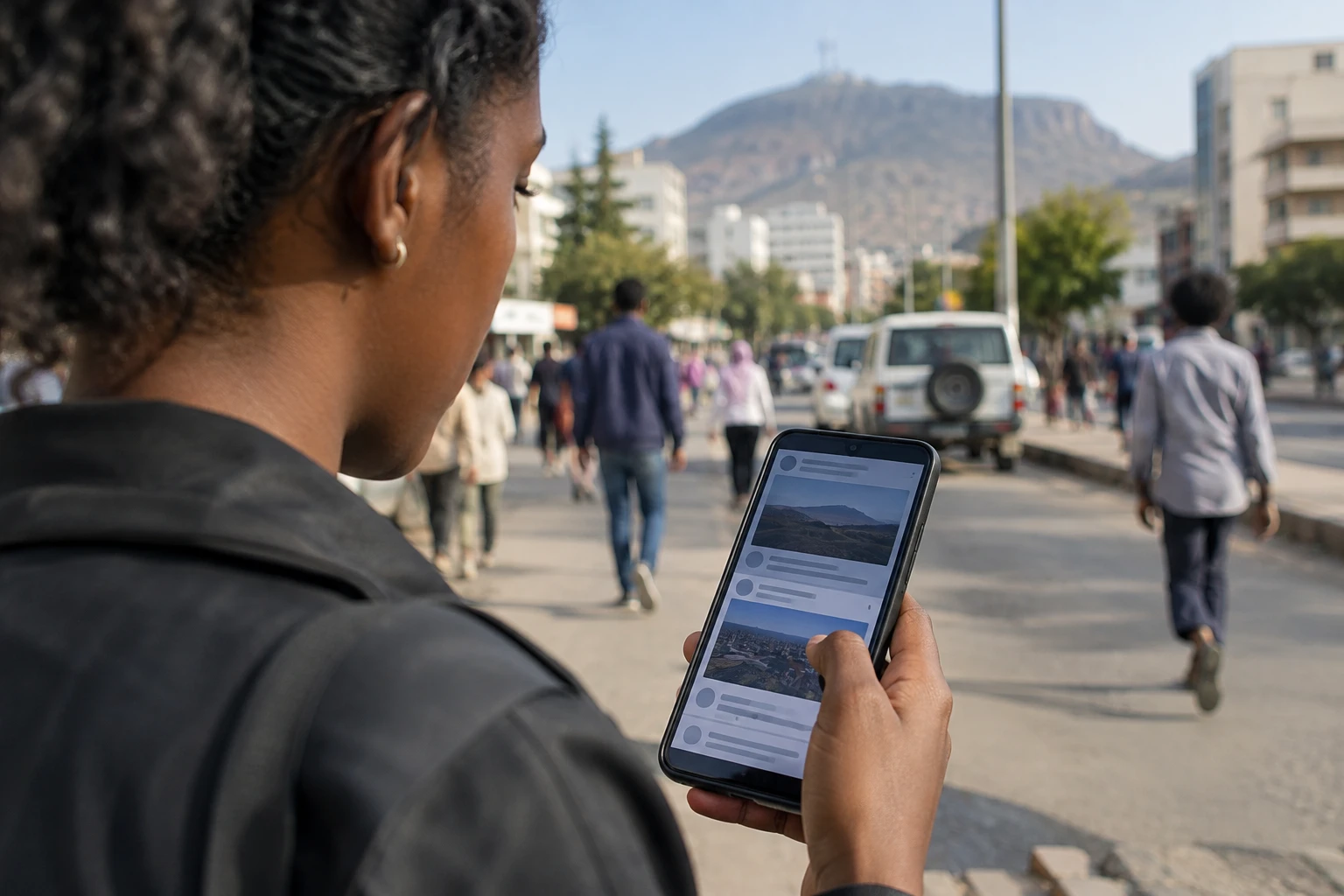
When communications are cut and journalists struggle to reach the area, a video posted on a phone can quickly become the only version of an event available to thousands of people. In Ethiopia, the resumption of clashes in Tigray is also testing residents’ ability to distinguish verified information from recycled images and propaganda messages.
A conflict that is difficult to document
Verification is particularly challenging in the north of the country. Fighting and communication restrictions limit access to witnesses and complicate the work of the media. During recent episodes in Tigray, internet and mobile network outages made it difficult to gather independent information on the ground.
The context is one of fragile peace. The Pretoria Agreement, signed in November 2022 by the federal government and the Tigray People’s Liberation Front (TPLF), ended two years of war. Since then, political disagreements and tensions over the agreement’s implementation have fuelled concern. New fighting has been reported in the region since 1 August 2026, but the accounts given by the parties must be examined separately and with caution.
The situation extends beyond Ethiopia’s borders. The Intergovernmental Authority on Development (IGAD), a regional organisation in the Horn of Africa, has called for de-escalation in northern Ethiopia. The African Union, headquartered in Addis Ababa, also has a stake in regional stability and the implementation of peace agreements.
Real images, but taken out of context
On TikTok, Telegram and Facebook, accounts associated with different sides are sharing videos presented as recent footage from the front. Some are old or were filmed elsewhere. Others have been cropped, given misleading captions or altered. A video’s appearance is therefore not enough to establish where and when it was filmed.
One example cited in the available material concerns a clip described as showing a roadblock. MultiFact Check says the images are old and do not confirm reports of roadblocks or transport blockades attributed to armed groups, including Fano, in the Amhara region. As this specific fact-check could not be cross-checked against a second accessible, independent publication, it should remain attributed to the organisation and not be presented as an independently confirmed finding.
Caution also applies to figures. The claim that “more than 800 problematic posts” identified since 1 August were subsequently removed is reported in the available material, without independent confirmation having been found. This is the tally announced by MultiFact Check, not a comprehensive account of disinformation in Ethiopia.
This distinction is essential. A misleading post does not, by itself, prove who created it or the author’s intent. And an authentic image can mislead if its date, location or context is wrong. During a conflict, repeating an unverified claim can help inflame tensions between communities and cloud understanding of events.
Training people to verify, without replacing journalism
Local initiatives are seeking to strengthen verification skills. The available material cites OMNI Ethiopia, an organisation that trains journalism students, among others, to examine content circulating on social media. Its project manager, Meti Melaku, says that posts far removed from the facts can cause confusion and that training should help young people identify reliable information. This quotation is reported in the material provided, but could not be found in an accessible independent source.
Such training can teach people to trace an image’s first appearance, compare versions, examine visible details and check location information. It cannot, however, replace access to the area or corroborated testimony. Digital verification can sometimes show that a video is old; it does not necessarily reveal what is happening today in an isolated locality.
The need to strengthen these capabilities is recognised in Ethiopia’s institutional debate. In May 2026, IGAD announced that it was preparing a national platform bringing together several stakeholders to combat hate speech and disinformation. Such an initiative also raises questions of trust: measures against misleading content must distinguish independent fact-checking from censorship and protect journalists’ work.
Real consequences for residents
For residents of Tigray and neighbouring regions, verified information is not an abstract issue. It can influence decisions about travel, contact with relatives or the assessment of an immediate risk. In areas where networks are unstable, rumours can spread faster than corrections.
The effects also vary across different audiences. Urban residents sometimes have greater access to networks and media, while rural populations rely on other channels and can be difficult to reach. Local journalists, meanwhile, work in an environment where access, security and political pressure can limit what they are able to confirm.
The Ethiopian diaspora also contributes to the circulation of content. It can help document events and share information, but distance and the speed of online platforms can sometimes make it harder to verify the location and date of an image. These difficulties do not make social networks useless: they make it essential to specify what is established, what is attributed and what remains unknown.
The next battle is over trust
The 2020-2022 war showed how competing narratives and lack of access can deepen mistrust. Renewed tensions do not mean that every post is part of a coordinated campaign. But they make verification work all the more important, particularly when images circulate without confirmed dates or locations.
For Ethiopia, the challenge is therefore twofold: to document the fighting without repeating the claims of belligerents as fact, and to maintain spaces where journalists can verify and publish. For IGAD and the African Union, regional de-escalation also depends on information that does not turn rumour into proof. As long as access to Tigray remains limited, readers must be able to clearly distinguish confirmed facts, attributed statements and questions that remain open.