Algeria
 Egypt
 Libya
 Morocco
 Sudan
 Tunisia
 Benin
 Burkina Faso
 Cabo Verde
 Côte d'Ivoire
 Ghana
 Guinea
 Guinea-Bissau
 Liberia
 Mali
 Mauritania
 Niger
 Nigeria
 Senegal
 Sierra Leone
 The Gambia
 Togo
 Central African Republic
 Chad
 DR Congo
 Equatorial Guinea
 Gabon
 Republic of the Congo
 São Tomé and Príncipe
 Burundi
 Comoros
 Djibouti
 Eritrea
 Ethiopia
 Kenya
 Madagascar
 Malawi
 Mauritius
 Mozambique
 Rwanda
 Seychelles
 Somalia
 South Sudan
 Tanzania
 Uganda
 Angola
 Botswana
 Eswatini
 Lesotho
 Namibia
 South Africa
 Zambia
 Zimbabwe
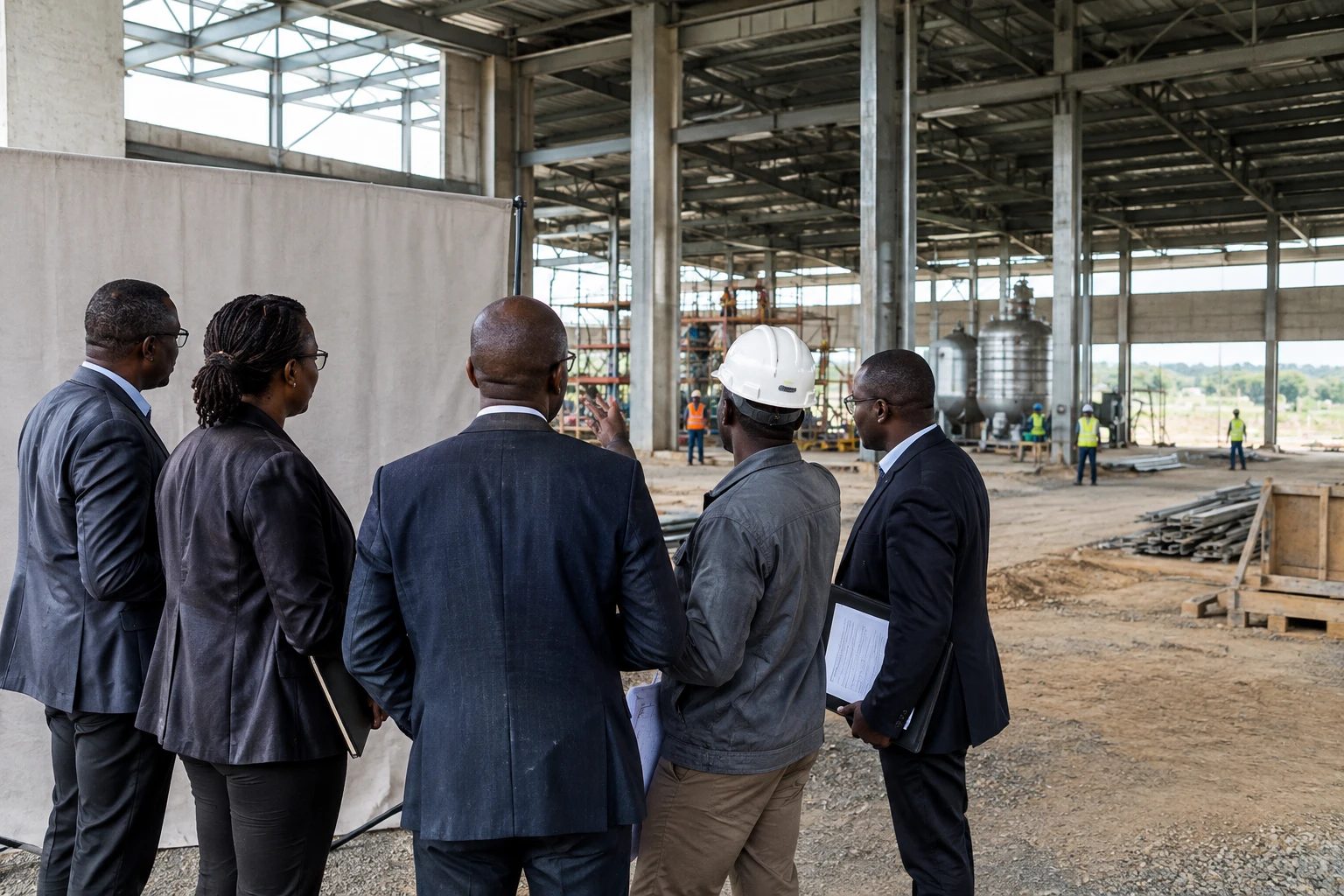
A medicines factory is measured by more than its walls. To supply treatments, it also needs customs-cleared equipment, water, electricity and quality controls. At Meyo, near Yaoundé, these material and administrative conditions will determine whether an ambitious industrial project can deliver on its health promises.
A project still reliant on equipment and utilities
On 13 October, Cameroon’s Prime Minister, Joseph Dion Nguté, visited the site, about a year after construction began, according to information provided during his visit. He criticised some government departments for failing to fulfil their role and said equipment was being held up in customs. “It is not normal for certain civil servants […] to take actions that slow down this project,” he said.
A large hall and another building are under construction at the site. The project’s promoter, Idriss Confiance, says it does not yet have water or electricity. He says he has been promised a connection within two months, after which he plans to install and test the equipment. He then refers to an assessment of the products by the World Health Organization before any production begins. This timetable is the promoter’s forecast, not a confirmed opening date.
The project is being developed by Yicheng Pharmaceutical Group. Its foundation stone was laid in Meyo on 3 October 2025. Cameroon’s Ministry of Mines, Industry and Technological Development gives a target capacity of 10 billion tablets a year, alongside several types of medicines and medical devices. This figure describes an announced goal; it does not represent production that has already taken place. The industrial targets announced by Cameroon’s Ministry of Industry.
Reducing an entrenched reliance
The stakes go beyond building a factory. Cameroon imports most of the medicines it consumes. In 2018, nearly 95% of medicines in circulation were manufactured abroad, according to a report by the French Treasury’s Directorate General. More recent figures reported by Investir au Cameroun put pharmaceutical product imports at CFA francs 170 billion in 2024, based on data attributed to the National Institute of Statistics. The years and scope differ, so these figures should not be conflated with the estimate of health coverage cited during the visit. Data on reliance on imported medicines.
Local production could reduce exposure to supply disruptions and limit some outflows of foreign currency. But stated capacity guarantees neither affordable medicines nor a supply suited to patients’ needs. It will be necessary to know which products are actually made, their prices, their availability in pharmacies and health facilities, and what share of production is intended for the Cameroonian market.
Quality is just as crucial. Equipment tests and product checks are not minor formalities: they determine patient safety and whether medicines can be distributed. The reference to future WHO involvement comes from the promoter. It does not, in itself, mean that the organisation has approved the site or certified production.
From industrial promise to access to healthcare
Health Minister Malachie Manaouda has argued for the value of local capacity in the face of epidemics and pandemics. He also cited the expected jobs and foreign currency savings. These benefits will nevertheless depend on the factory’s actual operation, the availability of raw materials, the skills of its workforce and distribution beyond Yaoundé.
The effects will not be the same for everyone. Health facilities and patients could benefit from more regular supplies if the products meet their needs and remain affordable. Pharmacists, wholesalers and local manufacturers, meanwhile, will have to contend with the arrival of a new player and with quality and competition rules. Finally, while water and electricity are unavailable at the site, the industrial timetable remains vulnerable to constraints that go beyond the construction work itself.
A hospital complex is also planned nearby in later phases of the project. This is a separate announced development, distinct from the factory under construction. Its delivery, financing and integration with existing services will be important in assessing the project as a whole: new infrastructure alone cannot replace healthcare needs in regions far from the capital.
A central African challenge
The project also targets the sub-region. Cameroon is a member of CEMAC, the Central African Economic and Monetary Community, which brings together six countries around a common market and currency. Cameroonian production could open up opportunities there, provided the medicines are approved, competitive and distributed in other member states. Pharmaceutical industrialisation therefore depends on more than a factory: it requires compatible rules and effective regional trade.
The United Nations Economic Commission for Africa has for several years highlighted the role of local production and continental coordination in reducing reliance on imports. The Meyo project reflects this ambition, but also its practical test: turning capacity announcements into medicines that are quality-controlled, available and affordable. In the short term, the clearest indicators will be the release of the equipment, connections to utilities, completion of the construction work and publication of a verifiable commissioning timetable. The regional stakes of pharmaceutical production in Central Africa.