Algeria
 Egypt
 Libya
 Morocco
 Sudan
 Tunisia
 Benin
 Burkina Faso
 Cabo Verde
 Côte d'Ivoire
 Ghana
 Guinea
 Guinea-Bissau
 Liberia
 Mali
 Mauritania
 Niger
 Nigeria
 Senegal
 Sierra Leone
 The Gambia
 Togo
 Cameroon
 Central African Republic
 Chad
 DR Congo
 Equatorial Guinea
 Gabon
 Republic of the Congo
 São Tomé and Príncipe
 Burundi
 Comoros
 Eritrea
 Ethiopia
 Kenya
 Madagascar
 Malawi
 Mauritius
 Mozambique
 Rwanda
 Seychelles
 Somalia
 South Sudan
 Tanzania
 Uganda
 Angola
 Botswana
 Eswatini
 Lesotho
 Namibia
 South Africa
 Zambia
 Zimbabwe
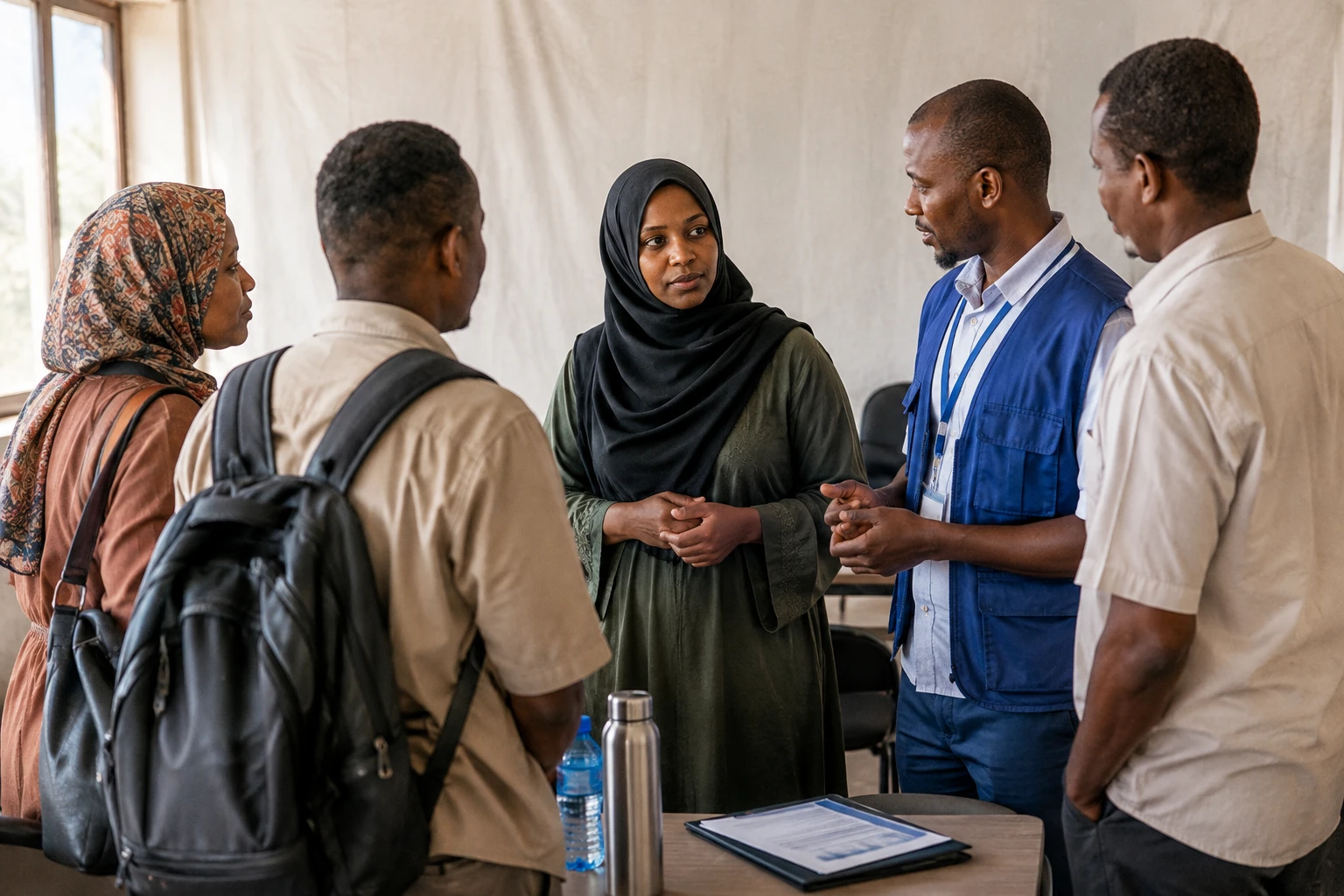
Migration routes in Djibouti do not run in just one direction. People arrive from Yemen to escape the fighting, while Ethiopian migrants cross the country hoping to reach that same Yemen and then the Gulf states. This simultaneous movement is testing reception and relief capacity, including in desert areas far from the capital.
A crossroads of movement in the Horn of Africa
Djibouti occupies a strategic position between Ethiopia, the Red Sea and the Gulf of Aden. The port of Obock and nearby coasts lie on the so-called Eastern Route, a corridor used by people leaving the Horn of Africa to reach Yemen and sometimes the Gulf states. The International Organization for Migration (IOM) describes this route as one of the busiest and most dangerous in the world.
This movement takes place in a regional space where journeys are closely linked. The Intergovernmental Authority on Development (IGAD), a cooperation organisation in the Horn of Africa, includes Djibouti, Ethiopia, Somalia and Yemen, among others. Conflicts, economic hardship and work opportunities across borders influence people’s journeys, although no two people’s trajectories are necessarily the same.
IOM data also show that these crossings do not always represent the same number of distinct people: one person may be counted during different movements. The figures should therefore be read as observed movements, not as a definitive count of unique new arrivals.
Thousands stranded far from help
Since 10 September 2026, more than 20,000 movements into Djibouti from Ethiopia have been observed, according to the IOM’s Displacement Tracking Matrix. The organisation also recorded 539 Ethiopian nationals returning to Djibouti from Yemen during this period. These figures point to a two-way flow: some continue towards the Arabian Peninsula, while others turn back.
Between 20 and 30 September, more than 3,000 stranded migrants were identified along the country’s routes. Many lacked water and food and showed signs of dehydration or exhaustion, according to information presented by the IOM at a United Nations press briefing. The organisation says it is providing emergency assistance — including water, food and medical care — and supporting voluntary returns requested by migrants.
Moving onto secondary tracks to avoid checks makes it harder to locate people and deliver aid. Distances, the isolation of some areas and a lack of resources make interventions more difficult. The danger does not end at a border crossing: the journey also exposes people to violence, exploitation and abandonment by smugglers.
The situation varies according to location and the actors involved. In Djibouti City, the authorities and humanitarian organisations coordinate some reception efforts. On desert routes, people in transit depend more heavily on access to water, transport and the chance of being found. Local communities may also be called upon when groups remain stranded near where they live.
War in Yemen drives arrivals in the opposite direction
At the same time, people are fleeing the conflict in Yemen and reaching Djibouti’s shores. The UN press briefing on 6 October reported that more than 3,700 refugees had arrived from Yemen over the previous three weeks. The IOM also said that fighting had displaced more than 184,000 people in Yemen since 1 August. These figures are attributed to the organisations that reported them; they may change as new observations are made.
Djibouti must therefore respond to different needs at the same time: protecting people arriving from Yemen, assisting those stranded on the Eastern Route and supporting those who choose to return. These statuses are not interchangeable. A refugee fleeing conflict and a migrant in transit may be subject to different procedures and protection needs, even if their routes intersect.
For the Djiboutian authorities, the challenge is also operational. Public services, humanitarian actors and available resources must be coordinated across a territory where movements are sometimes concentrated far from major urban centres. For migrants, uncertainty surrounds what comes next, access to medical care and the possibility of continuing their journey or returning safely.
A regional challenge beyond Djibouti
These movements are a reminder that national responses are not always enough on a route that crosses several countries and a maritime area. Cooperation between Djibouti, Ethiopia, Somalia and Yemen is crucial to sharing information, identifying people in danger and organising assistance that does not stop at the border. IGAD and UN agencies play a role in this regional coordination.
The next challenge will be to monitor both developments in the fighting in Yemen and assistance capacity along Djibouti’s routes. Crossing figures alone do not show how many people remain stranded for an extended period or which needs are still unmet. For Djibouti, a transit country and a place of refuge, the immediate difficulty is to protect people with different journeys without conflating their situations.
IOM data were reported at the UN press briefing on 6 October 2026. The information was also cross-checked against the Djiboutian News Agency and the African Press Agency.