Algeria
 Egypt
 Libya
 Morocco
 Sudan
 Tunisia
 Benin
 Burkina Faso
 Cabo Verde
 Côte d'Ivoire
 Ghana
 Guinea
 Guinea-Bissau
 Liberia
 Mali
 Mauritania
 Niger
 Nigeria
 Senegal
 Sierra Leone
 The Gambia
 Togo
 Cameroon
 Central African Republic
 Chad
 DR Congo
 Equatorial Guinea
 Gabon
 Republic of the Congo
 São Tomé and Príncipe
 Burundi
 Comoros
 Djibouti
 Eritrea
 Ethiopia
 Kenya
 Madagascar
 Malawi
 Mauritius
 Mozambique
 Rwanda
 Seychelles
 Somalia
 South Sudan
 Tanzania
 Uganda
 Angola
 Botswana
 Eswatini
 Lesotho
 Namibia
 South Africa
 Zambia
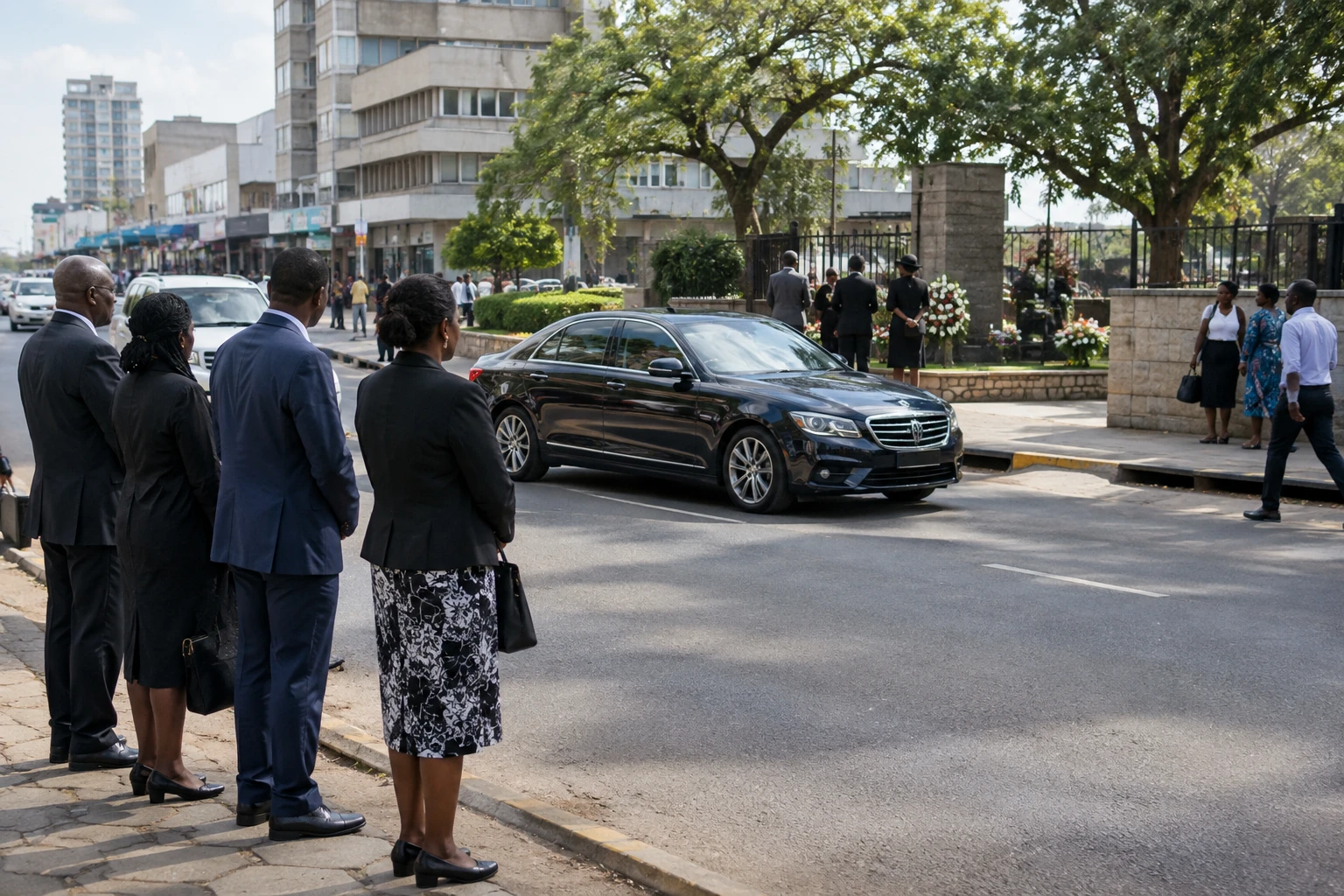
In Harare, the funeral of a businessman known for his spectacular gifts offered a glimpse of two realities that coexist in Zimbabwe: highly visible wealth close to the corridors of power, and an economic recovery whose benefits are felt unevenly. Wicknell Chivayo’s death does not close the questions surrounding his business dealings. It makes them harder to avoid.
A deadly crash, followed by a closely watched funeral
Wicknell Chivayo and his wife, Lucy Muteke, were buried on Thursday 8 October at Glen Forest Memorial Park in Harare, eight days after their helicopter crashed near Marondera, east of the capital. Zimbabwe’s public broadcaster and national daily The Herald confirmed the date and location of the funeral. The ceremony brought together family and friends, politicians, business figures and members of the public.
The number of victims varied in the first hours. Authorities initially said there were six people on board. Police later said five people had died: Chivayo, his wife, an aide and the two pilots. The revised toll was reported by the Associated Press. The cause of the crash had not been established in the information reviewed; it should therefore not be inferred from the circumstances of the accident.
At 43, according to initial reports, Chivayo had become a familiar figure in Zimbabwe under the nickname “Sir Wicknell”. He posted on social media about giving luxury cars and large sums of money to artists, religious leaders, sportspeople and friends and family. A few hours before the crash, he had announced gifts for two lawyers who had supported him. The amount subsequently reported by AP differs from figures in some initial accounts, so it is best not to present it as definitive.
Public contracts under scrutiny
The generosity displayed online was only part of his public image. His ties to President Emmerson Mnangagwa and the ruling Zanu-PF party, as well as his business activities, prompted questions about access to public contracts and the origins of his wealth. Those questions do not, by themselves, constitute proof of wrongdoing. AP reports that some controversies related to his contracts gave rise to allegations that were disputed or rejected in legal proceedings and investigations.
His company, Intratrek Zimbabwe, was associated in particular with the Gwanda solar project in the south of the country. Awarded in 2015, the contract was for a planned 100-megawatt power station. A Transparency International Zimbabwe report traces the delays and controversies surrounding the contract. Zimbabwe’s Supreme Court, for its part, issued a ruling in 2023 in a dispute between Zimbabwe Power Company and Intratrek. The case illustrates what is at stake: energy contracts involve public funds and shape electricity generation, which is essential to households and businesses alike.
The issue is therefore not just one individual’s lifestyle. It concerns the transparency of tendering, project monitoring and the ability of institutions to explain how contracts are awarded. For businesses that operate by the rules, fair access to contracts matters. For residents, infrastructure delays can mean less reliable services and fewer job opportunities.
An economic recovery that does not benefit everyone equally
Zimbabwe is emerging from years of severe economic instability. Agriculture and mining are supporting a recent recovery, but growth figures alone do not show how income and jobs are distributed. The World Bank estimates that gross domestic product grew by 8.3% in 2025, following a year affected by drought and lower agricultural output. It also notes that the recovery remains exposed to economic and climate risks.
Disparities are experienced differently depending on location and occupation. Large fortunes linked to public contracts, mining or political networks are particularly visible in Harare. By contrast, the incomes of small-scale rural producers depend more heavily on rainfall and harvests. In cities, growth that fails to create enough formal jobs can leave many workers reliant on informal activities. The contrast between highly publicised private gifts and everyday hardship thus feeds a debate about economic justice, though one man’s life cannot, by itself, sum up Zimbabwean society.
The ceremony also prompted differing reactions. Some praised Chivayo’s assistance and gifts; others recalled the controversies surrounding his business dealings and proximity to leaders. These views reflect public debate, but they are no substitute for an independent investigation or court rulings. Respecting the families’ grief and examining issues of public interest are separate matters.
Beyond Zimbabwe, the question of common rules
The case resonates across a region where energy needs, cross-border investment and public procurement often extend beyond national borders. Zimbabwe is a member of the Southern African Development Community, SADC, which brings together 16 states to strengthen economic co-operation and development. Energy projects are strategic: their credibility also depends on transparent contracts, verifiable deadlines and clearly established accountability.
For Harare, the next developments to watch are concrete: the findings of the crash investigation, the legal status of projects associated with Intratrek and the publication of information that makes it possible to track public contracts. Chivayo’s death does not answer these questions. Rather, it is a reminder that an economy is judged not only by growth or acts of charity, but also by how resources and opportunities are allocated.