Algeria
 Egypt
 Libya
 Morocco
 Sudan
 Tunisia
 Benin
 Burkina Faso
 Cabo Verde
 Côte d'Ivoire
 Ghana
 Guinea
 Guinea-Bissau
 Liberia
 Mali
 Mauritania
 Niger
 Nigeria
 Senegal
 Sierra Leone
 The Gambia
 Togo
 Cameroon
 Central African Republic
 Chad
 DR Congo
 Equatorial Guinea
 Gabon
 Republic of the Congo
 São Tomé and Príncipe
 Burundi
 Comoros
 Djibouti
 Eritrea
 Ethiopia
 Madagascar
 Malawi
 Mauritius
 Mozambique
 Rwanda
 Seychelles
 Somalia
 South Sudan
 Tanzania
 Uganda
 Angola
 Botswana
 Eswatini
 Lesotho
 Namibia
 South Africa
 Zambia
 Zimbabwe
Assembling vehicles in Kenya could open a new chapter for electric mobility in East Africa. But several steps remain between a major investment announcement and an industry genuinely rooted in the country: financing, timelines, local suppliers and regional trade rules.
A project announced in Nairobi, with details still to come
On 6 October 2026, the Kenyan government signed a memorandum of understanding with Endelevu Enterprise Corporation for an electric mobility project involving Chinese carmaker Geely Auto Group. President William Ruto presented the initiative in Nairobi. Its announced value is $3bn, or about 390bn Kenyan shillings.
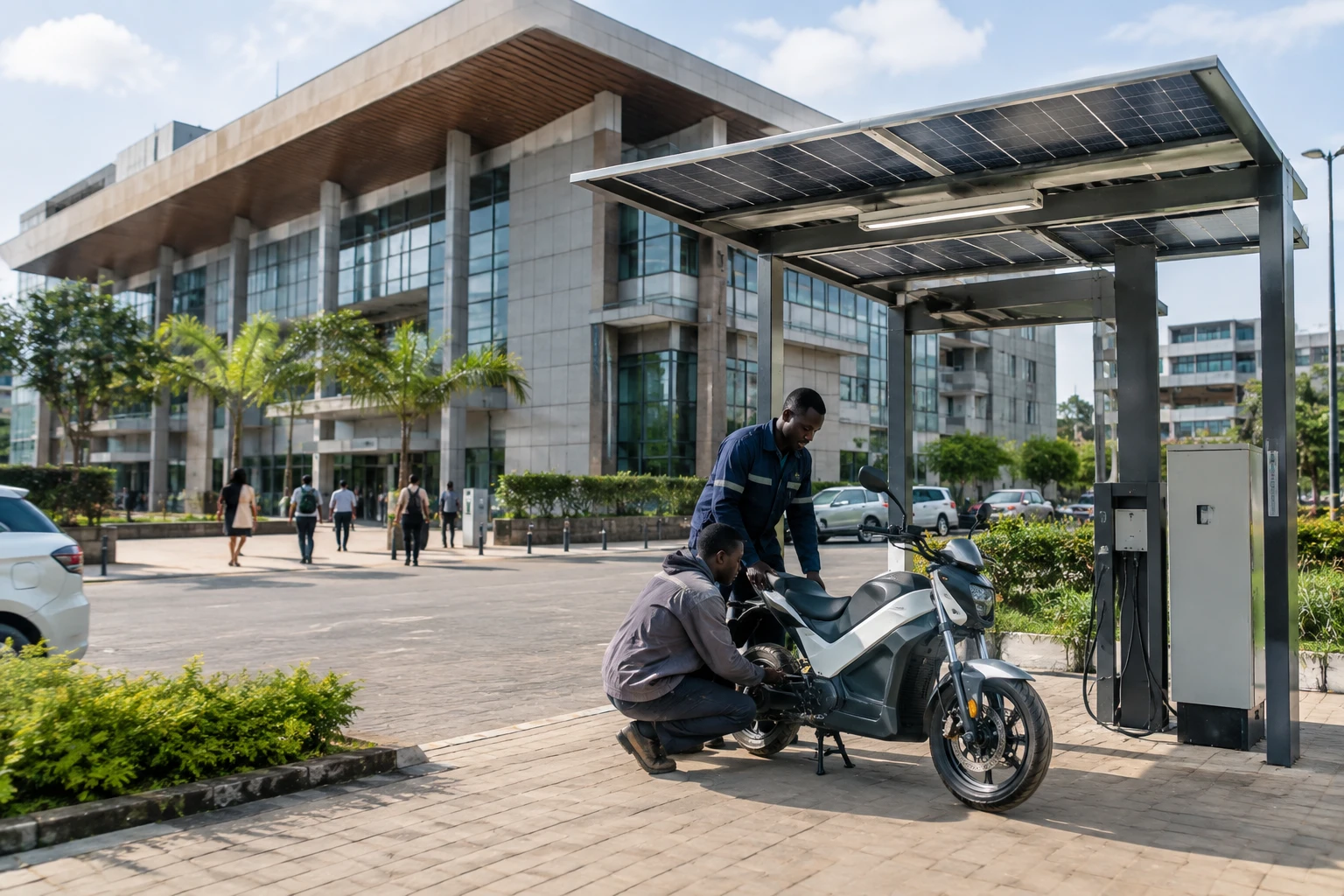
The programme envisages an assembly plant for 50,000 four-wheeled electric vehicles a year, as well as a second facility capable of producing up to 100,000 two-wheelers and light vehicles. It would also include 1,000 solar-powered charging stations and a digital platform designed to manage up to 100,000 vehicles. These are announced targets, not production capacity already in place.
Public details remain limited. Available information does not specify the location of the factories, their construction timeline or the financing structure. The memorandum of understanding therefore does not, by itself, guarantee that all the announced investment will be made. The precise nature of Geely’s involvement will also need to be clarified.
The president cited about 2,000 direct jobs and more than 20,000 indirect jobs. Further opportunities, numbering up to 80,000, are also mentioned in services related to electric mobility. These estimates remain government projections: they will depend on local content, the pace of deployment and demand.
An industrial strategy beyond assembly
Kenya is seeking to turn the growth of electric vehicles into local productive activity. Its national electric mobility policy, launched in February 2026, supports manufacturing, charging infrastructure and training. The government also presents the transition as a way to reduce the oil import bill, which the Ministry of Transport estimates at about $5bn a year.
The market has already grown, but the figures need to be read in context. Kenya’s Ministry of Roads and Transport reports a cumulative 39,324 electric vehicles registered in 2025, compared with 1,378 in 2022. This increase covers various categories, including two-wheelers, widely used for urban travel and short-distance journeys. It does not mean that electric passenger cars dominate the market.
For the project to go beyond assembling imported components, suppliers will need to be developed, technicians trained and vehicle and battery maintenance organised. The announced jobs could involve very different roles: factory workers, mechanics, digital specialists, charging operators or fleet managers. The actual breakdown will depend on training agreements and purchases from Kenyan companies.
Infrastructure will matter as much as assembly lines. The planned solar-powered stations could make charging easier beyond major urban routes, but their usefulness will depend on where they are located, their availability and their cost. For boda boda riders, small transport businesses and delivery operators, access to finance and battery life will directly influence the choice of an electric vehicle.
Access to the East African market will depend on rules of origin
The project also targets neighbouring markets. Kenya is a member of the East African Community (EAC), a regional bloc that includes a customs union. Goods manufactured in a member state can receive preferential treatment in the region, provided they meet rules of origin: these determine the amount of local processing required for a product to be considered made in the community.
Assembly alone therefore does not automatically guarantee preferential market access. The EAC’s new rules on assembly and manufacturing, which came into force on 1 July 2026, make the question of local content particularly concrete. The extent to which parts are integrated, the processes carried out locally and the traceability of components will all matter for access to regional markets.
This ambition is part of a regional industrial competition in which countries are seeking to attract capital, technology and jobs. For Nairobi, a production base could strengthen trade with other EAC members. But the benefits will not be measured solely by the number of vehicles assembled: the value added retained in the country, the skills acquired and the ability to develop local suppliers will be decisive.
The next steps will be decisive
The announcement reflects a shift already visible in Kenyan policy: electric mobility is no longer seen solely as a transport or climate issue, but as an industrial and energy choice. It could reduce the country’s exposure to imports of fuel while creating new economic activity. These benefits, however, depend on the investment being delivered and on reliable access to electricity.
The next developments to watch are clear: publication of a timeline, confirmation of financing, selection of a site, definition of Geely’s role and agreements with local companies. The first training contracts and procurement criteria will also help distinguish a sustainable production chain from a simple assembly site.
Across East Africa, the project could become a test of the EAC’s ability to turn trade rules into a tool for regional production. For now, Kenya has set out an ambition and signed a memorandum. The initiative’s industrial impact will depend on the verifiable commitments that follow.
Sources consulted: The Standard’s report on the announcement ; record of the memorandum and its publicly available terms ; the Kenyan Ministry of Transport’s national electric mobility policy ; EAC rules on assembly and manufacturing ; EAC rules of origin and common market.