Algeria
 Egypt
 Libya
 Morocco
 Sudan
 Tunisia
 Benin
 Burkina Faso
 Cabo Verde
 Côte d'Ivoire
 Ghana
 Guinea
 Guinea-Bissau
 Liberia
 Mali
 Mauritania
 Niger
 Nigeria
 Senegal
 Sierra Leone
 The Gambia
 Togo
 Cameroon
 Central African Republic
 Chad
 DR Congo
 Equatorial Guinea
 Gabon
 Republic of the Congo
 São Tomé and Príncipe
 Burundi
 Comoros
 Djibouti
 Eritrea
 Ethiopia
 Kenya
 Madagascar
 Malawi
 Mauritius
 Mozambique
 Rwanda
 Seychelles
 Somalia
 South Sudan
 Tanzania
 Uganda
 Angola
 Botswana
 Eswatini
 Lesotho
 Namibia
 Zambia
 Zimbabwe
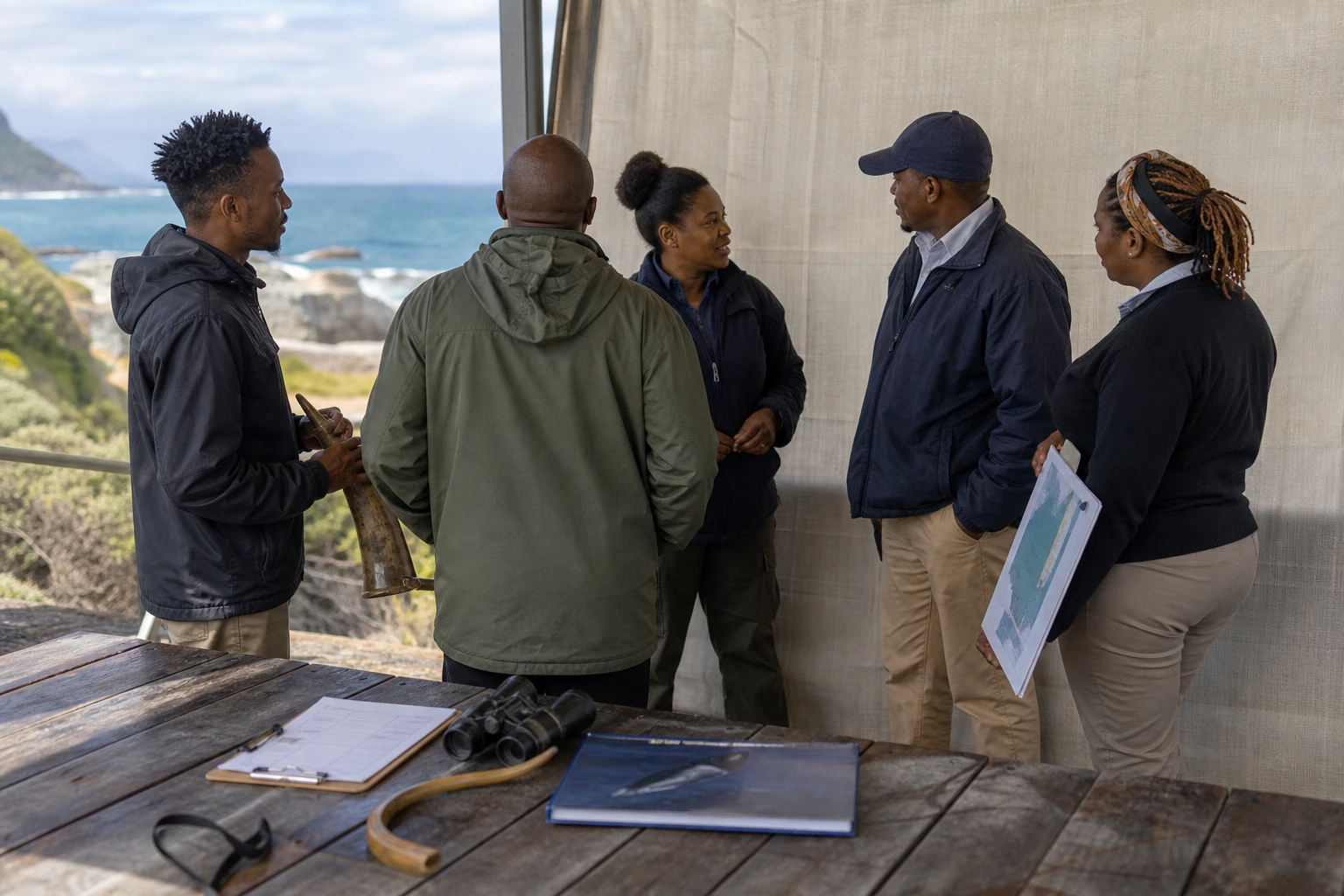
In Hermanus, the sea becomes an open-air viewing ground each winter. From the cliffs of Walker Bay, residents and visitors watch southern right whales return to give birth and nurse their calves near South Africa’s coast.
This annual event transforms the relationship between a coastal town and its marine environment. It supports tourism, but also serves as a reminder that the local economy depends on a fragile balance between human activity, cetacean protection and changing oceans.
A migration visible from the cliffs
Hermanus is in the Western Cape province, about 100 kilometres from Cape Town. The town is part of the Whale Coast tourism region, a stretch of coastline known for its scenery, nature reserves and cetacean watching.
Each year, southern right whales travel to the temperate waters of Walker Bay after passing through feeding grounds in the Southern Ocean. Females seek more favourable conditions there to give birth and care for their calves during the first weeks of their lives.
The whale-watching season generally runs from June to November. It often peaks between September and October, when females and calves come closer to shore. Visibility, however, depends on the weather, sea conditions and the animals’ behaviour.
The Cliff Path, a coastal trail of about 12 kilometres between New Harbour and Grotto Beach, offers several viewpoints accessible on foot. It follows the bay for much of its length. Visitors can sometimes see whales without boarding a boat.
This proximity does not mean the animals are available on demand. A whale may remain underwater for a long time, change direction or move away depending on currents and marine conditions. A lack of sightings therefore does not necessarily mean there are no whales in the bay.
The ‘whale crier’, a tradition turned institution
Hermanus has developed a distinctive way of signalling sightings. Since the early 1990s, a ‘whale crier’ has walked along the seafront with a horn made from dried kelp.
His role is simple. When a whale is visible from the coast, he blows his instrument and points visitors in the right direction. Different signals may correspond to different parts of the bay. The role began as a tourism initiative before becoming a recognisable part of local identity.
The system gives whale-watching a communal dimension. Rather than reserving the spectacle for visitors with binoculars or tickets for a boat trip, it allows walkers to share information quickly from public spaces.
The tradition is also part of South Africa’s wider cultural history. It brings together maritime heritage, outdoor pursuits and the local economy. In Hermanus, then, whales are not merely a subject of natural history. They are part of the town’s story.
A season that boosts the local economy
The return of the cetaceans coincides with an important period for accommodation providers, restaurants, guides, shops and boat-trip operators. Visitors come for the whales, but also buy products and services in the Overberg region.
The benefits are not limited to businesses directly involved in whale-watching. Transport providers, markets, cultural activities and independent operators also gain from the influx. In a modest-sized town, a few weeks of heavy visitor traffic can change the pace of the local economy.
This activity also brings demands. Traffic increases, public spaces come under greater pressure and water-based activities must comply with rules designed to minimise disturbance to the animals. Operators must, in particular, avoid getting too close and any behaviour likely to alter the whales’ movements.
Protection of these species falls under South Africa’s environmental framework. The Department of Forestry, Fisheries and the Environment, the national department responsible, among other things, for marine biodiversity, oversees research and certain activities that could affect cetaceans.
A natural spectacle that calls for restraint
Images of breaches, blows and calves draw the eye. But the spectacle alone does not tell us about the population’s health. Scientists also monitor reproduction, the physical condition of females, migration and the effects of changes in the ocean.
Southern right whales remain exposed to several pressures. Shipping, entanglement in fishing gear, underwater noise and changes in food supplies can affect their behaviour. Variations in temperature and marine productivity also make comparisons from one season to the next more difficult.
In this context, numerous sightings from the coast are not enough to establish a population trend. Observers’ accounts provide useful indications, but must be supplemented by scientific surveys and data collected over several years.
Research along South Africa’s coasts is specifically aimed at better understanding these changes. Aerial surveys and field monitoring help study the animals’ movements, reproduction and body condition. The data are then used to adapt management rules and marine activities.
From Walker Bay to regional cooperation
Hermanus illustrates an issue that extends beyond South Africa. Southern right whales cross several marine areas during their life cycle. Their protection therefore depends on the quality of observations, national rules and scientific cooperation between countries in the Southern Hemisphere.
The case of Walker Bay also highlights the role of African towns in conservation. A tourist destination can promote its natural heritage without reducing it to a product. This requires maintaining appropriate distances, informing the public and providing lasting funding for scientific monitoring.
The whale season will therefore remain a major event in Hermanus’s calendar. The annual marine festival extends its profile through cultural, educational and environmental activities. But the real work goes beyond the festivities: it lies in the ability to preserve a busy bay, protect females and their calves, and rigorously measure changes in the Southern Ocean.