Algeria
 Egypt
 Libya
 Morocco
 Sudan
 Tunisia
 Benin
 Burkina Faso
 Cabo Verde
 Côte d'Ivoire
 Ghana
 Guinea
 Guinea-Bissau
 Liberia
 Mali
 Mauritania
 Niger
 Nigeria
 Senegal
 Sierra Leone
 The Gambia
 Togo
 Central African Republic
 Chad
 DR Congo
 Equatorial Guinea
 Gabon
 Republic of the Congo
 São Tomé and Príncipe
 Burundi
 Comoros
 Djibouti
 Eritrea
 Ethiopia
 Kenya
 Madagascar
 Malawi
 Mauritius
 Mozambique
 Rwanda
 Seychelles
 Somalia
 South Sudan
 Tanzania
 Uganda
 Angola
 Botswana
 Eswatini
 Lesotho
 Namibia
 South Africa
 Zambia
 Zimbabwe
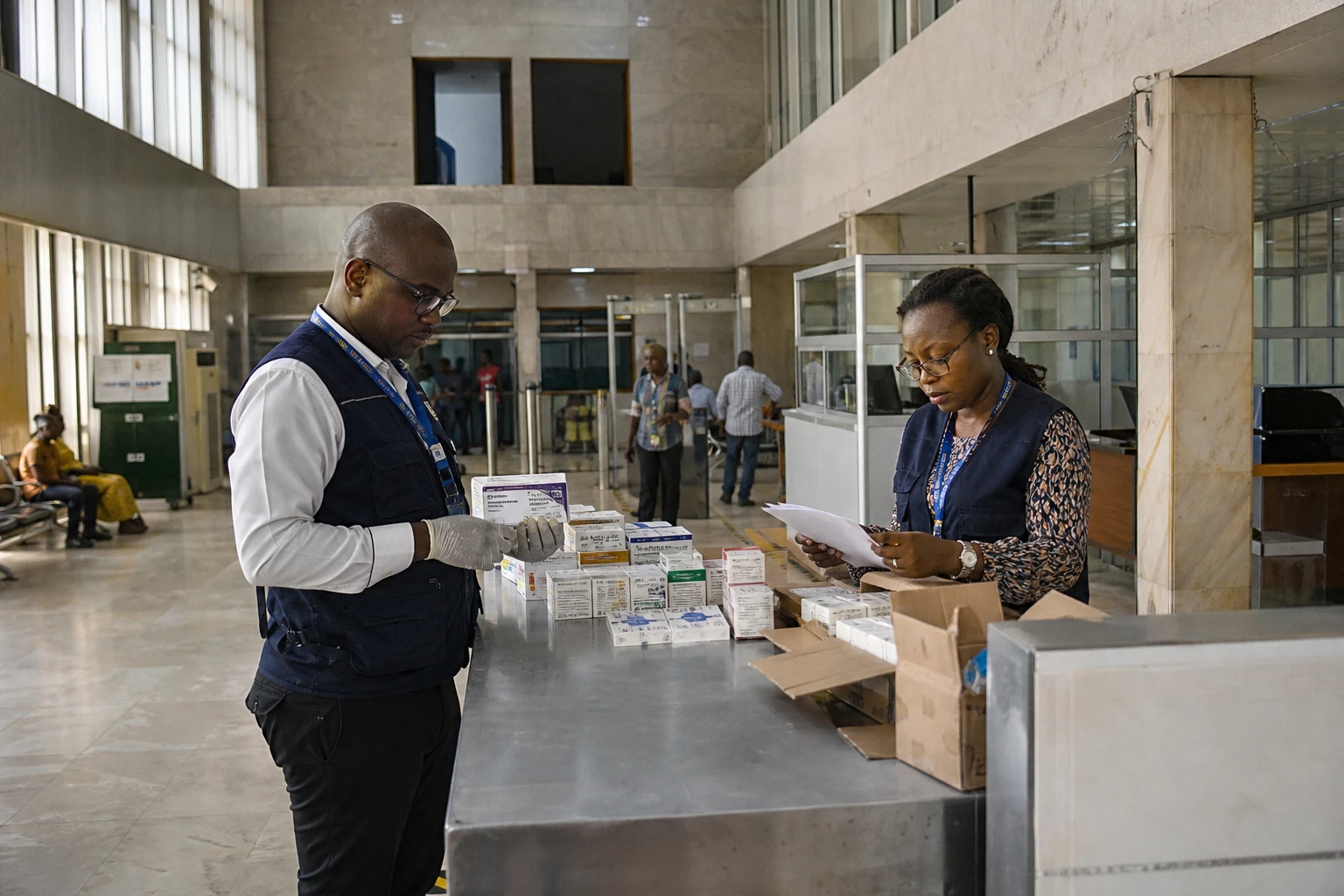
In the six countries of the Economic and Monetary Community of Central Africa (CEMAC), falsified medicines are no longer confined to small-scale clandestine trade. They circulate through networks able to exploit borders, weaknesses in the supply chain and growing demand for affordable healthcare.
More than 250 tonnes of medical products were seized in the CEMAC region between 2020 and 2025, according to data presented in a report on the phenomenon. This figure, however, measures only intercepted consignments. On its own, it cannot assess the total volume of products reaching patients.
A regional market driven by borders and price differences
CEMAC brings together Cameroon, the Central African Republic, the Republic of the Congo, Gabon, Equatorial Guinea and Chad. These countries share a customs and monetary union, but their health systems, enforcement capacity and supply networks remain very different.
This creates favoured transit points. Products can enter through the ports of the Gulf of Guinea, transit along major roads or travel through informal routes linking capitals with secondary cities. Urban markets, unauthorised shops and, increasingly, social media then serve as outlets.
The problem is not limited to medicines that are entirely counterfeit. It also concerns unauthorised, expired or improperly stored products, and those manufactured without meeting quality standards. The World Health Organization distinguishes, in particular, between substandard and falsified products. The former fail to meet the required specifications. The latter deliberately misrepresent their identity, composition or origin.
In practice, these categories can be found in the same supply chains. For patients, the consequences are often the same: treatment that is ineffective, dangerous or impossible to authenticate.
Local production adds to clandestine imports
The networks studied in Central Africa do not rely solely on consignments from abroad. Investigators also report growing local production of falsified products. This changes the response required.
The fight can no longer focus solely on border posts and port warehouses. It must also target manufacturing sites, packaging workshops, packaging printers and supply chains for raw materials.
Local manufacturing can reduce traffickers’ costs and lead times. It also enables them to tailor packaging to consumer habits and the languages used in the countries concerned. Boxes imitating well-known brands can thus be introduced into informal pharmacies or offered directly to patients.
The most sought-after products are often those that meet common needs: antimalarials, antibiotics, painkillers, antiparasitic medicines and drugs for chronic diseases. Strong demand makes them quick to sell and harder to detect when controls are limited.
The health risk goes beyond counterfeiting
A falsified medicine may contain no active ingredient. It may also contain too little, have an incorrect dosage or contain a toxic substance. The consequences vary according to the product and the patient’s condition.
For antibiotics and antimalarials, an under-dosed treatment can lead to therapeutic failure and increase drug resistance. The WHO considers substandard or falsified medical products a global problem, particularly serious in countries where access to healthcare remains unequal.
Healthcare facilities are also at risk. Falsified products can enter the regulated supply chain through a dubious supplier, a forged document or an incomplete inspection. Professional-looking packaging therefore does not, on its own, guarantee that the contents are genuine.
Authorities must also take storage into account. An authentic medicine can lose its effectiveness if exposed to excessive heat, humidity or prolonged light. In several parts of Central Africa, monitoring transport and storage conditions remains as important as checking import documents.
Controls remain divided among several agencies
Trafficking in medical products involves several agencies: customs, police, the judiciary, pharmaceutical authorities, health services and testing laboratories. Without rapid information-sharing, a seizure in one country may remain unknown to neighbouring states.
CEMAC has a regional framework to facilitate economic and customs cooperation. But the fight against falsified medicines requires precise operational mechanisms: shared databases, rapid alerts, harmonised procedures and exchanges between laboratories.
Resources are central to the issue. Identifying a falsified product requires more than examining its packaging. It may be necessary to analyse its composition, check its batches and trace its commercial journey. These operations require trained staff, equipped laboratories and a judicial process capable of preserving evidence.
Cooperation with international organisations can strengthen these capabilities. UNODC, the WHO and the CEMAC Commission are working on the issue through an approach that combines public health, security and the fight against organised crime. This coordination must, however, remain grounded in the realities of local administrations and markets.
Impact varies across communities and households
In capital cities, patients can sometimes compare several pharmacies or access better-equipped hospitals. In remote areas, choice is often more limited. Informal vendors then become local suppliers, even when their products are not inspected.
The situation weighs particularly heavily on low-income households. The lower price of an unauthorised medicine may seem decisive when set against the cost of a consultation, transport and a full course of treatment. The public response cannot therefore rely solely on cracking down on sellers.
It must also improve the availability of essential medicines, strengthen authorised pharmacies in secondary areas and inform patients without blaming them. An awareness campaign can never replace a reliable supply.
Informal-sector traders are not a homogeneous group either. Some deliberately take part in criminal networks. Others resell products whose origins they do not know. The courts and health authorities must distinguish between levels of responsibility while prosecuting organisers and manufacturers.
The next battle will be over traceability
The number of seizures recorded between 2020 and 2025 is a reminder of the scale of the problem. It also highlights the limitations of the available statistics. Seizure figures depend on the inspections carried out, the resources deployed and the ability of services to report products consistently.
The regional priority will therefore be to measure flows more effectively. This requires common definitions, comparable data and regular sharing of alerts among the six CEMAC countries.
Digital traceability, batch authentication and stronger national medicines authorities can help close some routes. These tools will only be effective if they also cover informal supply chains and areas far from the capitals.
For Central Africa, the challenge goes beyond seizing consignments. It concerns trust in healthcare, the ability of states to protect their populations and the strength of a regional pharmaceutical market under development. The response must therefore combine enforcement, local production that complies with standards, affordable access to treatment and cross-border cooperation.