Algeria
 Egypt
 Libya
 Morocco
 Sudan
 Tunisia
 Burkina Faso
 Cabo Verde
 Côte d'Ivoire
 Ghana
 Guinea
 Guinea-Bissau
 Liberia
 Mali
 Mauritania
 Niger
 Nigeria
 Senegal
 Sierra Leone
 The Gambia
 Togo
 Cameroon
 Central African Republic
 Chad
 DR Congo
 Equatorial Guinea
 Gabon
 Republic of the Congo
 São Tomé and Príncipe
 Burundi
 Comoros
 Djibouti
 Eritrea
 Ethiopia
 Kenya
 Madagascar
 Malawi
 Mauritius
 Mozambique
 Rwanda
 Seychelles
 Somalia
 South Sudan
 Tanzania
 Uganda
 Angola
 Botswana
 Eswatini
 Lesotho
 Namibia
 South Africa
 Zambia
 Zimbabwe
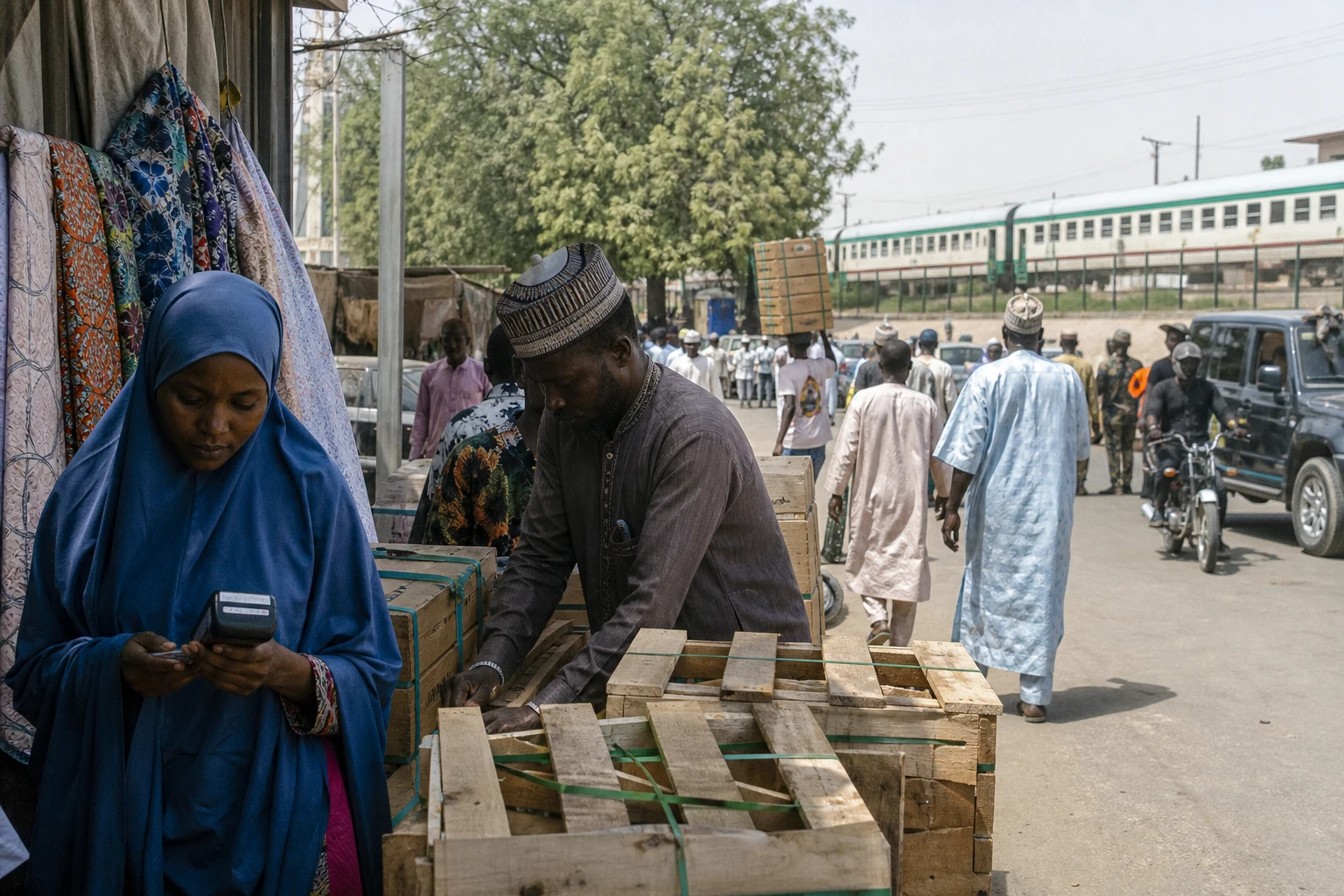
In Kano, in northern Nigeria, rail is no longer just a way to connect cities. It is becoming a tool in the competition between trade corridors in West Africa. With the link to Maradi, Abuja is seeking to bring its market closer to Niger and capture more of the flows destined for a landlocked country.
A corridor between two border economies
The Kano–Maradi project is intended to link Kano, in Nigeria, with Maradi, in southern Niger, passing through Daura and Katsina on the Nigerian side, then Jibiya before reaching Nigerien territory. Project documents describe a standard-gauge line of about 393 kilometres, part of it in Nigeria and with a cross-border extension to Maradi.
The ECOWAS Bank for Investment and Development, the financial institution of the Economic Community of West African States, has approved a $100 million allocation for rolling stock and operating equipment. The decision was taken at a meeting of its board of directors in Lomé, Togo, on 28 September 2026. The regional funding for equipment for the Kano–Maradi railway complements an initial $180 million line of credit awarded to Mota-Engil Nigeria in April 2025.
The planned capacity conveys the scale of the ambition. The line could carry about 9,300 passengers and 3,000 tonnes of goods a day. These projections nevertheless depend on the infrastructure becoming operational, trains being available and border operations running smoothly.
Niger seeks several gateways
For Niger, the stakes go beyond its link with Nigeria. The country depends on external corridors for its imports and exports. Some of its goods traditionally pass through the ports of Cotonou in Benin, Lomé in Togo or Tema in Ghana. Relations with Benin have, however, been strained by political and trade tensions that emerged after the change of power in Niamey in July 2023.
The Nigerien government therefore regards diversifying routes as a priority. In April 2026, Transport Minister Abdourahamane Amadou said the Kano–Maradi link was to be accompanied by logistics infrastructure, including an inland dry port in Maradi. A dry port is an inland facility where goods can be received, stored and cleared through customs far from the coast.
The minister also cited other options, including facilities in Agadez and connections to Algeria. This approach shows that Niamey does not want to depend on a single coastal neighbour or a single land route. It also opens up competition among Nigerian, Beninese, Togolese, Ghanaian, Cameroonian and Algerian corridors.
A meeting held in Niamey on 13 May 2026 between Nigerien and Nigerian officials, the contractor and financial partners focused on several practical issues. Discussions covered the progress of the works, land acquisition in Niger, the location of Maradi station, and coordination between customs and immigration services. Niger’s monitoring of the cross-border rail project confirms that the remaining obstacles are not solely technical.
For Abuja, an extension of rail strategy
Nigeria is placing Kano–Maradi within a broader modernisation of its rail network. For several years, Abuja has been developing standard-gauge lines to improve the movement of passengers and goods. The aim is also to ease pressure on roads, which still carry most domestic transport.
The link to Maradi gives this policy a regional dimension. It could extend northwards the connections intended to link southern Nigeria’s ports to major economic centres inland. In time, the corridor could therefore bring the port facilities of Lagos closer to the markets of Kano, Katsina and Maradi, provided the intervening sections are completed.
The timetable remains subject to change. In August 2026, Nigeria’s Federal Ministry of Transportation reaffirmed that the Kano–Daura–Katsina sections would enter service in December 2026. Mota-Engil, meanwhile, said the extension from Katsina to Maradi was due to be completed by the end of 2027. The timetable announced by the Nigerian authorities and the contractor’s technical presentation of the project therefore do not give exactly the same deadline for the entire link.
This difference reflects the construction of the line in several sections. It also makes it necessary to distinguish between the opening of a stretch in Nigeria and the full operation of the corridor to Maradi. For transport operators, that distinction is essential. A partially operational line is not enough to shift international flows on a lasting basis.
Competitiveness will be decided after construction
Rail will not automatically divert goods from the ports of Cotonou, Lomé or Tema. Shippers compare total cost, transit time, security, the quality of customs clearance and the regularity of services. They also assess last-mile risks, between the station, warehouses and markets.
Kano–Maradi will therefore have to operate as a complete chain. This requires freight terminals, warehouses, coordinated customs services and digital tracking procedures. Niger has already announced that it will strengthen the traceability of convoys and goods. Without these services, the theoretical advantage of rail could be eroded by border delays or the need to transfer cargo between modes.
The expected effects will not be the same for all stakeholders. Large companies could benefit from lower costs on high-volume shipments. Small traders, meanwhile, will depend more on train frequency, fares and access to logistics facilities. In the towns along the route, stations could support new economic activity. In rural areas, the impact will depend on links to local markets and keeping access costs under control.
Security will remain another decisive factor. Construction has already faced difficulties involving the theft of materials, access to land and building conditions. At regional level, the corridor’s continuity will also depend on the two states’ ability to protect the railway right of way and trains without making checks so onerous that they slow trade.
A test for West African integration
Kano–Maradi is therefore more than an infrastructure project. It tests ECOWAS’s ability to fund connections that support trade, mobility and regional integration. It is also being developed at a time when relations between Sahel states and regional organisations remain strained.
The next step is practical: complete the sections announced, resolve land issues in Niger and coordinate administrations on both sides of the border. The corridor’s success will not be measured solely by the length of the railway. It will be evident in the regularity of trains, the time taken to cross the border and Maradi’s ability to become a genuine commercial hub between Nigeria and the Sahel.