Algeria
 Egypt
 Libya
 Morocco
 Sudan
 Tunisia
 Burkina Faso
 Cabo Verde
 Côte d'Ivoire
 Ghana
 Guinea
 Guinea-Bissau
 Liberia
 Mali
 Mauritania
 Niger
 Nigeria
 Senegal
 Sierra Leone
 The Gambia
 Togo
 Cameroon
 Central African Republic
 Chad
 DR Congo
 Equatorial Guinea
 Gabon
 Republic of the Congo
 São Tomé and Príncipe
 Burundi
 Comoros
 Djibouti
 Eritrea
 Ethiopia
 Kenya
 Madagascar
 Malawi
 Mauritius
 Mozambique
 Rwanda
 Seychelles
 Somalia
 South Sudan
 Tanzania
 Uganda
 Angola
 Botswana
 Eswatini
 Lesotho
 Namibia
 South Africa
 Zambia
 Zimbabwe
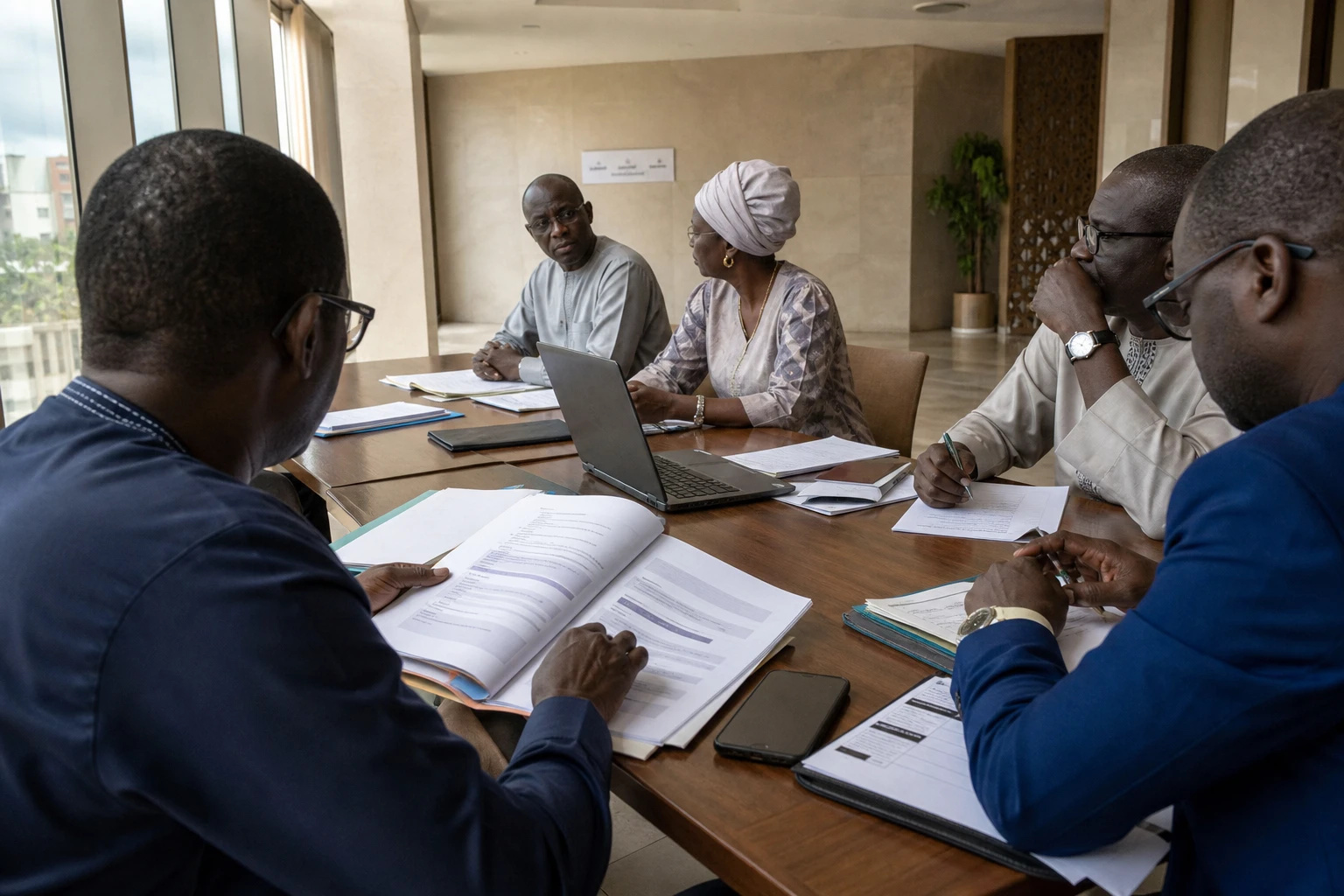
Across the UEMOA, social protection remains largely tied to formal employment. Yet most workers are employed in agriculture, commerce, crafts or independent services. The new regional strategy adopted in Dakar aims to narrow this gap over the next ten years.
Regional decision amid highly unequal coverage
The Council of Ministers of the West African Economic and Monetary Union (UEMOA), which brings together eight countries sharing a common economic and monetary area, approved the Regional Social Protection Strategy for 2026-2035 on 2 October 2026. The decision was taken at the year’s third ordinary session, held in Dakar, Senegal.
The text had been prepared several months earlier. The ministers responsible for social protection in the member states approved it on 8 May 2025, before it was considered by the Council of Ministers. The strategy is now to serve as a common framework for policies pursued in Benin, Burkina Faso, Côte d’Ivoire, Guinea-Bissau, Mali, Niger, Senegal and Togo.
The stated aim is twofold. First, to consolidate existing systems. Second, to widen access to them for people who remain outside conventional schemes. The strategy notably provides for stronger institutional frameworks, better co-ordination between government departments and more systematic consideration of vulnerable populations.
The UEMOA Commission presents this approach against a backdrop of low social security coverage. According to data available in the Union’s documentary resources, more than 90 % of the population of the eight member states does not benefit from any form of social security. This regional figure is based on data and estimates that do not all cover the same period. It nevertheless gives a clear indication of the scale of the challenge.
Mutual benefit schemes established by communities, professional associations or local organisations already play a role. However, many still operate within a fragile legal and financial framework. Regional regulations on social mutual societies, adopted in 2009, were intended to help organise these initiatives more effectively. Their implementation nevertheless remains uneven across countries.
The informal economy makes extending rights more difficult
The main obstacle lies in the structure of labour markets. Findings from the Regional Integrated Survey on Employment and the Informal Sector, conducted in 2017 and 2018 with national statistical institutes and Afristat, show an average regional unemployment rate of 4 %. This relatively low figure masks widespread job insecurity.
Underemployment stood at 31.1 %. Nearly 92 % of workers were employed in the informal economy, compared with just 8 % in the formal sector. Yet pension, health insurance and compensation schemes are generally easier to organise for registered employees.
This situation affects very different groups. In Dakar and Abidjan, it includes vendors, drivers, delivery workers, artisans and workers in small service businesses. In rural areas of Mali, Niger, Burkina Faso and northern Senegal, it also affects agricultural producers and seasonal workers. Women, often active in small-scale trade and food processing, may also face low incomes, no pension and limited access to credit.
Low statistical unemployment therefore does not mean that households have adequate protection. An illness, pregnancy, workplace accident or poor agricultural season can quickly reduce a family’s income. Extreme weather events and pressure on food prices add further strain.
National initiatives already offer a foundation
The regional strategy is not starting from scratch. Several UEMOA states have pension funds, health insurance programmes and social safety nets. Results vary, but some reforms offer useful examples for other countries.
In Benin, the Insurance Scheme for Strengthening Human Capital, known by its French acronym ARCH, targets poor people and workers in the informal economy, among others. Its programme has four components: health insurance, vocational training, access to credit and pension insurance.
The Beninese state fully covers health insurance for people considered extremely poor. It also provides partial coverage for poor people who do not fall into this category. The programme targets agriculture, commerce, transport, crafts, the arts and culture.
According to Benin’s National Social Protection Agency, ARCH aims, among other things, to facilitate access to healthcare for about 4.3 million people and enable nearly 2 million informal workers to subscribe to a pension. These are operational targets. They should not be confused with a definitive coverage record.
In Côte d’Ivoire, the Social Protection Investment Programme for the Agricultural and Informal Sectors, or PIPS, was adopted in October 2025 and officially launched on 2 December that year. It aims to bring agricultural producers and informal workers into the Universal Health Coverage scheme and the Social Security Scheme for Self-Employed Workers.
The Ivorian programme targets more than 5 million people working in agriculture, crafts and the informal sector. Its rollout will nevertheless need to take account of irregular incomes, workers’ mobility and households’ actual ability to pay contributions. In agricultural value chains, the timing of deductions will be crucial, as incomes are often concentrated in just a few periods of the year.
Funding and access to services will be decisive
Adopting a common framework will not be enough. The strategy’s success will depend on states’ ability to fund benefits sustainably and make it easier for beneficiaries to enrol. It will also depend on the quality of the services on offer.
Health insurance that is difficult to access, with distant health centres, unavailable medicines or high out-of-pocket costs, risks discouraging households. Similarly, a pension scheme that is hard to understand will remain unattractive to workers who regularly change jobs.
The UEMOA will therefore need to bring social protection closer to health, employment, agriculture and local development policies. The Commission has already launched joint initiatives on pharmaceutical regulation, epidemic prevention and health responses at borders. These efforts can strengthen regional coherence, provided they are connected to conditions on the ground.
The portability of rights will also be important. A worker moving from Togo to Benin, or from Côte d’Ivoire to Burkina Faso, should not lose the rights built up in their country of origin. Regional mobility makes this issue particularly tangible for traders, transport workers and seasonal labourers.
A roadmap that will be judged by its results
The 2026-2035 strategy gives the UEMOA a shared deadline. Its value will be measured by verifiable results: more people enrolled, contributions adapted to incomes, benefits actually paid and better protection against health, economic or climate crises.
The next challenge will be translating this regional framework into national budgets and programmes. Differences between capitals, secondary cities and rural areas will need to be tracked precisely. Progress in coverage cannot be assessed solely on the basis of official announcements.
For the UEMOA, the task therefore goes beyond administration. It affects household stability, labour productivity and trust in public institutions. Between 2026 and 2035, the regional promise will above all have to be borne out in the everyday lives of workers who remain outside formal systems today.