
 Algeria
 Egypt
 Libya
 Morocco
 Sudan
 Tunisia
 Benin
 Burkina Faso
 Cabo Verde
 Côte d'Ivoire
 Ghana
 Guinea
 Guinea-Bissau
 Liberia
 Mali
 Mauritania
 Niger
 Senegal
 Sierra Leone
 The Gambia
 Togo
 Cameroon
 Central African Republic
 Chad
 DR Congo
 Equatorial Guinea
 Gabon
 Republic of the Congo
 São Tomé and Príncipe
 Burundi
 Comoros
 Djibouti
 Eritrea
 Ethiopia
 Kenya
 Madagascar
 Malawi
 Mauritius
 Mozambique
 Rwanda
 Seychelles
 Somalia
 South Sudan
 Tanzania
 Uganda
 Angola
 Botswana
 Eswatini
 Lesotho
 Namibia
 South Africa
 Zambia
 Zimbabwe
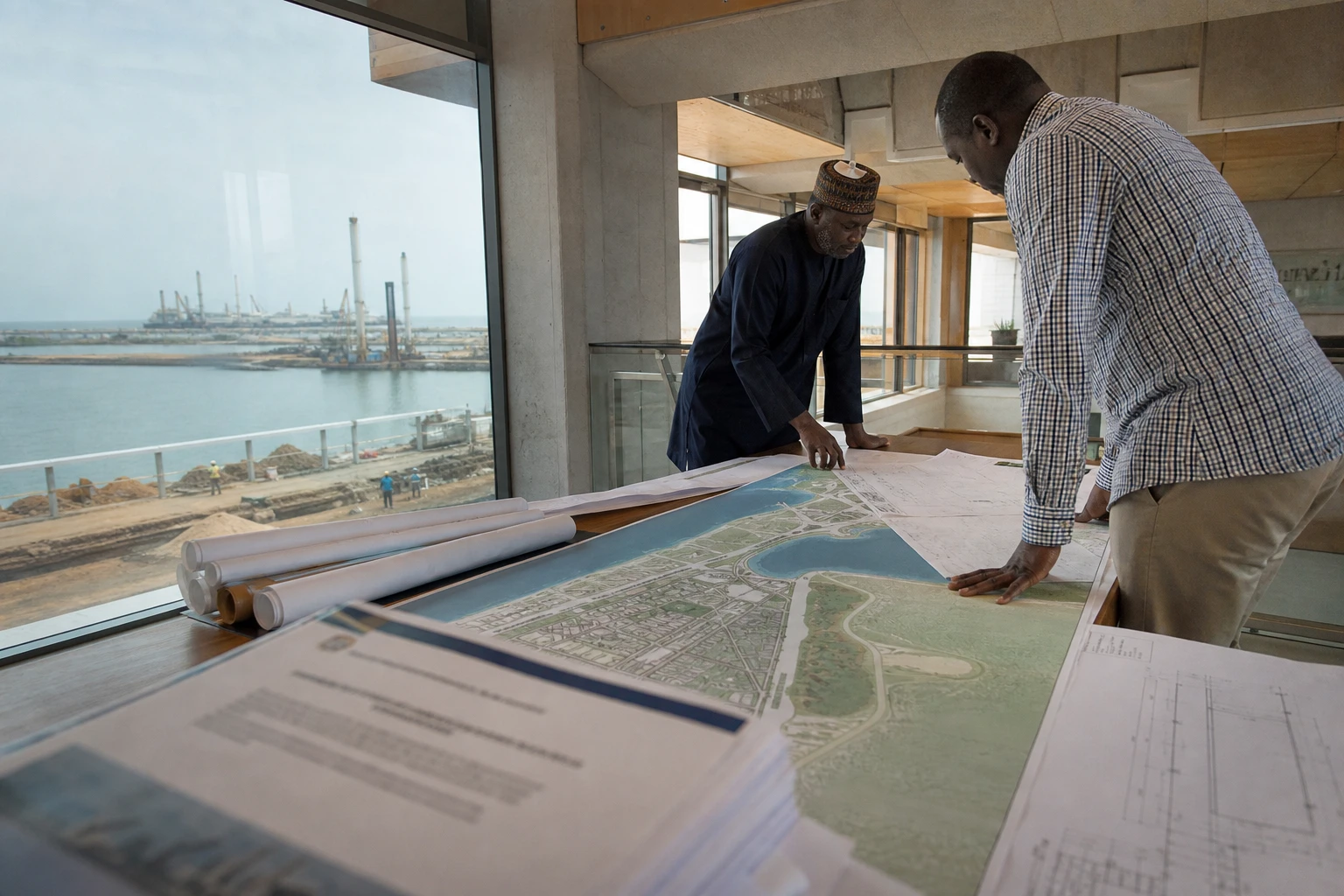
In Ogun Waterside, in south-west Nigeria, an old gas project is back in plans for a future port corridor. But reviving it means more than reopening an administrative file: it will have to overcome the same difficulties that drove away its original partners, notably access to gas, financing and a final investment decision.
An old project repositioned within a new industrial corridor
State-owned NNPC Ltd is taking another look at the Olokola LNG project, also known as OKLNG. The facility is intended to produce and export liquefied natural gas, which is cooled to a very low temperature so that it can be transported by ship.
The project has been under consideration since 2005. It was initially due to involve NNPC, Chevron, Shell and BG Group. However, the international partners gradually withdrew after several years without a final investment decision. Chevron confirmed its departure in August 2013, following the withdrawal of BG Group and Shell. The project therefore never reached the construction stage. Gas industry records recall that a lack of progress and a shift in investment portfolios were among the reasons given at the time.
The project is now returning in a different context. Ogun State is seeking to develop Ogun Waterside around a deep-water port, a special economic zone and industrial activities. On 24 September 2026, the state authorities announced the signing of memorandums of understanding with DP World for the future port and logistics complex.
According to information released after a meeting on 30 September 2026 between Governor Dapo Abiodun and NNPC officials, the state-owned company would handle the acquisition of the land required. Ogun State, for its part, has pledged to facilitate land and administrative procedures.
The gas project would thus be incorporated into a broader scheme. The port is intended to serve as an entry and exit point for goods. The industrial zone is intended to attract processing activities. The LNG terminal would add energy export capacity to the complex.
Substantial land requirements, but few industrial certainties
NNPC estimates that the project will require 1,728 hectares of land. It would also need about 2.5 kilometres of Atlantic coastline. Up to three jetties could be built to accommodate LNG carriers, the ships that transport liquefied natural gas.
These figures give an idea of the site’s scale. They do not yet amount to a decision to build. Production capacity, the final investment amount, new partners and the timetable have yet to be specified.
The most sensitive issue is gas supply. No specific field has been officially designated to supply the future terminal. Yet a liquefaction plant cannot operate without regular flows of natural gas. It also needs robust contracts, gathering and transport infrastructure, and a sufficiently predictable commercial framework.
This issue extends beyond Olokola. Nigeria LNG Limited, which operates the Bonny Island plant, is already experiencing supply difficulties. Its managing director, Adeleye Falade, said in August 2026 that Nigeria’s share of the global LNG market had fallen to 5%, from 6% a few years earlier. He warned that it could drop to as low as 2% if problems with gas supply and capacity expansion persist. Statements reported by TheCable present the decline as the result of slower growth than that of international competitors.
Nigeria nevertheless has considerable gas reserves. The challenge is to turn them into regular production, public revenue and industrial jobs. Delays to infrastructure, regulatory constraints, security problems and competition between exports and domestic consumption complicate that goal.
Revival must avoid the deadlocks of the past
Olokola LNG had already been presented as a flagship project for Nigeria’s gas strategy. Its planned capacity then stood at several tens of millions of tonnes a year. At the time, the project was to be built around four liquefaction trains. A train is a complete industrial unit that converts natural gas into LNG.
But delays have undermined the project’s credibility. The successive withdrawal of partners showed that a project’s size alone is not enough to attract investors over the long term. It also needs clear governance, a risk-sharing arrangement acceptable to each party and a credible supply base.
NNPC now says it is re-examining the reasons for the stalemate. The state-owned company could invest $10 billion in a first phase, according to reports in the Nigerian press. However, this figure should be treated as a media estimate until it is confirmed by a published and detailed investment plan.
For Ogun State, the issue is also territorial. Ogun is already one of Nigeria’s main industrial hubs, thanks to its proximity to Lagos and its road links. Ogun Waterside could extend this base towards the Atlantic coast. The expected benefits include logistics, construction, port services and manufacturing.
However, these benefits will not come automatically. Local communities will need to be involved in discussions on land, access to the coast and compensation. Skilled workers could gain new opportunities, while local economies that depend on fishing or small-scale commercial activities will need to be taken into account in the development plans.
A test for Nigeria’s gas strategy
At regional level, the project is part of competition among LNG-exporting countries. Nigeria faces Angola, Egypt, Algeria and new projects in East Africa. In this market, delays can mean losing contracts, customers and market share.
Olokola’s revival also comes amid the trajectory of ECOWAS, the Economic Community of West African States. Developing a major port and gas infrastructure could strengthen trade along the West African coast. It could also support regional industry, provided the energy produced is not reserved for export.
The next indicator will be the publication of a complete technical and financial plan. Key points to watch will include the source of the gas, the structure of the partnerships, public guarantees, the environmental study and the date of any final investment decision.
For Abuja, Olokola LNG therefore represents more than an old project brought back onto the agenda. It is a test of the credibility of Nigeria’s gas policy. For Ogun, it is an opportunity to link industry, port and energy. For investors, the question remains the same as in 2013: can the project finally move from announcements to construction backed by actual financing ?



