Algeria
 Egypt
 Libya
 Morocco
 Sudan
 Tunisia
 Benin
 Burkina Faso
 Cabo Verde
 Côte d'Ivoire
 Ghana
 Guinea
 Guinea-Bissau
 Liberia
 Mali
 Mauritania
 Niger
 Nigeria
 Senegal
 Sierra Leone
 The Gambia
 Togo
 Cameroon
 Central African Republic
 Chad
 DR Congo
 Equatorial Guinea
 Gabon
 Republic of the Congo
 São Tomé and Príncipe
 Burundi
 Comoros
 Djibouti
 Eritrea
 Ethiopia
 Kenya
 Madagascar
 Malawi
 Mauritius
 Mozambique
 Rwanda
 Seychelles
 Somalia
 South Sudan
 Uganda
 Angola
 Botswana
 Eswatini
 Lesotho
 Namibia
 South Africa
 Zambia
 Zimbabwe

In Dodoma, the question is no longer simply how to sustain growth. The challenge now is to turn that expansion into better-paid, more productive jobs that are less vulnerable to shocks. Tanzania is expected to record growth of 6.1 % in 2026, after its gross domestic product rose by 5.9 % in 2025.
The forecast appears in the latest economic update on the Tanzanian economy from the World Bank, published on 2 October 2026. Over the medium term, the institution expects average growth of 6.5 %. It believes, however, that this momentum will have lasting effects only if the country improves job quality and strengthens the skills of its workforce.
An economy driven by services and investment
The expected performance is based first and foremost on private-sector activity. Financial services, trade and transport are among the main drivers of recent expansion. Agriculture, extractive industries, construction and infrastructure also continue to support economic activity.
The growth recorded in 2025 formed part of a broader recovery. Public investment supported infrastructure, while private investment, particularly foreign investment, began to regain momentum. The World Bank also highlights the role of public spending ahead of the October 2025 general election in the economic activity recorded that year.
This growth has been accompanied by relatively stable prices. According to the Bank of Tanzania, average inflation in mainland Tanzania reached 3.5 % in the fourth quarter of 2025. It therefore remained within the national target range of 3 to 5 %. The central bank expects inflation to stay within this range throughout 2026.
Monetary policy therefore retains room to support economic activity. The Bank of Tanzania kept its policy rate at 5.75 % in the fourth quarter of 2025. Credit to the private sector, meanwhile, grew rapidly, signalling more dynamic access to finance for businesses and creditworthy households.
Macroeconomic stability does not resolve the jobs question
The main challenge, however, lies in the quality of growth. Tanzania is generating economic activity and jobs, but a large share of the workforce remains concentrated in low-productivity agriculture and the informal economy. These jobs often offer irregular incomes, limited social protection and high exposure to price or climate fluctuations.
The World Bank believes the country’s primary problem is not a shortage of jobs. Rather, it is their low productivity and pay. This distinction matters for the young Tanzanians entering the labour market each year, as well as for small businesses seeking to move from informal to more structured activities.
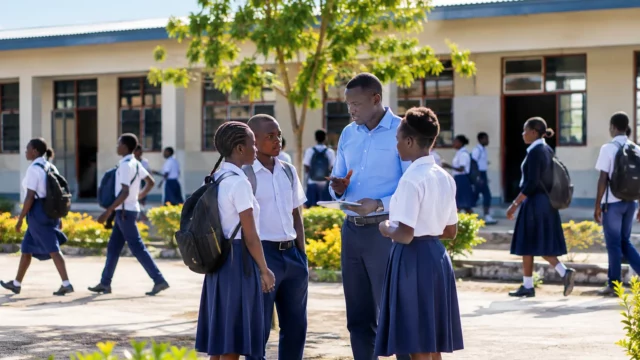
In this context, investment in human capital is crucial. Basic education, technical training, health and the acquisition of skills suited to businesses’ needs can boost productivity. They can also ease access to the fastest-growing sectors, such as digital services, finance, logistics, industry and tourism.
The issue also affects different parts of the country. The benefits of growth are not distributed evenly between Dar es Salaam, other urban centres and rural areas. Infrastructure can open up new markets for rural producers. However, without reliable access to electricity, finance, roads and training, small farms risk remaining low-yielding.
External and climate risks to watch
The forecasts remain exposed to international tensions. A further rise in oil prices would increase the cost of transport, fertilisers and other agricultural inputs. It would also weigh on business costs and household purchasing power.
Tensions in the Middle East could also affect trade routes, logistics and tourism. Tanzania relies on external trade for some of its foreign-exchange earnings. Disruptions to shipping routes or a fall in tourist demand would therefore have differing effects across sectors and regions.
Climate is another source of vulnerability. Droughts, excessive rainfall and flooding can reduce harvests, damage infrastructure and add to pressure on food prices. For the rural economy, these shocks directly affect incomes. In cities, they can lead to higher prices for agricultural products.
Fiscal consolidation will also be closely watched. The aim is to reduce imbalances without slowing essential spending on infrastructure, education and health. An overly abrupt adjustment would weigh on economic activity. Conversely, insufficient discipline would limit the government’s financing capacity and increase debt-related risks.
A challenge for East Africa
Tanzania’s trajectory is part of the East African Community, or EAC, which brings together several economies pursuing gradual trade and financial integration. With its ports, transport corridors and domestic market, Tanzania plays an important role in trade between the Indian Ocean and the East African hinterland.
Growth of more than 6 % could therefore support regional trade. It could also strengthen demand for goods produced in neighbouring countries. But this outlook will depend on the ability to improve cross-border infrastructure, cut logistics costs and facilitate trade.
The next test will be as much social as macroeconomic. Indicators of growth, inflation and investment will remain important. They will not be enough to measure the success of this trajectory. The key question will be whether the expansion forecast in Dodoma, Dar es Salaam and the main economic hubs also translates into higher incomes, more secure jobs and opportunities for young people and rural workers.