Algeria
 Egypt
 Libya
 Morocco
 Sudan
 Tunisia
 Benin
 Burkina Faso
 Cabo Verde
 Côte d'Ivoire
 Ghana
 Guinea
 Guinea-Bissau
 Liberia
 Mali
 Mauritania
 Niger
 Nigeria
 Senegal
 Sierra Leone
 The Gambia
 Togo
 Cameroon
 Central African Republic
 Chad
 DR Congo
 Equatorial Guinea
 Gabon
 Republic of the Congo
 São Tomé and Príncipe
 Burundi
 Comoros
 Djibouti
 Eritrea
 Ethiopia
 Madagascar
 Malawi
 Mauritius
 Mozambique
 Rwanda
 Seychelles
 Somalia
 South Sudan
 Tanzania
 Uganda
 Angola
 Botswana
 Eswatini
 Lesotho
 Namibia
 South Africa
 Zambia
 Zimbabwe
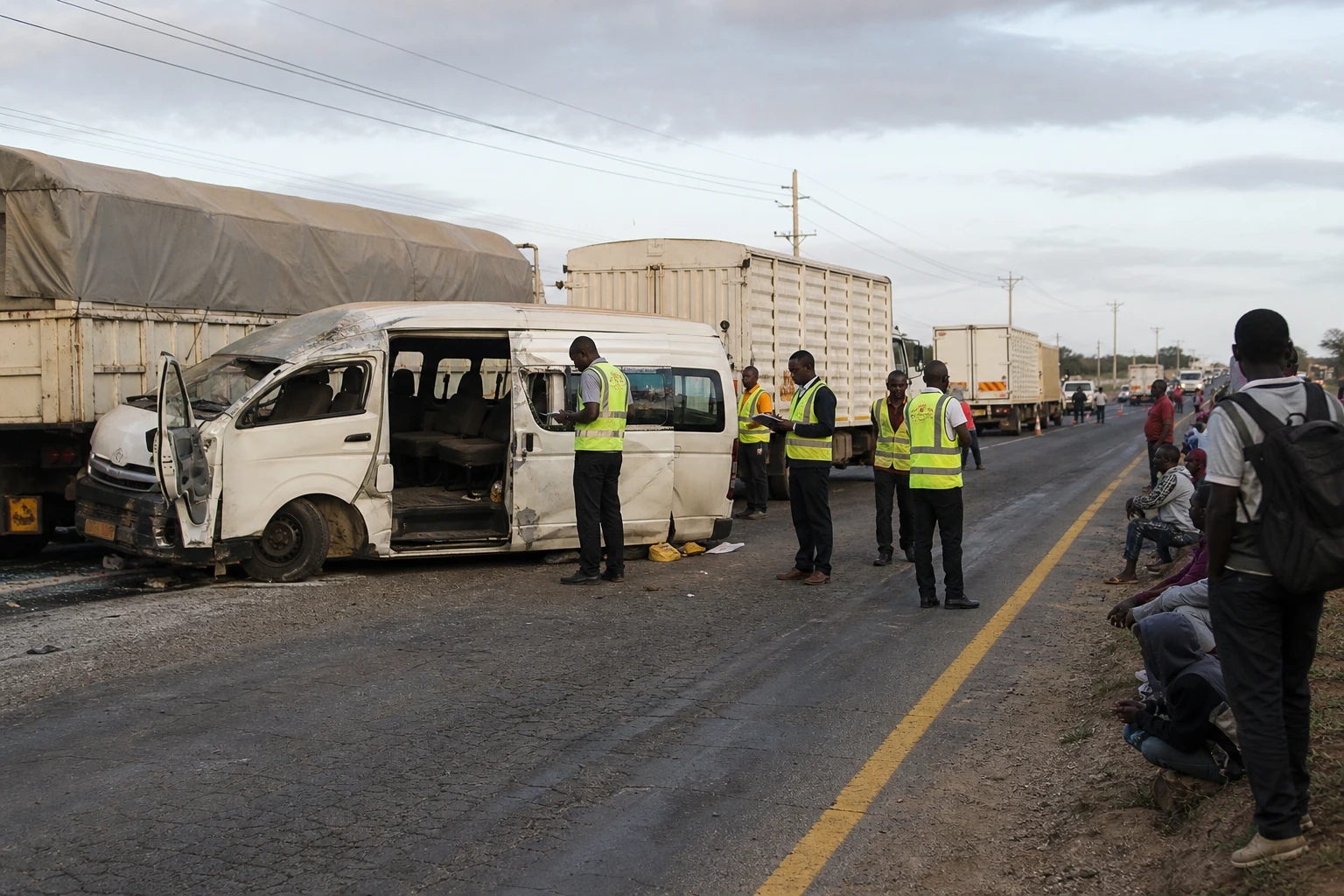
A religious journey on the road between Mombasa and Nairobi turned into a tragedy. Seventeen Catholic worshippers lost their lives in the night from Friday 2 to Saturday 3 October 2026, in Makueni County, south-east of the Kenyan capital.
Multi-vehicle collision at Salama
The accident happened shortly after midnight in the Salama area, on the main road linking Nairobi and Mombasa. Several vehicles, including heavy goods vehicles and a minibus, were involved in the collision.
According to initial information released by the Kenyan police, a lorry is believed to have attempted to overtake another heavy goods vehicle. The manoeuvre is thought to have triggered a series of collisions involving, among others, the minibus carrying the passengers.
All seventeen occupants of the minibus died at the scene. The group comprised the driver and sixteen passengers, most of them women. Others were injured and taken to medical facilities in the region.
The National Transport and Safety Authority, Kenya’s transport safety regulator, sent a team of investigators to the scene. Its investigation is expected to examine the condition of the vehicles, compliance with traffic rules and the precise circumstances of the collision. The investigation announced by the NTSA had not established definitive responsibility at the time of the first official statements.
Pilgrims on their way to Subukia
The victims came from Mikindani Catholic Parish in Mombasa. They were travelling to the Subukia National Shrine in Nakuru County to take part in a national day of prayer.
The Catholic Archdiocese of Mombasa confirmed the group’s identity and expressed its grief. This helps explain the journey: the passengers had left the Kenyan coast for a destination several hundred kilometres away, in the west of the country.
President William Ruto sent his condolences to the families, loved ones and Catholic community. Religious leaders also called for support for the bereaved families and care for the survivors.
Post-mortem examinations of the victims were due to be carried out at Sultan Hamud Hospital in Makueni County. The bodies were then to be transferred to Mombasa, where the families and the parish concerned are based. These steps remain essential to ensure full identification and the dignified return of the bodies.
A stretch already identified as dangerous
The Mlima Kiu-Salama area is considered a “black spot” by the NTSA, meaning a section of road where serious accidents occur repeatedly. The authority says recommendations had already been made to improve safety on this part of the route.
The Nairobi-Mombasa road plays a central role in Kenya’s economy. It links the capital to the port of Mombasa and carries heavy traffic, including lorries, buses, minibuses and private vehicles. It also passes through several urban and rural areas, where road users sometimes share a busy carriageway with local forms of transport.
In this context, an overtaking manoeuvre can quickly trigger a chain collision. Night-time traffic also increases the risks when visibility is reduced, vehicles are difficult to spot or fatigue slows drivers’ reactions.
The exact causes of the accident will nevertheless have to be established by the investigation. The authorities have yet to confirm all the possible factors, including the mechanical condition of the lorries, speed, visibility and the precise layout of the road.
Road safety remains a national concern
Kenya records several thousand road deaths each year. Official figures may, however, underestimate the true toll, particularly when people die after being taken to a health facility or when incidents are not immediately reported to a central authority.
Kenyan authorities regularly cite several risk factors: speeding, dangerous overtaking, mechanical defects, drink-driving and the poor condition of some infrastructure. These are compounded by the challenges of responding on busy routes and the night-time movement of heavy goods vehicles.
The consequences are not the same for everyone. Passengers’ families bear the human and financial cost of the tragedy. Transport companies face vehicle losses and disrupted traffic. In rural areas, hospitals sometimes have to treat several injured people with limited resources, while commercial activity is disrupted by the temporary closure of the route.
A warning for East Africa
The Salama tragedy extends beyond Makueni County. The Nairobi-Mombasa road is one of East Africa’s main transport corridors. It links the Kenyan port to domestic markets and trade networks connected to the East African Community (EAC), which brings together several countries in the region.
The safety of this route therefore matters to Kenyan passengers, heavy goods vehicle drivers and regional trade. Repeated accidents raise questions not only about road design but also about vehicle inspections, driver training and compliance with speed limits.
For now, the NTSA investigation and the police findings will be closely watched. They will need to establish whether recommendations already made for this black spot were implemented and what measures could reduce the risk of further collisions on this strategic road.