Algeria
 Egypt
 Libya
 Morocco
 Sudan
 Tunisia
 Benin
 Burkina Faso
 Cabo Verde
 Côte d'Ivoire
 Ghana
 Guinea
 Guinea-Bissau
 Liberia
 Mali
 Mauritania
 Niger
 Senegal
 Sierra Leone
 The Gambia
 Togo
 Cameroon
 Central African Republic
 Chad
 DR Congo
 Equatorial Guinea
 Gabon
 Republic of the Congo
 São Tomé and Príncipe
 Burundi
 Comoros
 Djibouti
 Eritrea
 Ethiopia
 Kenya
 Madagascar
 Malawi
 Mauritius
 Mozambique
 Rwanda
 Seychelles
 Somalia
 South Sudan
 Tanzania
 Uganda
 Angola
 Botswana
 Eswatini
 Lesotho
 Namibia
 South Africa
 Zambia
 Zimbabwe
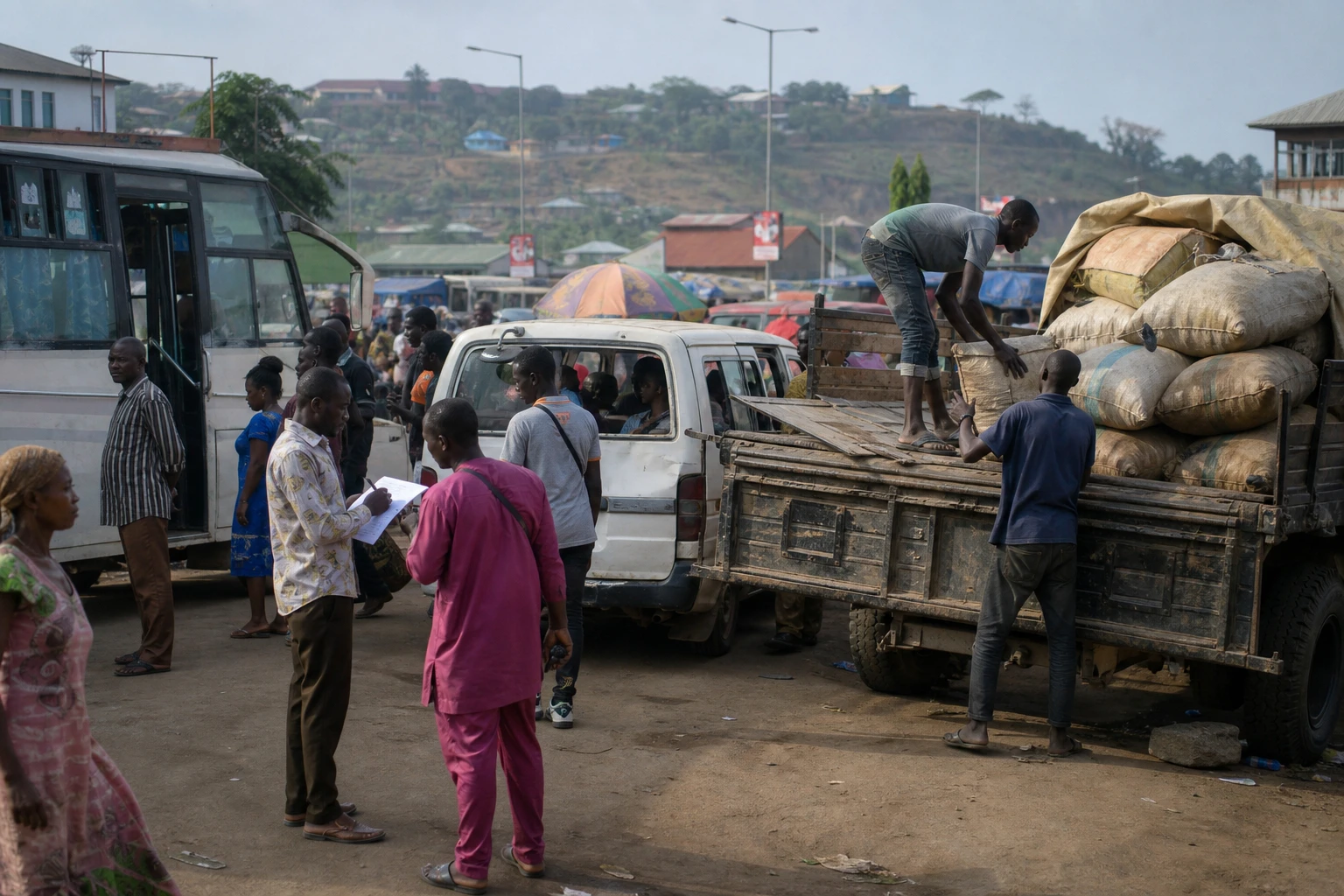
In Lagos, cassava is no longer just for food markets. It is also becoming a possible component of Nigeria’s energy strategy. The challenge is now to connect farms, factories and filling stations without undermining food supplies or increasing costs for households.
An industrial project spanning Lagos and four south-western states
On 29 September 2026, the Ogun-Osun River Basin Development Authority (OORBDA), the federal agency responsible for managing water resources in the Ogun and Oshun river basins, signed a memorandum of understanding with industrial partners linked to Nigeria’s energy sector. The aim is to develop a cassava-based bioethanol production plant in the Itokin area of Lagos State.
The project represents a planned investment of €256 million. The plant is to be built on a 200-hectare site. Its supply would rely on the allocation of 15,000 hectares for cassava cultivation in Lagos, Ogun, Osun and Oyo states.
The bioethanol produced would be intended for blending with Premium Motor Spirit, or PMS, the fuel commonly known as petrol in Nigeria. The principle is to incorporate a share of ethanol into petrol in order to reduce consumption of fossil fuels and the associated imports.
At this stage, it remains a development agreement. Construction of the plant, mobilisation of funding, securing land and signing contracts with producers are all key steps that must be completed before commercial production can begin.
Cassava at the heart of a new value chain
Nigeria is described by its institutions as the world’s largest cassava producer. Yet much of this output is still used for food or is lost after harvest. Industrial processing could therefore open up new markets, provided the collection, storage and transport of the tubers are better organised.
The Central Bank of Nigeria estimates that national production reaches several tens of millions of tonnes a year. It also highlights the sector’s persistent difficulties, including low average productivity, post-harvest losses and irregular access to processing facilities. Bioethanol is therefore not a standalone solution. It depends on an agricultural and industrial ecosystem that remains uneven across states.
The federal government is seeking to broaden this foundation. In January 2026, the Ministry of Budget and Economic Planning announced plans to involve around 14 million smallholders in the Cassava Bioethanol Value Chain Development Project. The programme aims to organise the sector from the supply of improved planting materials through to industrial processing.
The authorities are promoting a model known as the “triple helix”. It is based on cooperation between universities, businesses and the state. In practice, this approach is intended to encourage the spread of higher-yielding varieties, technology transfer, farmer training and access to finance.
For producers, however, the challenge will be very practical. A plant can operate only if it receives sufficient volumes of cassava regularly. This requires predictable purchase prices, passable roads, collection equipment and transparent contracts. Without these safeguards, smallholders risk bearing the costs of the transition without gaining a more stable income.
Reducing dependence on fuel imports
The project is part of a long-standing energy policy. The national biofuels policy adopted in 2007 already envisaged blending 10% ethanol into petrol. That target was not met by the planned deadline of 2020.
Nearly 20 years later, Abuja is seeking to revive this ambition. The Nigerian Midstream and Downstream Petroleum Regulatory Authority, the NMDPRA, is preparing an E10 pilot programme. This fuel contains 10% bioethanol and 90% conventional petrol.
The scheme is being developed with NNPC Retail, the Standards Organisation of Nigeria and other technical stakeholders. It is intended in particular to test the compatibility of vehicles, tanks, pipelines and distribution equipment. Storage and transport will be closely monitored, as ethanol has different properties from conventional petrol.
Pressure on the domestic market remains high. According to the NMDPRA, average PMS consumption reached 56.74 million litres a day in October 2025. The same authority said that about 49% of this volume then came from imports. These figures were reported by several Nigerian media outlets, including TheCable and Vanguard.
The Ministry of Budget and Economic Planning says the bioethanol value chain could save more than 3 trillion naira a year in foreign exchange. This estimate, however, depends on several factors: actual production levels, processing costs, the price of cassava, distribution capacity and the pace at which the E10 blend is adopted.
A transition to watch in rural areas and cities alike
For motorists, the expected benefit is greater security of supply. Local ethanol production could reduce exposure to international market fluctuations and import pressures. It would not, however, remove the difficulties associated with petrol prices, which also depend on crude oil, the exchange rate, transport and taxation.
In rural areas, the effects could be broader. An organised value chain can create markets for farmers, stimulate mechanisation services and support processing activities. It could also intensify competition between food and energy uses of cassava if agricultural planning remains inadequate.
Land rights will therefore be central. The 15,000 hectares announced should not be treated as a simple industrial reserve. Their use must take account of community rights, existing farms and environmental balances across Lagos, Ogun, Osun and Oyo.
Nigeria already has research experience in producing bioethanol from cassava peelings. The Raw Materials Research and Development Council presents this type of work as a way to produce fuel from agricultural waste without directly diverting tubers intended for food.
A regional issue for West Africa
The success of Nigeria’s programme would have implications beyond its national borders. Nigeria is West Africa’s largest economy and the heavyweight of the Economic Community of West African States, ECOWAS. A local bioethanol industry could feed into regional debates on agricultural processing, renewable fuels and reducing energy imports.
It could also encourage new technology exchanges with neighbouring cassava-producing countries. But this prospect will first depend on Abuja’s ability to turn announced agreements into operational facilities.
The next steps will therefore be decisive: final financing, technical studies, securing land, contracts with farmers, fuel standards and the actual launch of the E10 pilot. For Nigeria, bioethanol will not just be a matter of building a plant. It will be a test of coordination between agricultural policy, industry and energy reform.