
 Algeria
 Egypt
 Libya
 Morocco
 Sudan
 Tunisia
 Benin
 Burkina Faso
 Cabo Verde
 Côte d'Ivoire
 Ghana
 Guinea
 Guinea-Bissau
 Liberia
 Mali
 Mauritania
 Niger
 Nigeria
 Senegal
 Sierra Leone
 The Gambia
 Togo
 Cameroon
 Central African Republic
 Chad
 DR Congo
 Equatorial Guinea
 Gabon
 Republic of the Congo
 São Tomé and Príncipe
 Burundi
 Comoros
 Djibouti
 Eritrea
 Kenya
 Madagascar
 Malawi
 Mauritius
 Mozambique
 Rwanda
 Seychelles
 Somalia
 South Sudan
 Tanzania
 Uganda
 Angola
 Botswana
 Eswatini
 Lesotho
 Namibia
 South Africa
 Zambia
 Zimbabwe
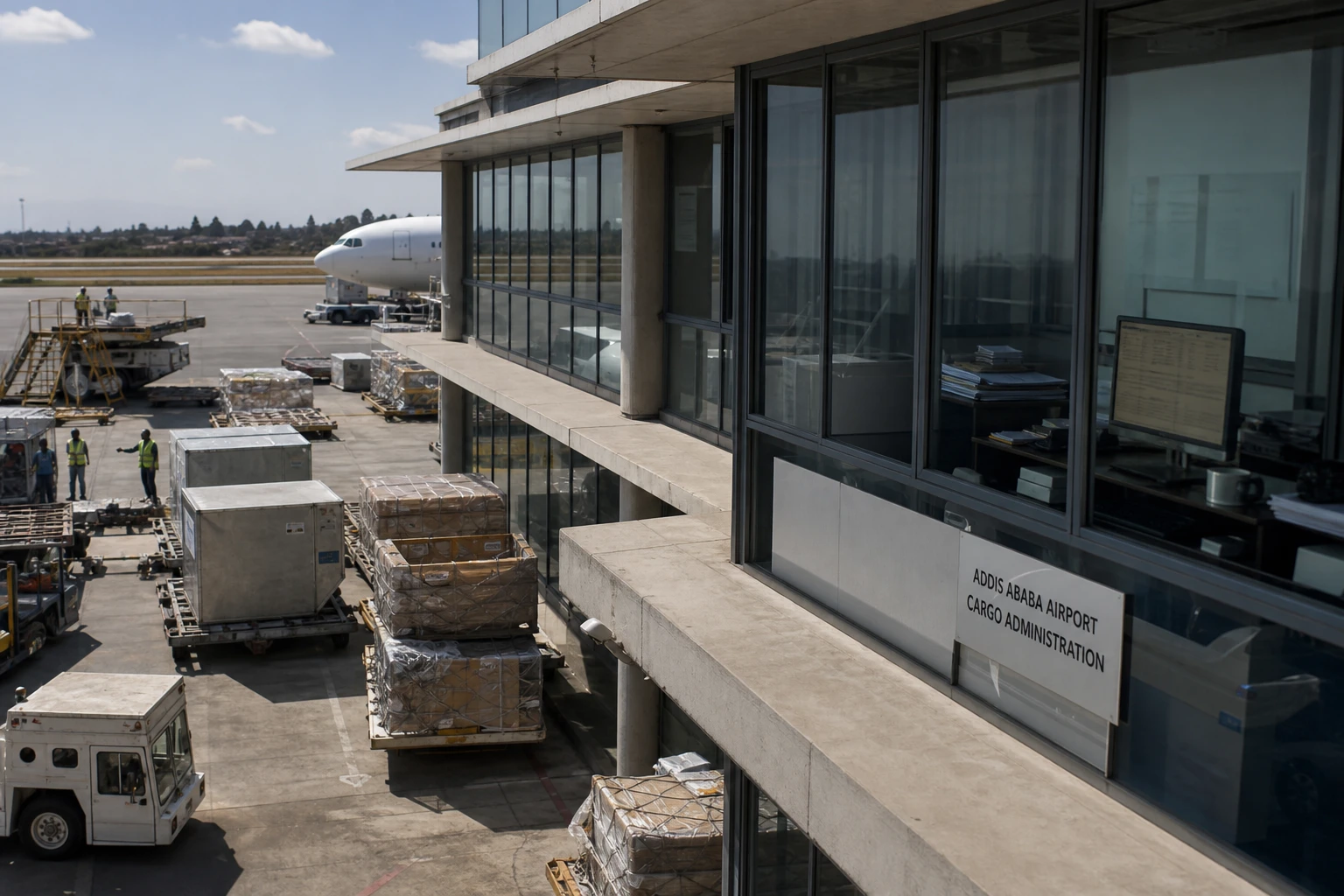
In Addis Ababa, air cargo is becoming an industrial driver in its own right. Ethiopian Airlines has secured a new tranche of investment to strengthen its role as a gateway between Africa, Asia, Europe and the Middle East.
A firm order, with room to go further
On 30 September 2026, Ethiopian Airlines signed an agreement with Boeing for ten freighters. The order comprises eight next-generation 777-8Fs and two 777Fs currently in production.
The two 777Fs are due for delivery in 2027 and 2028. The eight 777-8Fs are expected between 2033 and 2035. The Ethiopian airline also holds purchase rights for eight additional 777-8Fs. These aircraft do not yet constitute a firm order.
At list prices, the ten aircraft are worth about $5 billion. The actual amount negotiated between Ethiopian Airlines and Boeing has not been disclosed. The distinction matters, as list prices often differ from the amounts paid by carriers.
The airline’s chief executive, Mesfin Tasew, described the agreement as a way to increase available capacity and support the expansion of Ethiopian Airlines’ global logistics network. The Ethiopian company thus becomes the first African airline to order the 777-8F.
Cargo at the heart of Ethiopia’s strategy
Ethiopian Airlines already operates a substantial cargo business. Its fleet includes 12 Boeing 777Fs, three Boeing 767s and four Boeing 737s converted to carry freight on medium-haul routes.
The airline has more than 140 aircraft in total. This gives it the ability to connect its Addis Ababa hub with several African and intercontinental markets. A hub is a platform where flights are organised to facilitate connections between different destinations.
The choice of two 777Fs in the short term addresses an immediate need. These aircraft are expected to increase cargo capacity before the arrival of the next-generation planes. The eight 777-8Fs, in turn, are intended to support the airline’s long-term planning.
This combination gives Ethiopian Airlines greater flexibility. It allows the carrier to quickly strengthen existing rotations while preparing for the gradual renewal of an ageing cargo fleet. It also limits the risk of relying on a single industrial timetable.
A global market in flux
The order comes as Boeing prepares to transition from the 777F to the 777-8F. The former is based on a proven generation of aircraft. The latter belongs to the 777X family, designed to offer greater capacity and improved operational efficiency.
The timetable nevertheless remains a key point of concern. The 777X programme has faced certification and delivery delays. Ethiopian Airlines will therefore have to wait several years before receiving most of the aircraft it has ordered.
This timeline also gives Airbus more time to establish itself in the long-haul cargo market. The European manufacturer made the first flight of its A350F on 29 September 2026, the day before the Ethiopian announcement.
Rivalry between the two manufacturers is not limited to technical performance. It also concerns their ability to deliver aircraft on time, control costs and meet the aviation sector’s new environmental requirements.
For Ethiopian Airlines, the challenge is to modernise its fleet without halting the growth of its network. For Boeing, the agreement provides significant commercial support for a programme that is still ramping up.
Addis Ababa, gateway for regional trade
The airline’s strategy reflects Ethiopia’s particular position in East Africa. Addis Ababa is home to the African Union headquarters and is one of the continent’s main air connectivity points.
The country is also a member of the Intergovernmental Authority on Development, or IGAD. This regional organisation brings together several states in the Horn of Africa and works, in particular, on economic cooperation, infrastructure and connectivity.
Air transport plays an essential role in the region. Overland distances are long. Rail networks remain unevenly developed. Air freight can therefore deliver pharmaceuticals, industrial parts, high-value agricultural products and urgent goods quickly.
Ethiopian Airlines’ growth does not, however, benefit all players in the same way. Exporters with a well-structured supply chain can access international markets more easily. Small businesses and informal-economy operators continue to face greater challenges from transport costs, customs formalities and storage constraints.
The airline will also have to turn its aviation strength into broader benefits for the Ethiopian economy. This will require maintenance services, training, cargo handling, specialised warehouses and partnerships with local producers.
An airport project that changes the scale
The investment in freighters accompanies another major project. Ethiopian Airlines is helping to finance a new airport at Bishoftu, about 40 kilometres south-east of Addis Ababa.
The project’s announced cost is $12.5 billion. Ethiopian authorities want it to become Africa’s largest airport. The first phase is due to enter service in 2030.
If the timetable is met, the infrastructure could strengthen Ethiopia’s capacity for connecting flights. It would also provide more space for cargo terminals, maintenance operations and logistics services.
The project nevertheless raises practical questions. It will need to be efficiently connected to production zones and road networks. It will also have to ensure operational continuity during the transition from existing facilities to the new airport.
Expansion that calls for close monitoring
Ethiopian Airlines had already announced the acquisition of six Boeing 787-9s to support its development on long-haul routes. The company is therefore pursuing a simultaneous strategy in passenger transport and logistics.
The success of this course will depend on several factors. Global cargo demand will have to remain sufficiently strong. Deliveries of the 777-8F will need to follow the announced timetable. Finally, the new airport will have to be financed and built without unbalancing the airline’s accounts or excessively increasing costs for users.
The next milestone will be the entry into service of the two 777Fs, scheduled for 2027 and 2028. These deliveries will show whether Ethiopian Airlines can rapidly increase capacity before the shift to the new generation of freighters.



