Algeria
 Egypt
 Libya
 Morocco
 Sudan
 Tunisia
 Benin
 Burkina Faso
 Cabo Verde
 Côte d'Ivoire
 Ghana
 Guinea
 Guinea-Bissau
 Liberia
 Mali
 Mauritania
 Niger
 Nigeria
 Senegal
 Sierra Leone
 The Gambia
 Togo
 Central African Republic
 Chad
 DR Congo
 Equatorial Guinea
 Gabon
 Republic of the Congo
 São Tomé and Príncipe
 Burundi
 Comoros
 Djibouti
 Eritrea
 Ethiopia
 Kenya
 Madagascar
 Malawi
 Mauritius
 Mozambique
 Rwanda
 Seychelles
 Somalia
 South Sudan
 Tanzania
 Uganda
 Angola
 Botswana
 Eswatini
 Lesotho
 Namibia
 South Africa
 Zambia
 Zimbabwe
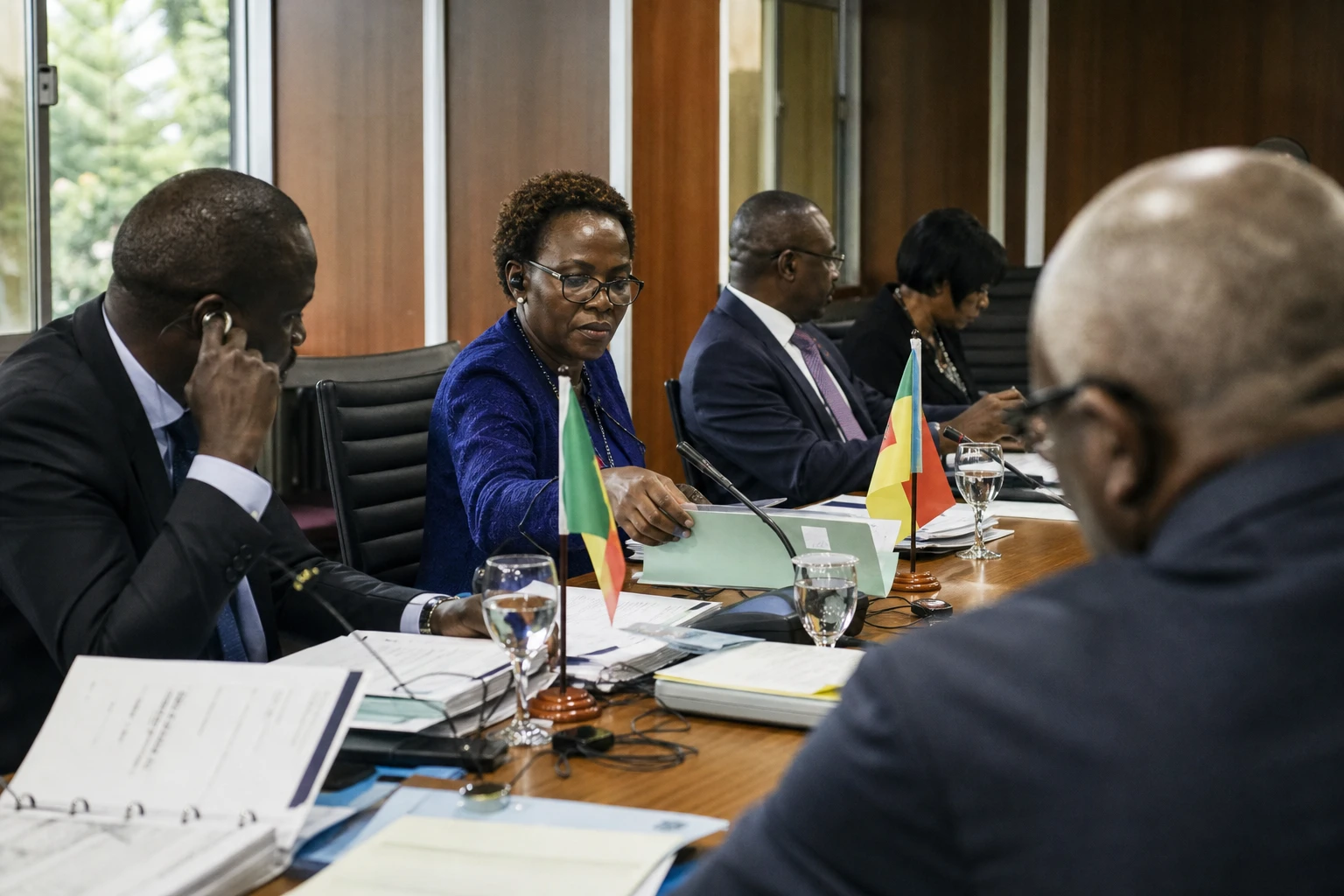
In Cameroon, public money remains spread across several banking channels. This makes it harder to assess the state’s cash position. The Ministry of Finance therefore wants to update its mapping of accounts held by government departments with commercial banks.
The exercise comes at an important time. The Cameroonian government identified nearly 450 billion CFA francs in public deposits in an earlier survey. Four years later, Yaoundé is seeking to establish what has been repatriated, what remains in banks and what is still held in active accounts.
A national reform within the CEMAC framework
The project goes beyond accounting arrangements. It is part of the reform of the Treasury Single Account, a system intended to bring public cash management together under a central account held at the Bank of Central African States, or BEAC.
The reform stems from CEMAC’s harmonised framework for public financial management. CEMAC is the Economic and Monetary Community of Central Africa. The reform therefore concerns Cameroon as well as other member states seeking to better co-ordinate their fiscal and monetary policies.
In Cameroon, the principle is set out in the state’s financial regime. Public revenue must be collected and managed by public accountants, then held in the Treasury Single Account. In practice, several public institutions, local authorities and state bodies still have accounts with commercial banks.
The Ministry of Finance presents the Treasury Single Account as a tool for visibility. It is intended to show what liquidity is available, limit idle funds and improve payment planning.
A new snapshot of public assets
Finance Minister Louis Paul Motaze chaired a workshop on Tuesday 29 September devoted to an inventory of public administrations’ accounts at commercial banks. Representatives of the banking and financial sector took part in the discussions.
The work is intended to answer three concrete questions: which entities hold these accounts, at which institutions are they held, and what amounts are kept in them? The answers should give the Treasury an updated basis for tracking centralisation operations.
The previous survey identified nearly 450 billion CFA francs in public deposits at commercial banks. This amount does not necessarily represent all the state’s resources. It covers assets identified at banking institutions during that exercise.
The Ministry of Finance also recorded 2,890 bank accounts linked to public entities. The repatriation of these resources was due to take place gradually between 1 January 2023 and 31 December 2025.
The timetable was intended to avoid a sudden transfer of liquidity. Commercial banks use some of the deposits they collect to finance the economy, notably through loans to businesses and households.
Centralisation advances amid budget discipline and banking stability
The inventory is therefore not simply an administrative exercise. It is intended to measure the gap between the planned reform and its actual implementation. An identified account is not necessarily closed. Similarly, resources officially earmarked for repatriation may still remain temporarily in a commercial bank.
For the state, centralisation first offers a more complete picture of its available funds. It can reduce reliance on short-term financing when public liquidity already exists across several dispersed accounts.
It can also lower some costs. Having multiple accounts entails fees for account maintenance, reconciling entries and administrative oversight. By consolidating flows, the Treasury hopes to improve the quality of budget data and speed up payments.
For banks, the stakes are different. Public deposits are a source of liquidity. Transferring them to the Treasury account at BEAC may change the resources available in Cameroon’s banking system.
That is why repatriation was designed to take place in stages. The timetable was to take account of the volume of deposits held by each bank and its commitments in the government securities market. Implementation that is too rapid could reduce some institutions’ ability to finance economic activity.
The effects will not be the same for all actors. Central government departments should gain greater control. Local authorities and public institutions, for their part, will have to adapt their procedures. Banks will also need to improve the traceability of the accounts concerned and discuss transfer arrangements with the authorities.
What Yaoundé must now clarify
The next step will be to publish a precise statement of the accounts identified. The authorities will need to specify, in particular, the number of accounts still open, the amounts involved and the share actually transferred into the Treasury Single Account framework.
This transparency will be important in distinguishing three situations: accounts needed for the day-to-day running of government departments, accounts to be merged and resources to be transferred to the central system.
Monitoring will also need to clarify the role of decentralised local authorities and state-owned companies. These entities have their own operational constraints. Their full integration does not depend solely on a decision by the Ministry of Finance. It requires procedures compatible with their responsibilities and payment obligations.
The reform will also have to preserve the continuity of public services. Salaries, public contracts, social spending and payments to suppliers must not be slowed by a poorly sequenced banking reorganisation.
A test of financial governance in Central Africa
Beyond Cameroon, this exercise highlights a question shared by CEMAC states: how can they better understand and manage public liquidity in a shared monetary area?
Centralisation can strengthen budget discipline and planning capacity. It can also improve relations between national treasuries and BEAC. Its effectiveness, however, will depend on reliable data, compliance with deadlines and co-ordination with banks.
In Yaoundé, the new survey will therefore provide a benchmark. It will make it possible to measure the results achieved since the identification of the 2,890 accounts and the launch of the repatriation timetable. The most anticipated figure will not simply be the number of accounts found. It will be the amount of resources actually centralised.