Algeria
 Egypt
 Libya
 Morocco
 Sudan
 Tunisia
 Burkina Faso
 Cabo Verde
 Côte d'Ivoire
 Ghana
 Guinea
 Guinea-Bissau
 Liberia
 Mali
 Mauritania
 Niger
 Nigeria
 Senegal
 Sierra Leone
 The Gambia
 Togo
 Cameroon
 Central African Republic
 Chad
 DR Congo
 Equatorial Guinea
 Gabon
 Republic of the Congo
 São Tomé and Príncipe
 Burundi
 Comoros
 Djibouti
 Eritrea
 Ethiopia
 Kenya
 Madagascar
 Malawi
 Mauritius
 Mozambique
 Rwanda
 Seychelles
 Somalia
 South Sudan
 Tanzania
 Uganda
 Angola
 Botswana
 Eswatini
 Lesotho
 Namibia
 South Africa
 Zambia
 Zimbabwe
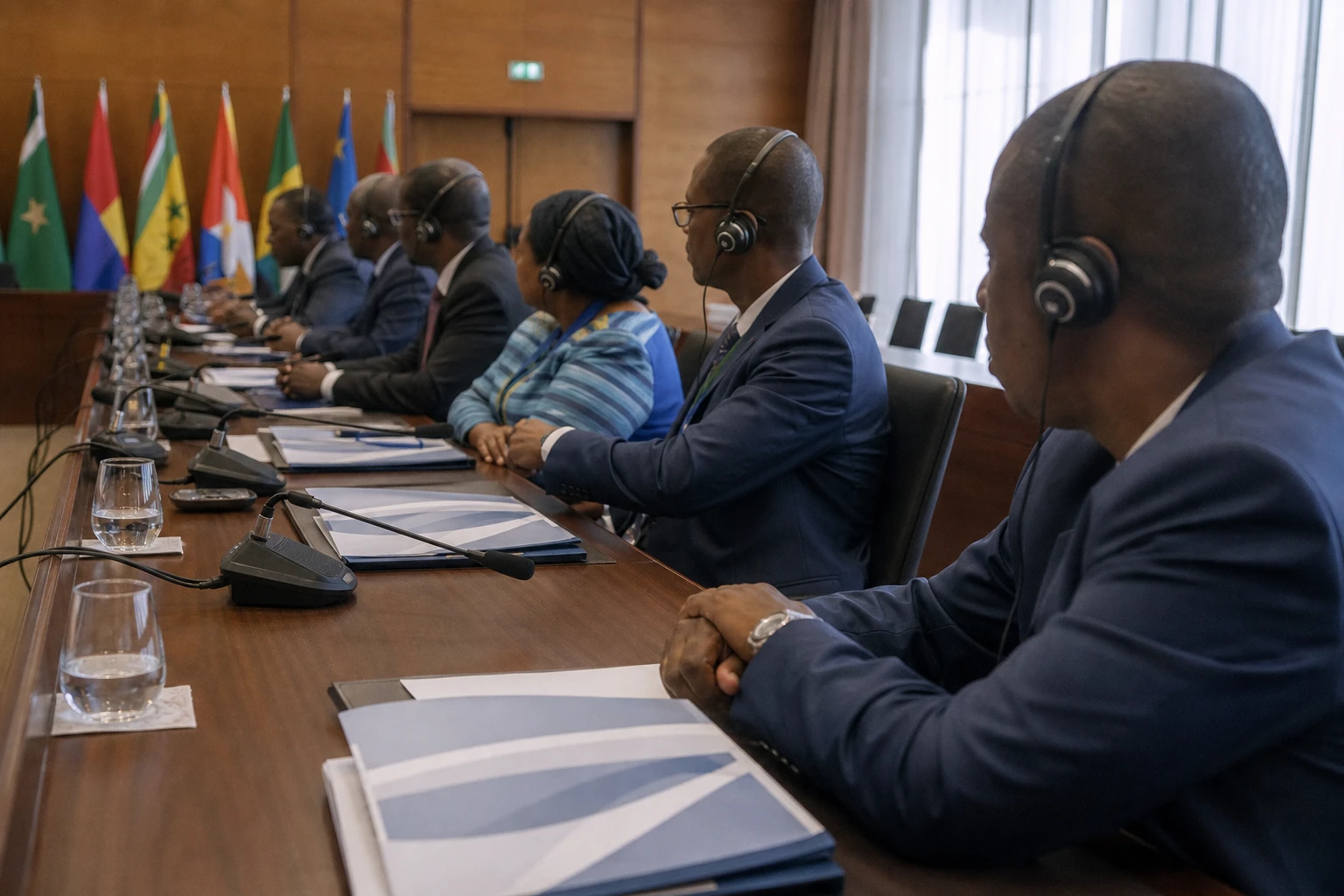
In Benin, artificial intelligence is gradually moving beyond the circle of experts and into classrooms, government offices and development strategies. The country now wants to turn its progress in digital governance and training into industrial capacity, as technological competition intensifies in West Africa.
A position built over time
This ambition is part of a transformation launched in 2016. Under President Patrice Talon, the Beninese authorities accelerated the digitisation of government and the modernisation of public services. Romuald Wadagni, sworn in as president in May 2026, intends to continue this trajectory by giving greater weight to infrastructure, skills and innovation.
The issue extends beyond the national level. Benin belongs to the Economic Community of West African States (ECOWAS), which is seeking to strengthen regional integration, and the West African Economic and Monetary Union (WAEMU), which is responsible, among other things, for coordinating the economic policies of its member states. In this region, data, digital services and artificial intelligence skills are becoming factors in competitiveness.
The first Africa AI Governance Index, published in 2026 by Lawyers Hub’s Africa AI Policy Lab, ranks Benin third on the continent. The index assesses all 54 African states against eight pillars and 80 indicators. A Beninese specialist media outlet reports a score of 2.58 out of 4, behind Rwanda and Nigeria. The result measures a governance framework. It does not yet mean that Benin leads the continent in AI model production or private investment.
This distinction is essential. Public policy can be well structured without immediately producing companies capable of competing with major global groups. The real challenge, therefore, is to move from strategy to use, and then from use to value creation.
Institutions and training to support the ecosystem
Benin has a National Artificial Intelligence and Big Data Strategy, known by the acronym SNIAM 2023-2027. It aims to regulate the use of data and develop applications tailored to the country’s needs. The framework is supported by the Digital Code and personal data protection mechanisms.
The Agency for Information Systems and Digital Technology plays a central role in the digital transformation of the state. This structure helps limit the fragmentation of projects across ministries. It also facilitates interoperability, meaning the ability of several government bodies to exchange information in compatible formats.
Training is the other pillar of the programme. At Sèmè City, the Sèmè City Institute of Technology and Innovation offers a Bachelor’s degree in digitalisation and data science. The programme covers data analysis, artificial intelligence, programming, digital project management and data governance. The institution says it has trained more than 1,900 students in computing, design, AI and data science.
This policy is also beginning to reach secondary schools. In June 2026, Benin held its first National Artificial Intelligence Olympiad. Twenty young people were recognised, including four girls. Eight candidates subsequently joined preparations for the national delegation to the international competition.
In Astana, Kazakhstan, from 2 to 8 August 2026, Emmanuel Christiano Guidimadjegbe, a student from Porto-Novo, won a bronze medal at the International Olympiad in Artificial Intelligence. Raphaël Nguebou received an honourable mention. The Beninese delegation ranked third in Africa among 106 participating countries, according to the Government of Benin and the Benin Radio and Television Corporation.
The difficult transition from governance to industry
The continental ranking and the students’ performance have given Benin new visibility. They do not, however, resolve structural challenges. The country still needs to expand access to good-quality internet, strengthen research laboratories and retain engineers trained on its territory.
Data will be just as decisive. Artificial intelligence that is useful in agriculture, healthcare or public services requires reliable data, regularly updated and representative of local realities. It must also protect citizens from automated errors, discrimination and the misuse of their personal information.
Language is another challenge. The major models available on the market understand some international languages better than African languages. Tools capable of processing Fon or other national languages could make it easier to access administrative procedures and information services. But their development requires language corpora, researchers and lasting partnerships. Claims that models are operational at scale must therefore be distinguished from public policy objectives.
Applications will also be judged by their tangible effects. In urban areas, AI can improve administrative management, transport analysis or access to financial services. In rural areas, its usefulness will depend more on network coverage, the cost of equipment and the availability of simple voice interfaces. A national strategy will produce equitable results only if it takes these disparities into account.
A test for West Africa
Benin is therefore seeking to build a model based on three elements: a digitised administration, a data protection framework and a training policy. This combination could allow it to position itself as a regional laboratory, particularly for digital public services and applications adapted to West African realities.
Competition will remain strong. Rwanda, Nigeria, Kenya and South Africa also have active ecosystems, larger markets or significant research capacity. Regional complementarity may therefore matter more than competition in isolation. Beninese companies would be well advised to target the ECOWAS and African Continental Free Trade Area markets, rather than a single national market.
The next step will be to demonstrate results. This will require solutions that are genuinely used, skilled jobs, African research partnerships and public procurement open to local companies. Benin has secured a place in the continental debate on AI governance. It still has to show that this institutional lead can become lasting technological capacity, accessible to Beninese people and useful to the region.