Algeria
 Egypt
 Libya
 Morocco
 Sudan
 Tunisia
 Benin
 Burkina Faso
 Cabo Verde
 Côte d'Ivoire
 Ghana
 Guinea
 Guinea-Bissau
 Liberia
 Mali
 Mauritania
 Niger
 Senegal
 Sierra Leone
 The Gambia
 Togo
 Cameroon
 Central African Republic
 Chad
 DR Congo
 Equatorial Guinea
 Gabon
 Republic of the Congo
 São Tomé and Príncipe
 Burundi
 Comoros
 Djibouti
 Eritrea
 Ethiopia
 Kenya
 Madagascar
 Malawi
 Mauritius
 Mozambique
 Rwanda
 Seychelles
 Somalia
 South Sudan
 Tanzania
 Uganda
 Angola
 Botswana
 Eswatini
 Lesotho
 Namibia
 South Africa
 Zambia
 Zimbabwe
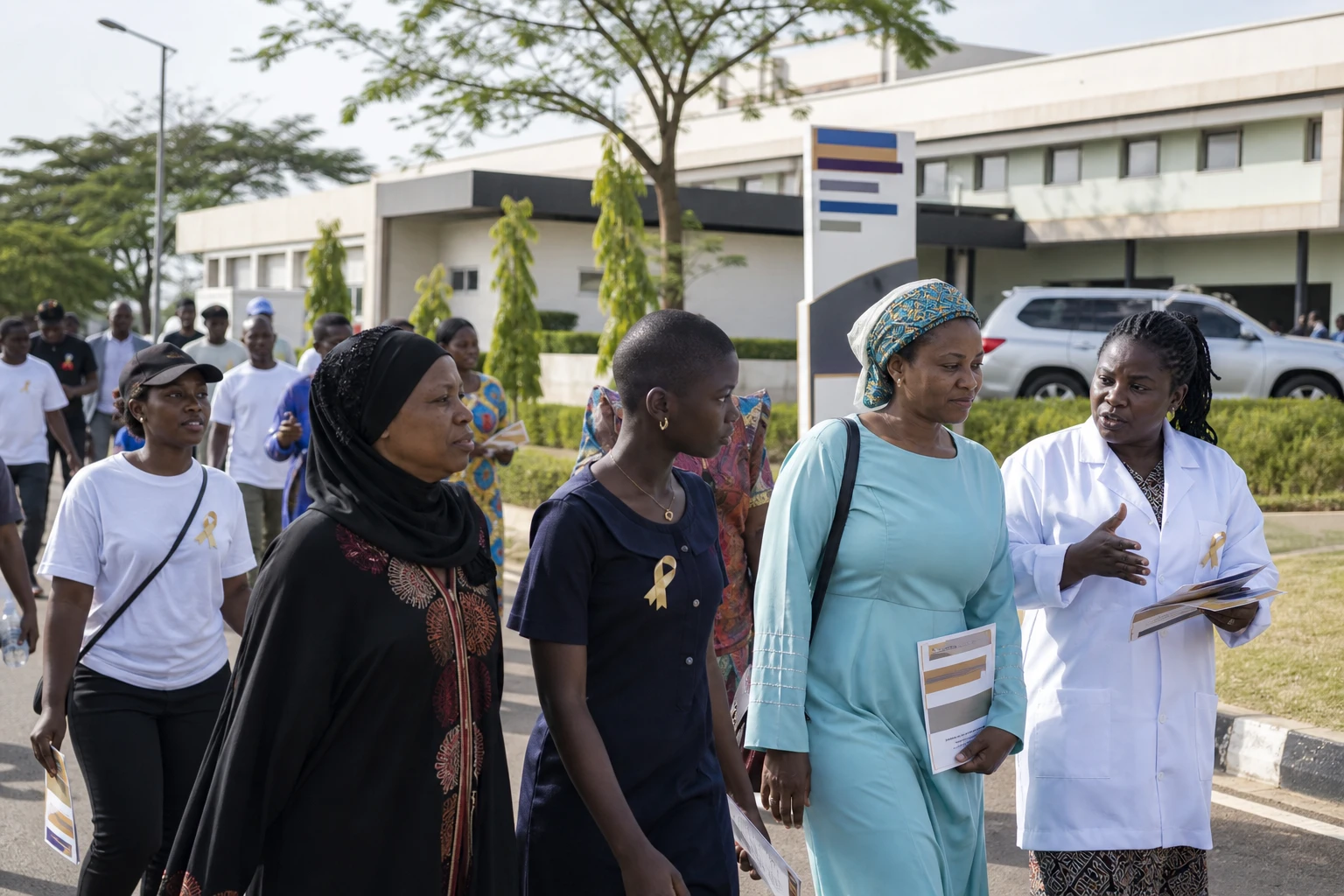
In Abuja, childhood cancer is not only fought in oncology departments. It also depends on a family’s ability to recognise a symptom, reach a hospital and continue treatment that is often lengthy and costly. That was the message of a sensitisation march organised in the Nigerian capital by the Okapi Children Cancer Foundation.
In Abuja, survivors put a face to the campaign
Families, survivors, healthcare workers and campaigners gathered to draw attention to a disease that remains little known to the general public. The march sought to remind people that children can also be affected by leukaemia, brain tumours and other forms of cancer.
Among those taking part was Hope Tobi. Diagnosed at the age of nine, while in her fifth year of primary school, she had to interrupt her education for four years to undergo treatment in hospital.
Now in remission, she was taking part in the campaign for the fourth time with her family. Her testimony highlights a reality often absent from statistics: cancer also transforms young patients’ school lives, social relationships and mental health.
“Every step we take represents hope for children, who can see that they are not fighting alone,” she said.
The presence of survivors plays an important role. It shows that a cancer diagnosis is not automatically a death sentence. It also underlines that recovery can involve a gradual return to school, medical follow-up and psychological support.
Diagnostic delays remain a major obstacle
In Nigeria, access to care varies considerably according to where people live and their families’ resources. Children living far from major urban centres may face greater difficulties obtaining a specialist consultation, undergoing tests or accessing medicines.
The Okapi Foundation therefore conducts awareness-raising activities beyond Abuja. Its aim is to help families and communities better identify certain persistent signs, while directing them to healthcare professionals.
Dr Ikenna Igbodika believes this outreach is essential. “We go into the most remote corners to engage people and help them understand the reality of childhood cancer,” he explained.
This approach does not replace medical diagnosis. Rather, it aims to reduce delays before the first consultation. The World Health Organization says early detection, accurate diagnosis and access to appropriate treatment significantly improve survival chances.
The signs can be difficult to interpret because they sometimes resemble those of more common conditions. Persistent fatigue, unusual paleness, unexplained weight loss, ongoing pain, a lump or repeated infections should nevertheless prompt a medical consultation. Only a healthcare professional can confirm or rule out cancer.
The cost of care weighs on families
Awareness-raising is not enough if families cannot afford tests and treatment. Care may involve chemotherapy, surgery, radiotherapy, transfusions and supportive care. It also requires repeated journeys to hospitals with specialist services.
For some households, these expenses come on top of a loss of income. A parent may have to give up work temporarily to accompany the child. In rural areas, transport and accommodation near a hospital can also become major costs.
The Okapi Children Cancer Foundation says it has supported more than 200 children receiving care at public facilities in Abuja. It also says it has raised awareness among more than 5,000 people through community and school activities. These figures are from the organisation’s own account, and a significant part of its work is currently concentrated in the federal capital.
The foundation is calling for more resources to be devoted to paediatric oncology. Its founder, Oluwakemi Adekanye, emphasises knowledge of symptoms and support for families.
“It is important for adults to know the common symptoms of childhood cancer and understand how to support a child effectively,” she says.
This call echoes the difficulties identified in a national assessment of Nigeria’s cancer-control capacity. The report highlights several priorities: early diagnosis, access to treatment, equipment and the availability of specialist staff.
A national issue that extends beyond Abuja
Abuja is home to federal institutions and several referral hospitals. However, improving care cannot depend on the capital alone. Nigeria’s states need effective referral pathways so that children are identified earlier and transferred quickly to the appropriate services.
The challenge also concerns continuity of care. A child who begins treatment must be able to continue it without avoidable interruption. Medicine shortages, transport difficulties and a lack of information can all undermine this continuity.
Psychological support also deserves a lasting place. In June 2026, cancer survivors gathered in Abuja called for better access to psychosocial support and quality treatment at reduced cost. This matters for children, but also for parents, brothers and sisters.
The issue is part of a wider movement in West Africa. Nigeria, the region’s largest economy and most populous country, influences the health policies of the Economic Community of West African States, ECOWAS. Progress in its hospitals, referral systems and funding programmes can therefore inform regional discussions.
Globally, the WHO aims for at least 60% survival among children with cancer by 2030. In low- and middle-income countries, the organisation estimates that survival often remains below 30%, because of diagnostic delays, a lack of treatment and interruptions in care.
The Abuja march is therefore not a complete response. It makes a public health problem visible and confronts decision-makers with several practical priorities: informing communities, strengthening specialist services, reducing the cost of care and ensuring support after treatment.