Algeria
 Egypt
 Libya
 Morocco
 Sudan
 Tunisia
 Benin
 Burkina Faso
 Cabo Verde
 Côte d'Ivoire
 Ghana
 Guinea
 Guinea-Bissau
 Liberia
 Mali
 Mauritania
 Niger
 Nigeria
 Senegal
 Sierra Leone
 The Gambia
 Togo
 Cameroon
 Central African Republic
 Chad
 DR Congo
 Equatorial Guinea
 Gabon
 Republic of the Congo
 São Tomé and Príncipe
 Burundi
 Comoros
 Djibouti
 Eritrea
 Kenya
 Madagascar
 Malawi
 Mauritius
 Mozambique
 Rwanda
 Seychelles
 Somalia
 South Sudan
 Tanzania
 Uganda
 Angola
 Botswana
 Eswatini
 Lesotho
 Namibia
 South Africa
 Zambia
 Zimbabwe
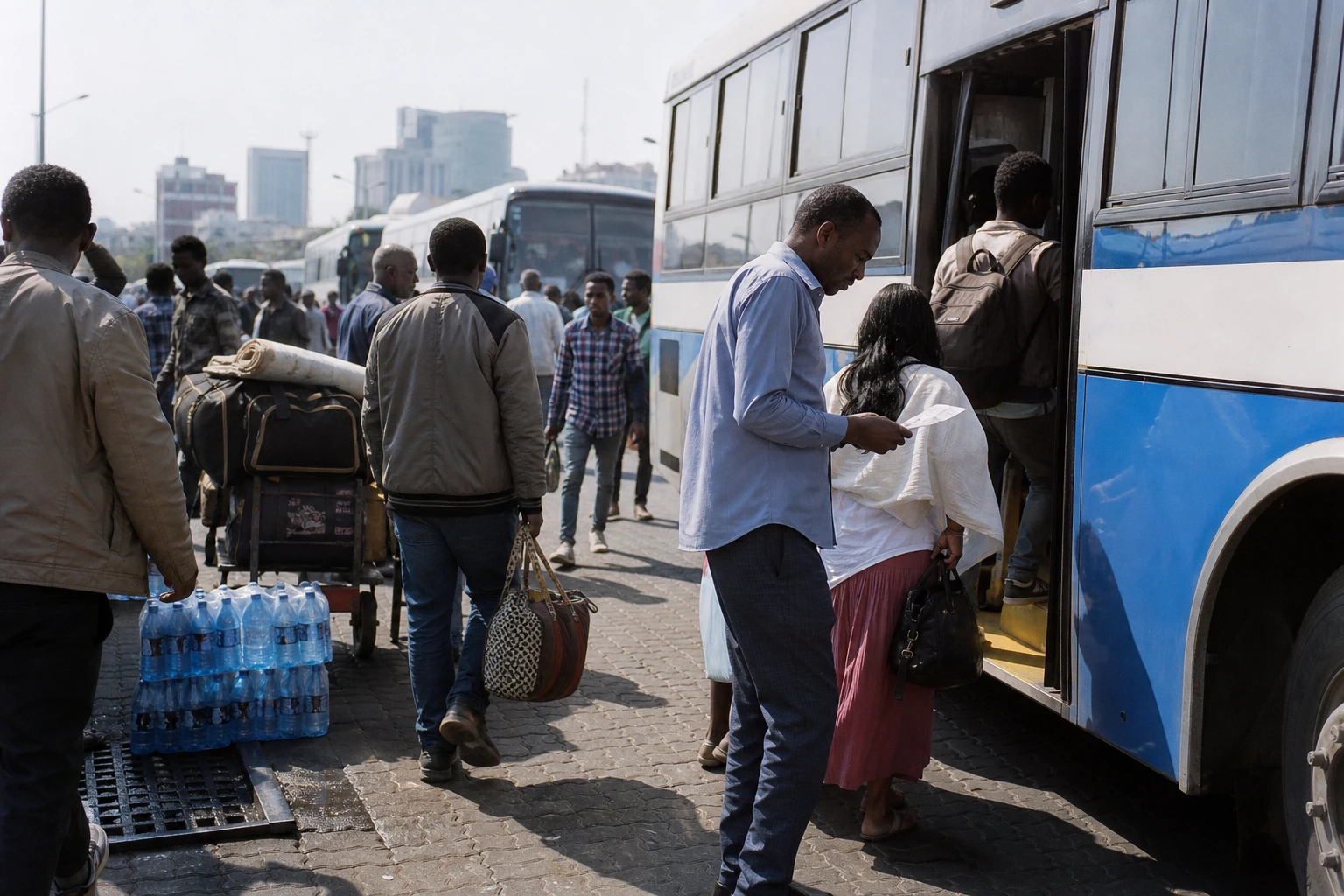
In Ethiopia, the return of fighting in the north of the country has raised fears that an already fragile balance could collapse. In Addis Ababa, the federal government presents its operation as a response to an offensive. In Tigray, regional authorities are now speaking of «total war». Between these two accounts, one certainty is emerging: the truce signed in November 2022 is no longer enough to contain tensions.
A front extending beyond Tigray
Clashes resumed on Tuesday 22 September 2026 along several fronts in northern Ethiopia. They involve Tigray, Amhara and Afar in particular, three neighbouring regions whose borders and disputed territories were at the heart of the previous war.
Tigray is the region governed by the Tigray People’s Liberation Front, or TPLF. Amhara, meanwhile, is marked by the presence of the Fano, nationalist militias that have opposed federal rule since 2023. Afar occupies a strategic area between northern Ethiopia, Djibouti and the Red Sea.
This geographical expansion changes the nature of the crisis. It is no longer simply a confrontation between Addis Ababa and Mekele, the regional capital of Tigray. The fighting now involves several armed forces, shifting alliances and areas vital to trade routes.
Tigrayan officials say their forces have retaken control of several airports in the region, including Mekele airport. These reports have been carried by several media outlets, but their exact military significance remains difficult to establish amid limited communications.
Army announces toll that remains impossible to verify
On 24 September, Ethiopia’s federal army said it had killed 272 rebel fighters and wounded 260 others in 48 hours. It said the losses were inflicted during a counter-offensive in the Amhara region, particularly in the North Wollo zone.
The figures come solely from the federal military’s communications. They have been carried by several international agencies and media outlets, but no independent mission has been able to confirm separately the number of people killed or wounded. They should therefore be treated as a toll claimed by one of the parties.
Tigrayan forces, for their part, dispute the government’s account. They accuse the federal army of launching a ground offensive backed by drones, artillery and mechanised units. The government, by contrast, maintains that Tigrayan armed groups attacked first.
Local reports have also described strikes around Alamata and Raya, in southern Tigray. The mayor of Alamata cited 14 dead and 22 wounded. This toll has not yet received sufficient independent confirmation and should remain attributed to the local authority.
Pretoria peace deal shows its limits
The current crisis revives memories of the Tigray war, which pitted federal forces and their allies against the TPLF from November 2020 to November 2022. The conflict ended with the Pretoria agreement, concluded under the mediation of the African Union.
The agreement provided for a cessation of hostilities, the gradual disarmament of Tigrayan forces and the return of the federal administration to the region. It also paved the way for the resumption of humanitarian aid and the TPLF’s political reintegration.
But several issues remain unresolved. The status of the disputed territories between Tigray and Amhara remains explosive. The disarmament of fighters has not been fully completed. The return of displaced people also remains a sensitive issue.
These issues are compounded by tensions between the TPLF and the federal government over regional autonomy, reconstruction and the role of Tigrayan forces in the security apparatus. The crisis is therefore part of a broader disagreement over how Ethiopia’s ethnic federal system should work.
Military alliance widens the risk
The TPLF is not isolated. Tigrayan fighters are said to have co-ordinated some operations with the Fano, despite the groups having opposed each other during the 2020–2022 war. Their co-operation illustrates the shifting nature of Ethiopian alliances.
Their rapprochement appears to be based less on a shared political project than on a common adversary: the government of Prime Minister Abiy Ahmed. An alliance of convenience can nevertheless have lasting effects. It risks multiplying fronts and complicating any negotiations.
This development comes days after the announcement of a coalition bringing together several armed and political opposition movements. According to the Associated Press, the alliance includes the TPLF, the Fano and the Oromo Liberation Army, as well as other groups active in several regions of the country.
For the federal government, this convergence confirms the existence of a co-ordinated national threat. For its opponents, it reflects rejection of what they see as excessive centralisation. Both interpretations can coexist, without either being sufficient on its own to explain the reality on the ground.
Immediate consequences for the population
The priority is now to protect civilians. The renewed clashes threaten travel between Tigray, Amhara and Afar. They could also disrupt markets, transport and the delivery of aid.
Rural areas are particularly exposed. They have fewer hospitals, passable roads and means of communication. In cities, residents are most concerned about flight cancellations, movement restrictions and rising prices.
The crisis is also weighing on the national economy. Northern Ethiopia relies heavily on regional trade, agriculture and corridors linking the country’s interior to the port of Djibouti. Any prolonged disruption could affect household incomes, imports and commercial activity in Addis Ababa.
The humanitarian situation is all the more concerning because Tigray is only just emerging from a devastating war. Renewed fighting could interrupt reconstruction programmes, slow the return of displaced people and make access to healthcare more difficult.
Implications for the Horn of Africa
The crisis extends beyond Ethiopia’s borders. Ethiopia plays a central role in the Horn of Africa and in the Intergovernmental Authority on Development, IGAD. Another war could affect Sudan, already ravaged by conflict, as well as Djibouti and Eritrea.
It could also undermine trade corridors to the Red Sea. The African Union and the European Union have called for immediate de-escalation. The African Union is directly concerned: its Pretoria agreement is the main available framework for peace.
The coming days will be decisive. The changing military positions around Amhara, Tigray and Afar will need to be verified. Contacts between Addis Ababa, Tigrayan leaders and other armed groups will also need to be monitored.
The main risk is not simply a return to the Tigray war. It is the transformation of regional tensions into a co-ordinated national conflict. For Ethiopia, the question now is whether the 2022 agreement can be revived or whether the country is entering a new phase of confrontation.