Algeria
 Egypt
 Libya
 Morocco
 Sudan
 Tunisia
 Benin
 Burkina Faso
 Cabo Verde
 Côte d'Ivoire
 Ghana
 Guinea
 Guinea-Bissau
 Liberia
 Mali
 Mauritania
 Niger
 Senegal
 Sierra Leone
 The Gambia
 Togo
 Cameroon
 Central African Republic
 Chad
 DR Congo
 Equatorial Guinea
 Gabon
 Republic of the Congo
 São Tomé and Príncipe
 Burundi
 Comoros
 Djibouti
 Eritrea
 Ethiopia
 Kenya
 Madagascar
 Malawi
 Mauritius
 Mozambique
 Rwanda
 Seychelles
 Somalia
 South Sudan
 Tanzania
 Uganda
 Angola
 Botswana
 Eswatini
 Lesotho
 Namibia
 South Africa
 Zambia
 Zimbabwe
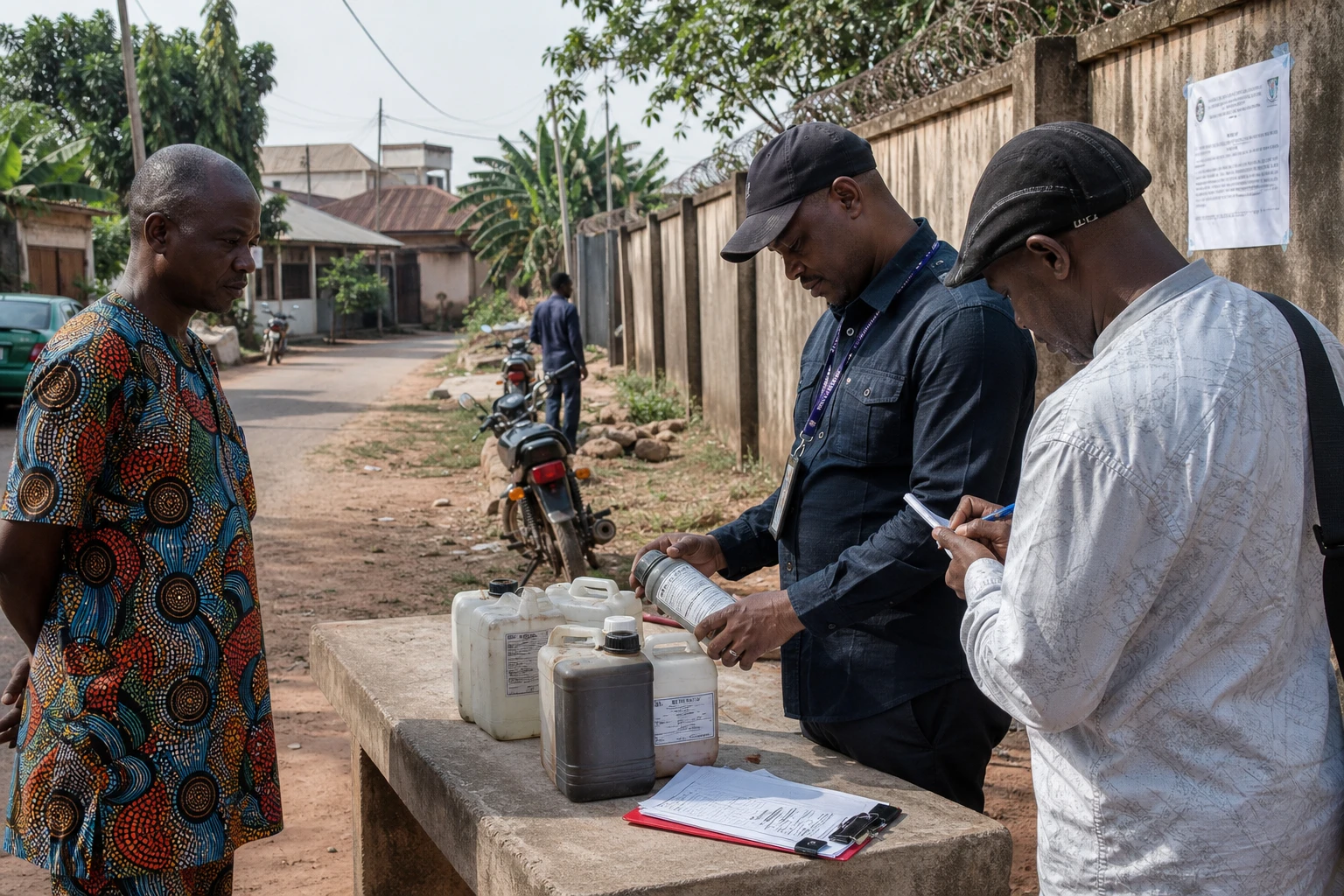
In south-eastern Nigeria, the discovery of a clandestine laboratory is a reminder that synthetic drug trafficking is no longer limited to transit. Nigerian investigators now suspect networks capable of establishing local production facilities, with international links.
Operation in Enugu State
The National Drug Law Enforcement Agency (NDLEA), Nigeria’s federal agency responsible for tackling narcotics, announced on Thursday 24 September 2026 that it had dismantled a methamphetamine laboratory in the community of Eziama, in Obeagu, in Awgu local government area, Enugu State.
Two Nigerians were arrested: Chukwu Obumneme Christopher, aged 45, and Chukwu Georginus Monday, aged 60. The NDLEA describes them as the alleged principal operators of the site. That status will, however, have to be established by the courts.
According to the agency, the two men worked with Rodriguez Villanueva, described as a Mexican national linked to a cartel based in Mexico City. He is still being sought. Two other people named in the proceedings are also said to be at large.
The search led to the seizure of large quantities of chemicals used in the manufacture of methamphetamine. The NDLEA cited, in particular, 690 litres of methylamine, 1,000 litres of isopropyl alcohol, 300 litres of hydrochloric acid, as well as several hundred litres of toluene, acetone and liquid caustic soda.
Investigators also found rudimentary reaction and distillation equipment. According to the NDLEA, the facility was capable of producing methamphetamine on a commercial scale. The presence of chemical precursors does not, on its own, prove how much was actually manufactured. It does, however, confirm the structured nature of the facility described by the authorities.
The two suspects appeared before the Federal High Court sitting in Enugu. They face five charges, including conspiracy, the alleged management and financing of a drug-trafficking organisation, and unlawful possession of controlled chemicals. The next hearing is scheduled for 21 October 2026.
A network extending beyond Nigeria’s borders
The case is part of a series of operations conducted by the NDLEA against clandestine laboratories. The agency says it has found comparable facilities in Ogun, Oyo and Ebonyi states. It describes this as a shift in the market: Nigeria is no longer being used only as a transit point, but also as a possible site for processing and production.
In May 2026, another operation in a forested area of Ogun State led to the closure of a laboratory described as industrial in scale. The NDLEA then announced the arrest of Nigerian and Mexican suspects, as well as the seizure of chemicals and methamphetamine that the agency estimated to be worth several hundred billion naira. Nigerian media and the Associated Press reported the operation, while noting that the allegations remained subject to judicial proceedings.
The similarities between the two cases do not yet establish that they involve a single organisation. They do, however, show that Nigerian investigators are monitoring links between local operators and foreign technicians or intermediaries. In cases of this kind, chemicals, equipment, financial routes and communications are generally more significant than the suspects’ nationality alone.
Methamphetamine is a synthetic drug made from chemical precursors. Its clandestine production poses a twofold risk. It fuels consumption and trafficking, while also exposing local residents to toxic substances, fires and contamination of soil or water.
Nigeria faces regional pressure
The discovery comes in a country already confronted with trafficking routes linking West Africa, Central Africa, Asia, Latin America and Europe. Ports, major roads and land borders give criminal networks several ways to move chemicals, drugs or money.
Nigeria occupies a central position in the Economic Community of West African States (ECOWAS). The organisation brings together countries in the region and facilitates co-operation on security, movement and cross-border crime. Traffickers, however, often exploit differences between national laws, enforcement resources and judicial capacity.
For Abuja, the challenge therefore goes beyond the arrest of two suspects in Enugu. It is a matter of preventing laboratories from taking root in areas far from major urban centres, where monitoring is more difficult. Enugu State, like several regions in the south-east, has significant road and commercial links with other economic centres in the country.
The consequences are not the same for everyone. Federal authorities are seeking to contain a transnational criminal threat. Communities near clandestine sites may face health and environmental risks from the substances being handled. Transport operators, landowners and chemical companies must also strengthen their checks to prevent their services from being used without their knowledge or with the complicity of intermediaries.
A battle that will also take time
The NDLEA will now have to establish the precise role of each defendant, trace financial flows and determine the intended destination of the production. The courts will also have to verify the agency’s claims about the link to the Mexican national.
Co-operation with customs services, port authorities and foreign agencies will be crucial. It will need to cover not only arrests but also the monitoring of chemical precursors, import controls and information-sharing.
At the West African level, the case also highlights a trend already noted in several reports on illicit markets: networks are seeking to diversify their routes and production sites. Nigeria will therefore need to avoid a response limited to raids. The next stage of the case, including the hearing on 21 October 2026 and any arrests of fugitives, will help gauge the true scale of the alleged organisation.