Algeria
 Egypt
 Libya
 Morocco
 Sudan
 Tunisia
 Benin
 Burkina Faso
 Cabo Verde
 Côte d'Ivoire
 Ghana
 Guinea
 Guinea-Bissau
 Liberia
 Mali
 Mauritania
 Niger
 Nigeria
 Senegal
 Sierra Leone
 The Gambia
 Togo
 Cameroon
 Central African Republic
 Chad
 DR Congo
 Equatorial Guinea
 Gabon
 Republic of the Congo
 São Tomé and Príncipe
 Burundi
 Comoros
 Djibouti
 Eritrea
 Ethiopia
 Kenya
 Madagascar
 Malawi
 Mauritius
 Mozambique
 Seychelles
 Somalia
 South Sudan
 Tanzania
 Uganda
 Angola
 Botswana
 Eswatini
 Lesotho
 Namibia
 South Africa
 Zambia
 Zimbabwe
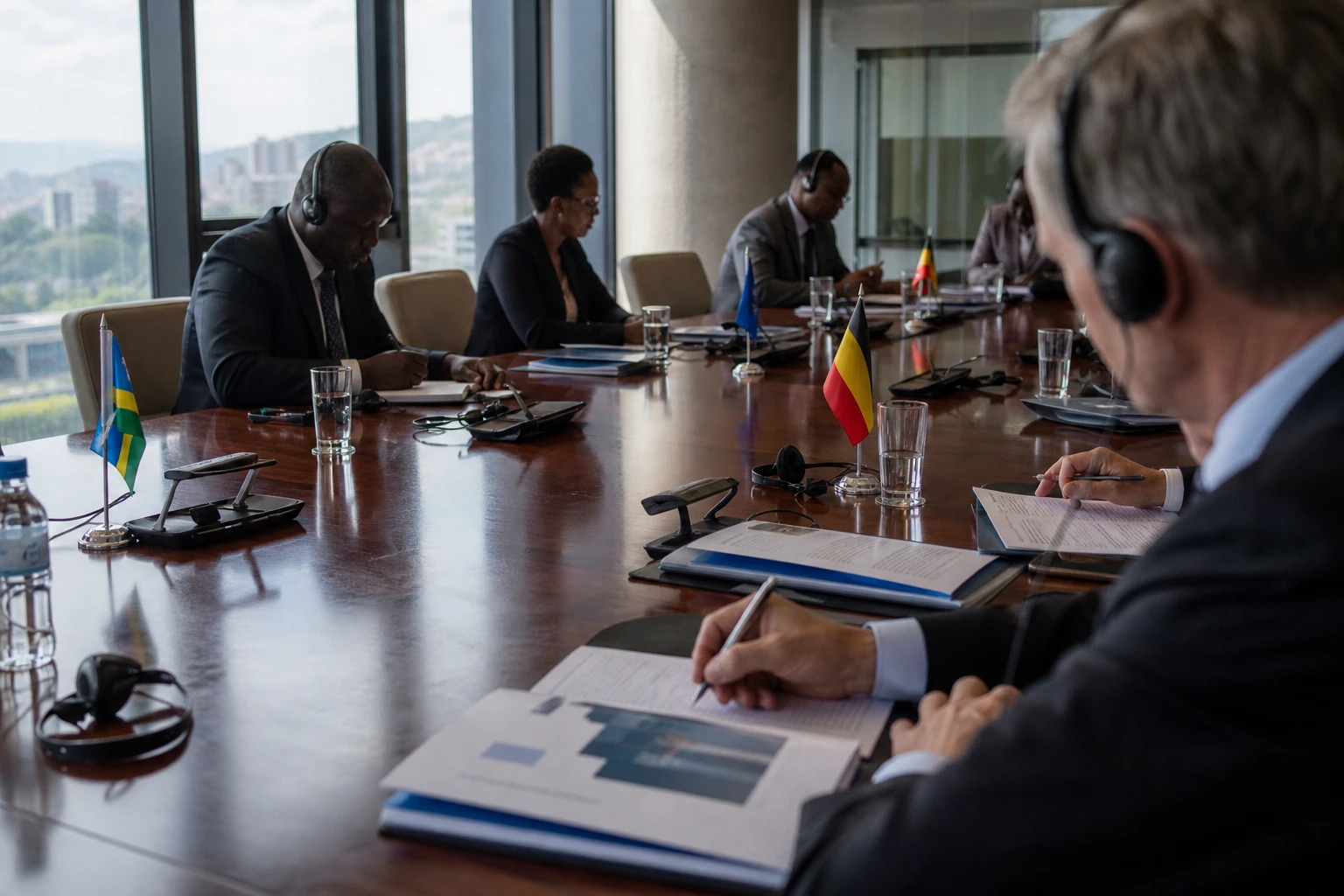
In Kigali and Brussels alike, the resumption of dialogue does not mean disagreements have disappeared. Rather, it marks the return of a direct diplomatic channel after 18 months of tensions linked in particular to the war in the east of the Democratic Republic of the Congo (DRC).
Rwanda and Belgium announced the restoration of diplomatic relations on 22 September 2026. The decision was taken on the sidelines of the United Nations General Assembly in New York by the foreign ministers, Olivier Nduhungirehe and Maxime Prévot. It provides for the two countries’ embassies to reopen soon. The joint Rwandan and Belgian declaration sets out the arrangements for resuming relations.
A gradual return, without erasing differences
Initially, each embassy will be headed by a chargé d’affaires ad interim. A diplomat or consul, together with a small technical team, will support this transitional phase. The two governments will then have to put forward ambassadors-designate.
The future Rwandan ambassador to Belgium is also expected to be accredited to the European Union. This choice would give Kigali a diplomatic interlocutor covering both bilateral relations with Brussels and some of its dealings with European institutions.
The rupture began on 17 March 2025. On that day, Rwanda announced the immediate end of its diplomatic relations with Belgium. The Belgian embassy in Kigali closed its doors, and consular services were transferred to Nairobi, Kenya. Belgian consular information published in June 2026 still confirmed this situation before the September announcement.
The crisis unfolded against a tense regional backdrop. For several years, Belgium and Rwanda have put forward different interpretations of the security situation in eastern DRC, where armed rebellions, regional rivalries, the presence of local groups and issues linked to resources intersect. Brussels has regularly stressed the protection of civilians and respect for Congolese sovereignty. Kigali, for its part, has denounced what it considers hostile or unbalanced positions.
Qatar, a discreet facilitator
The joint statement credits Qatar with a role in bringing the two sides closer. The Rwandan and Belgian authorities say Doha facilitated an initial meeting between their foreign ministers in June 2025.
This mediation is part of a Qatari diplomacy that has become more visible on several international issues. In the Rwandan-Belgian case, its role appears to have been to create a space for contact rather than impose a political solution on the two parties.
After that first meeting, Kigali and Brussels continued informal exchanges. The statement refers to several meetings and contacts devoted to “points of divergence and misunderstanding”. The two governments say they discussed these issues in a constructive spirit.
The wording remains cautious. It signals neither an agreement on the conflict in eastern DRC nor an abandonment of the positions defended by either side. Rather, it indicates that the two capitals accept managing their differences within a restored diplomatic framework.
What normalisation changes in practice
For the leaders, the resumption of relations restores an official line of communication. It could facilitate exchanges on consular matters, economic cooperation, regional security and the nationals of both countries.
For Rwandans living in Belgium and Belgians in Rwanda, the return of the embassies could also reduce the need to handle procedures remotely. Before the reopening, Rwandan visa applicants had, among other things, to turn to Belgian services based in Nairobi. The precise timetable for the return of consular services has not yet been announced.
The effects will not be the same for everyone. Administrations and large companies generally have alternative channels. Students, families, small businesses and regular travellers depend more on consular services accessible in Kigali and Brussels.
The resumption could also provide a more predictable framework for cooperation stakeholders. Belgium has long maintained institutional ties with Rwanda in health, education, governance and development. However, cooperation will not automatically return to its previous level. Restrictions and political disagreements from the period of the rupture will continue to weigh on trust.
A step in the reshaping of the Great Lakes region
The issue goes beyond relations between Kigali and Brussels. Rwanda is a member of the East African Community, a regional organisation bringing together several East African countries and seeking to strengthen economic ties and political coordination. The Congolese crisis directly affects this area because of population displacement, cross-border trade and fighting in provinces neighbouring Rwanda.
Belgium also remains an important European player in discussions on the DRC and the Great Lakes region. Restoring dialogue with Kigali could therefore facilitate exchanges between Rwanda and some European officials. It does not replace African mediation mechanisms, including those led by the African Union and regional organisations.
The agreement’s impact will now depend on its implementation. The first milestone will be the actual reopening of the embassies. Next will come the appointment of ambassadors, the resumption of consular services and the two governments’ ability to sustain dialogue when their positions diverge.
The principle announced by Kigali and Brussels is based on non-interference, mutual respect and constructive engagement. These terms will be tested by future developments in eastern DRC. Normalisation is therefore real, but it remains a procedural step. It restores diplomatic channels without closing the regional debate that led to their rupture.