Algeria
 Egypt
 Libya
 Morocco
 Sudan
 Tunisia
 Benin
 Burkina Faso
 Cabo Verde
 Côte d'Ivoire
 Ghana
 Guinea
 Guinea-Bissau
 Liberia
 Mali
 Mauritania
 Niger
 Nigeria
 Senegal
 Sierra Leone
 The Gambia
 Togo
 Cameroon
 Central African Republic
 Chad
 DR Congo
 Equatorial Guinea
 Gabon
 Republic of the Congo
 São Tomé and Príncipe
 Burundi
 Comoros
 Djibouti
 Eritrea
 Kenya
 Madagascar
 Malawi
 Mauritius
 Mozambique
 Rwanda
 Seychelles
 Somalia
 South Sudan
 Tanzania
 Uganda
 Angola
 Botswana
 Eswatini
 Lesotho
 Namibia
 South Africa
 Zambia
 Zimbabwe
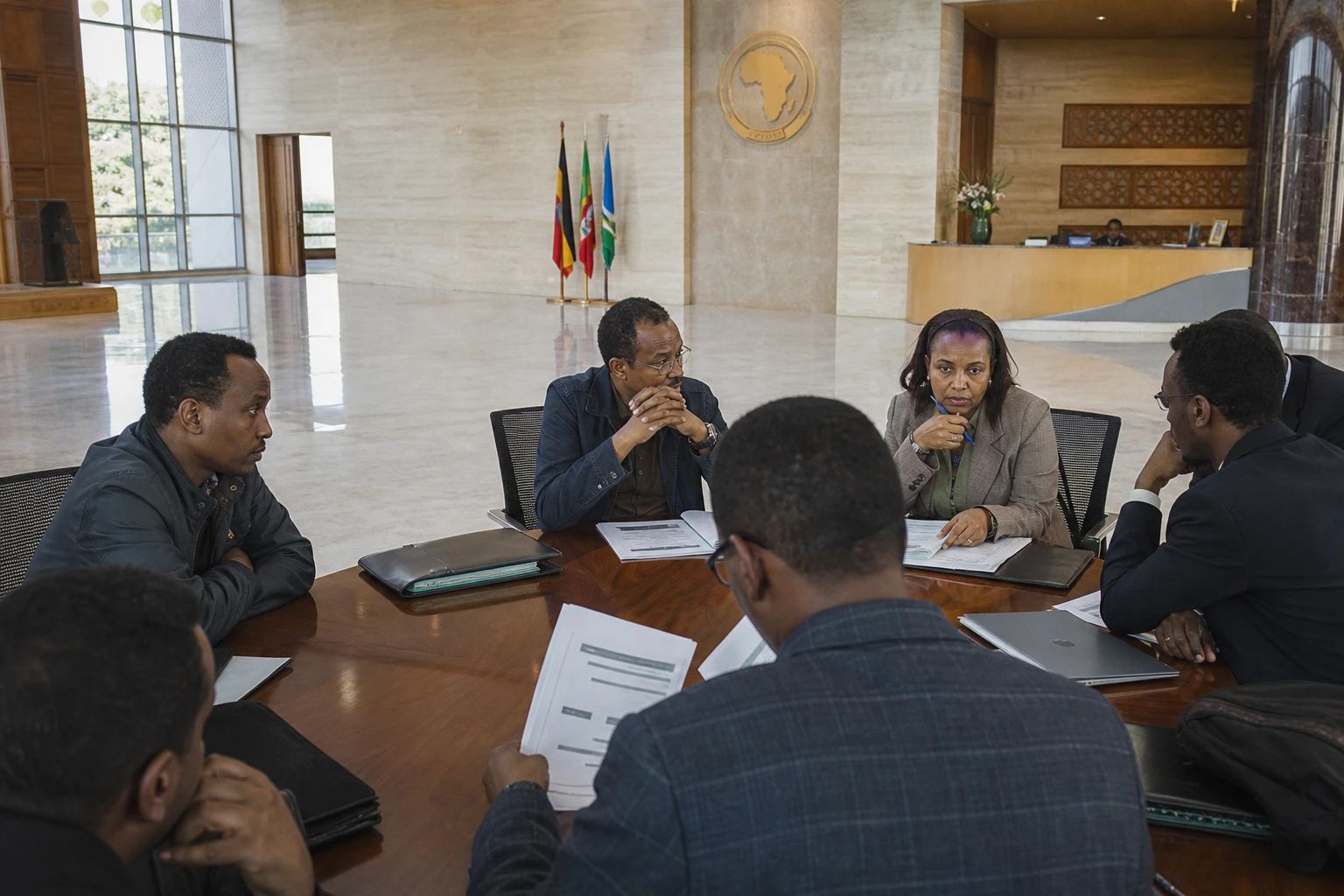
In Addis Ababa, the announcement of an alliance between seven armed groups turns a fragmented opposition into a coordinated national challenge. Its stated aim is to bring down the federal government and open the way to a political transition. But the proclaimed unity remains fragile, as these forces share neither the same history nor the same vision of Ethiopia.
A coalition born of distinct fronts
On 20 September 2026, seven Ethiopian organisations announced the creation of a coalition called the “Ethiopian Peoples’ Forces Coalition for Survival”. They say they want to remove the government led by Prime Minister Abiy Ahmed and establish an inclusive transitional administration.
The grouping brings together the Amhara national movement Fano, the Oromo Liberation Army, the Tigray People’s Liberation Front, the Ogaden National Liberation Front, the Afar Revolutionary Democratic Unity Front, the Benishangul People’s Liberation Movement and the Gumuz People’s Democratic Movement.
The make-up of this alliance is particularly significant. The Tigray People’s Liberation Front, or TPLF, governed Ethiopia for nearly three decades before Abiy Ahmed came to power in 2018. Between 2020 and 2022, its forces fought the federal army in a war that profoundly destabilised the country’s north.
Fano militias, meanwhile, have been fighting federal forces in the Amhara region since 2023. The Oromo Liberation Army is waging an insurgency in several parts of Oromia, the country’s most populous region. These three actors have a stronger local presence and greater military capacity than the alliance’s other announced members.
The coalition’s existence was reported by the African Press Agency and confirmed by several international media outlets. TPLF officials have described the cooperation as political and military. The Oromo Liberation Army, however, referred to a procedural agreement, without specifying that there was a consensus on all political issues.
The legacy of the Tigray war weighs on the announcement
Ethiopia has officially been out of the Tigray war since the cessation of hostilities agreement was signed in Pretoria, South Africa, on 2 November 2022. The text halted fighting between the federal government and the TPLF. It did not, however, settle all the issues relating to territorial control, disarmament and the return of displaced people.
Since then, tensions have shifted to other regions. In Amhara, the federal government is seeking to regain control of weapons and local security structures. This policy has led to clashes with Fano. Operations against the Oromo Liberation Army are also continuing in Oromia.
The parliamentary elections of 1 June 2026 confirmed the dominance of the Prosperity Party, Abiy Ahmed’s political formation. According to results announced by the National Election Board of Ethiopia, the party won 438 of the 501 seats in the House of Peoples’ Representatives. The vote nevertheless took place amid insecurity, particularly in Amhara and Oromia.
This situation creates a twofold contrast. Institutionally, the federal government has a very large parliamentary majority. On the ground, it continues to face several armed centres of resistance challenging its authority in areas far from Addis Ababa.
Military unity, but few political guarantees
The coalition gives the armed groups a common message. It could facilitate coordination, information-sharing and pressure on the government. It also extends the opposition across several regions, from Amhara and Tigray to Afar, Gumuz, Benishangul and Somali territories.
That geography does not, however, mean that the groups jointly control a continuous territory. Their forces are separated by vast distances. Their demands also have different foundations: regional autonomy, stronger federalism, the defence of community interests or a change in central government.
The main test will therefore be command. The groups will have to determine who makes decisions, how resources are allocated and what authority could represent the coalition. Above all, they will have to answer a central question: what would an “inclusive transition” mean for populations that have already endured several years of war?
A seizure of power by force would not automatically guarantee stability. On the contrary, it could open a new phase of rivalry between former adversaries. The TPLF and Amhara forces fought each other directly during the Tigray war. Their current rapprochement is based first and foremost on a shared goal: challenging Abiy Ahmed’s government.
For residents, the impact will depend on the area concerned. In rural regions, fighting can disrupt roads, harvests, markets and access to healthcare. In cities, particularly Addis Ababa, the main risks are restrictions, arrests and political tensions. The informal economy, which supports a large part of the population, would be particularly exposed to any new interruption of trade.
The Horn of Africa on alert
This development is not confined to Ethiopia. The country occupies a central position in the Horn of Africa and plays a major role in the Intergovernmental Authority on Development, or IGAD, which brings together several states in the region. Any expansion of the fighting could affect borders with Eritrea, Sudan, South Sudan, Somalia and Djibouti.
The war in neighbouring Sudan adds further pressure. Population displacement, arms flows and regional rivalries can amplify existing crises. It would nevertheless be premature to claim that a regional war is under way or inevitable.
The government in Addis Ababa will probably seek to show that the coalition lacks the means to overthrow the federal state. The armed groups, for their part, will have to prove that their alliance goes beyond a political declaration. Their ability to maintain a united front, preserve humanitarian corridors and prevent further violence against civilians will be decisive.
The next steps will therefore be crucial: developments in the fighting in Amhara and Oromia, the TPLF’s position in the political process, the federal authorities’ response and any involvement by African regional organisations. For the African Union, whose headquarters are in Addis Ababa, the challenge will be to support a negotiated outcome without legitimising violence or reducing the crisis to a simple confrontation between leaders.
The coalition marks a significant realignment of Ethiopia’s armed opposition. It is not yet evidence of a shift in power. It does, however, show that four years after the start of the Tigray war and nearly four years after the Pretoria agreement, national divisions remain unresolved.