Algeria
 Egypt
 Libya
 Morocco
 Tunisia
 Benin
 Burkina Faso
 Cabo Verde
 Côte d'Ivoire
 Ghana
 Guinea
 Guinea-Bissau
 Liberia
 Mali
 Mauritania
 Niger
 Nigeria
 Senegal
 Sierra Leone
 The Gambia
 Togo
 Cameroon
 Central African Republic
 Chad
 DR Congo
 Equatorial Guinea
 Gabon
 Republic of the Congo
 São Tomé and Príncipe
 Burundi
 Comoros
 Djibouti
 Eritrea
 Ethiopia
 Kenya
 Madagascar
 Malawi
 Mauritius
 Mozambique
 Rwanda
 Seychelles
 Somalia
 South Sudan
 Tanzania
 Uganda
 Angola
 Botswana
 Eswatini
 Lesotho
 Namibia
 South Africa
 Zambia
 Zimbabwe
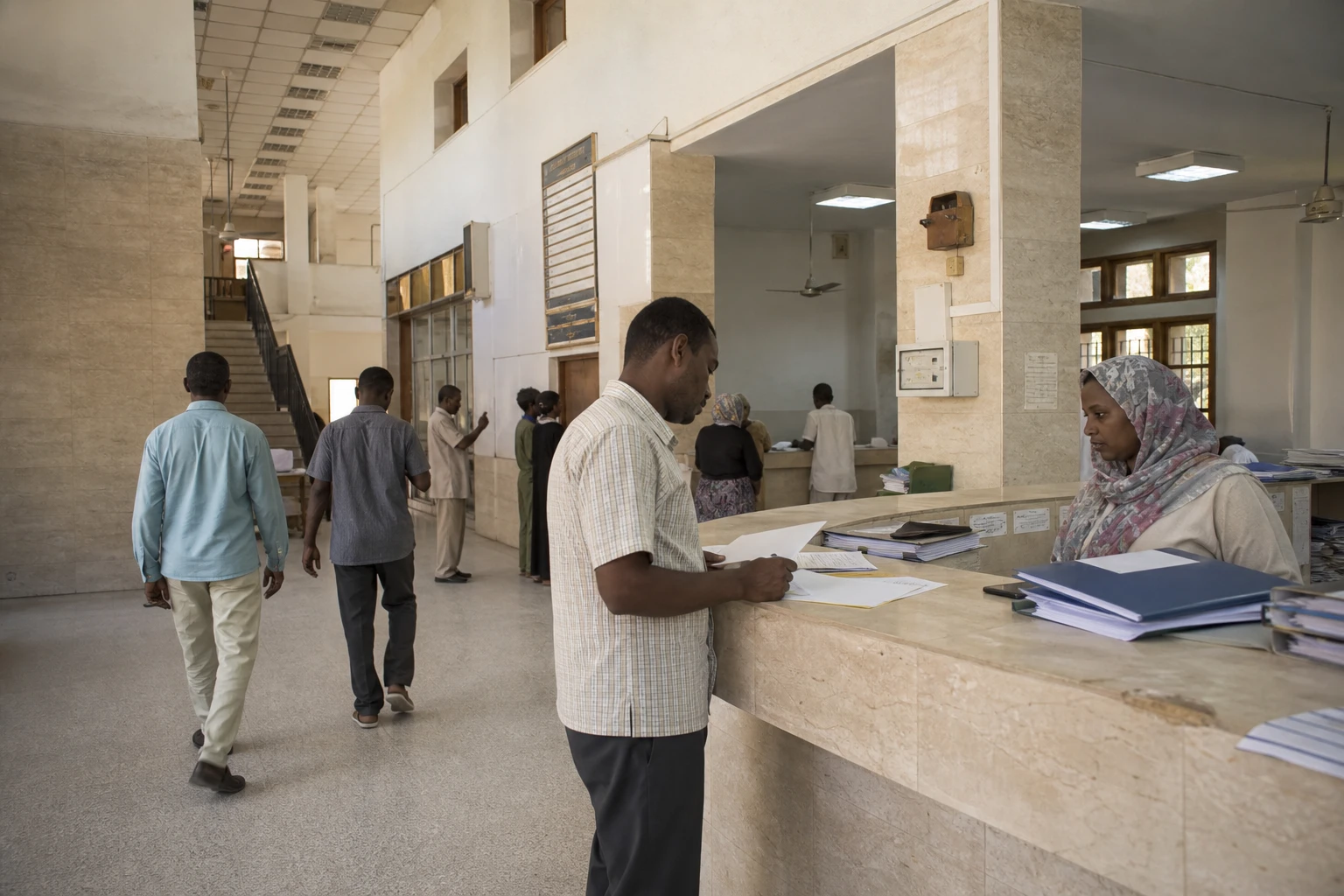
In Khartoum and cities retaken by the Sudanese army, the return of government offices does not yet mean a return to normal life. For households, the most visible sign of the war is often the price displayed in the market. Since early summer 2026, the Sudanese pound has lost almost half its value in areas controlled by the armed forces.
A currency that no longer circulates in the same way across territories
The fall has not affected the whole country uniformly. Sudan now operates through economic zones separated by front lines, roadblocks and competing authorities. Exchange rates vary according to the area under control, access to banks and supply routes.
In army-held regions, currency depreciation immediately makes imported goods more expensive. Fuel, medicines, flour, spare parts and some food products are paid for at the dollar price or at a parallel rate. Each further fall in the pound is therefore quickly passed on to markets.
In territories controlled by the Rapid Support Forces, the Sudanese currency has followed a different course in recent months. This relative stability does not reflect a healthy economy. Rather, it reflects separate trade routes, local resources and different balances of power. The same sum therefore does not provide the same access to goods in Omdurman, Port Sudan, Darfur or rural areas.
The phenomenon is documented in an analysis of the collapse of the Sudanese currency, published on 22 September 2026 and based on information gathered in Omdurman. Its findings are consistent with available data on inflation and the sharp rise in the parallel exchange rate.
War disrupts the entire economic chain
The currency crisis has no single cause. Since the war began on 15 April 2023, fighting between the Sudanese Armed Forces and the Rapid Support Forces has fragmented institutions, disrupted trade and damaged infrastructure.
Banks have closed in many localities. Payment networks are unreliable. Transport costs more. Businesses no longer have normal access to credit, foreign currency or wholesale markets. In several regions, traders must pass through successive checkpoints before reaching consumers.
The replacement of banknotes ordered in areas controlled by the army has also complicated transactions. The operation is intended to regain control of the money supply, but it can penalise households living far from bank branches. The World Bank had already noted in an earlier analysis that households had struggled to exchange old banknotes and that some had seen prices rise after the operation.
Price pressures continued in 2026. Sudan Tribune reported in July that annual inflation had reached 51.28% in June, up from 44.50% in May. This figure is a national average. It does not necessarily reflect conditions in isolated cities or areas where supplies are most difficult to obtain.
Households forced to cut spending
For Sudanese people, the loss of the currency’s value is more than a financial indicator. It reduces the amount of food, medicine or fuel that can be bought with a salary, pension or money received from relatives living abroad.
Informal-sector workers are particularly exposed. Their income varies with the day’s activity, while prices can change before their next payment. Civil servants and employees of businesses still operating also see their incomes eroded when wages do not keep pace with inflation.
In rural areas, the effects are different but just as severe. Farmers have to pay more for seeds, fertiliser, fuel and transport. When roads become dangerous or impassable, a harvest may never reach urban markets. The resulting drop in supply then pushes prices higher.
The United Nations Development Programme estimates that cereal production fell by 46% during the first year of the war. In 2025, nearly 90% of farmers and producer groups surveyed reported lower harvests, with yields falling by as much as 71% in areas worst affected by fighting.
This agricultural disruption increases dependence on imports and humanitarian aid. It also undermines rural incomes, as many displaced people try to resume work in regions where public services remain limited.
Recovery impossible without restoring national trade
Authorities in areas controlled by the army are seeking to signal a recovery. The return of some government offices and appeals for refugees to return to the country are part of this strategy. Yet a sustainable economic recovery requires more than the reopening of public offices.
Connections between regions must be restored, roads secured, banks brought back into operation and a currency made usable beyond areas of control. As long as resources, ports, farmland and trade routes remain divided among several authorities, the Sudanese market will remain deeply fragmented.
This fragmentation also affects the country’s main resources. A significant share of gold, livestock, oilseeds and gum arabic is produced in territories administered by a different power from the ports and financial centres in the east. Revenue therefore struggles to reach a national budget capable of funding essential services.
Sudan at the heart of the Horn of Africa’s balance of power
Sudan’s economic crisis extends beyond its borders. Sudan is part of the Intergovernmental Authority on Development, or IGAD, which brings together several countries in the Horn of Africa and East Africa. The war is weighing on trade, population movements and food security in neighbouring countries.
Nearly 13 million people are reported to have been forcibly displaced since April 2023, according to a United Nations summary. Several million of them have gone to neighbouring countries. This movement puts further pressure on markets, public services and host communities.
The depreciation of the Sudanese pound is therefore an indicator of a wider problem: the gradual break-up of the national economic space. As long as the fighting continues, each area may develop its own monetary, fiscal and trade networks. The next development to watch will therefore be less the announcement of an isolated measure than the ability of regional and continental mediation efforts to secure regular humanitarian access, a verifiable truce and, ultimately, the reunification of Sudan’s economic institutions.