Algeria
 Egypt
 Libya
 Morocco
 Sudan
 Tunisia
 Benin
 Burkina Faso
 Cabo Verde
 Côte d'Ivoire
 Ghana
 Guinea
 Guinea-Bissau
 Liberia
 Mali
 Mauritania
 Niger
 Nigeria
 Senegal
 Sierra Leone
 Togo
 Cameroon
 Central African Republic
 Chad
 DR Congo
 Equatorial Guinea
 Gabon
 Republic of the Congo
 São Tomé and Príncipe
 Burundi
 Comoros
 Djibouti
 Eritrea
 Ethiopia
 Kenya
 Madagascar
 Malawi
 Mauritius
 Mozambique
 Rwanda
 Seychelles
 Somalia
 South Sudan
 Tanzania
 Uganda
 Angola
 Botswana
 Eswatini
 Lesotho
 Namibia
 South Africa
 Zambia
 Zimbabwe

A legal case that goes beyond one former soldier
In Banjul, military justice is not merely trying a prolonged absence from duty. In its own way, it is reopening a period when the Gambian state operated for years in the shadows, amid coerced loyalty, fear and impunity. Sanna Manjang’s name evokes that painful memory: that of the Junglers, a paramilitary unit associated with the worst abuses of Yahya Jammeh’s regime.
The Gambia, a small West African republic surrounded by Senegal, is still emerging from a fragile political transition that began in 2017. That year, Yahya Jammeh’s departure was secured under joint pressure from ECOWAS, the West African regional organisation, the African Union and the United Nations. Since then, the country has sought to reconcile institutional stability, truth about past crimes and the expectations of a population demanding accountability, not abstract promises.
What the trial opened in Banjul is about
On 21 September 2026, a court martial opened Sanna Manjang’s trial in Banjul on charges of desertion. The former lieutenant-colonel is accused of leaving his post in the State Guards Battalion on 21 January 2017 and then remaining absent for nearly nine years. The Gambia Armed Forces says he was arrested on 29 November 2025 in Casamance, southern Senegal, before being returned to The Gambia a month later.
The proceedings are military, but the stakes are not solely so. In several investigations into the Jammeh era, Manjang has already been identified as an actor linked to the Junglers, the paramilitary force described by human rights investigators as an armed arm of the regime, involved in arbitrary arrests, enforced disappearances and summary executions. The AP reported in January 2026 that the criminal trial opened in Banjul then concerned two murders dating back to 2006, while Gambian media later reported changes to the indictment. The military desertion case is now proceeding on separate ground, but in a judicial climate still burdened by crimes attributed to Jammeh’s inner circle.
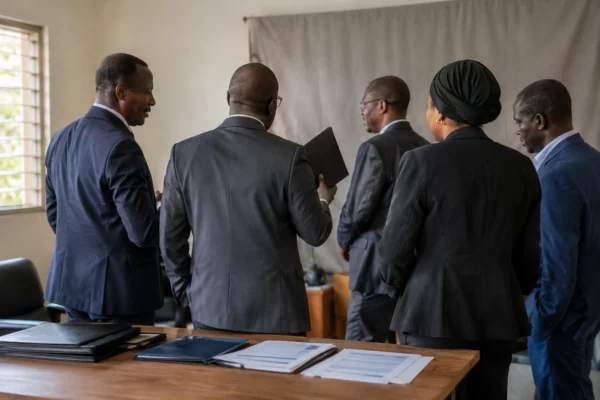
The military court, presided over by senior officers, must also address a delicate question: how can former alleged members of the Junglers testify without undermining ongoing cases or exposing witnesses to risks? Several earlier hearings have shown that evidence often rests on internal accounts, military records and protected testimony. The public hearings announced by the army do not change this underlying reality: in cases stemming from the Jammeh era, the chain of evidence is often as sensitive as the facts themselves.
The long shadow of the Junglers and pressure for truth
The Manjang case is part of a broader process launched after Yahya Jammeh’s fall. The Truth, Reconciliation and Reparations Commission, established in 2017, documented crimes committed under his regime and recommended prosecutions of several alleged perpetrators. In its compendium published by the Gambian Ministry of Justice, the commission estimates that more than 67 West African migrants were executed on Jammeh’s direct orders in July 2005, and names Sanna Manjang among those to be prosecuted for their role in these crimes. Other summaries of the same investigation put the total number of deaths attributed to the state apparatus during the Jammeh era at between 240 and 250.
These figures are not mere archival data. They shape public demands for justice in The Gambia. For victims, the issue is not simply the conviction of one individual. It is a matter of finding out who gave the orders, who carried them out, who covered them up and who allowed the silence to persist. For the army, the case tests another boundary: that between internal discipline and the duty to tell the truth. By prosecuting Manjang for desertion, the military institution is signalling that it also wants to close its own grey areas, without suggesting that former actors in the system can escape the rules for good.
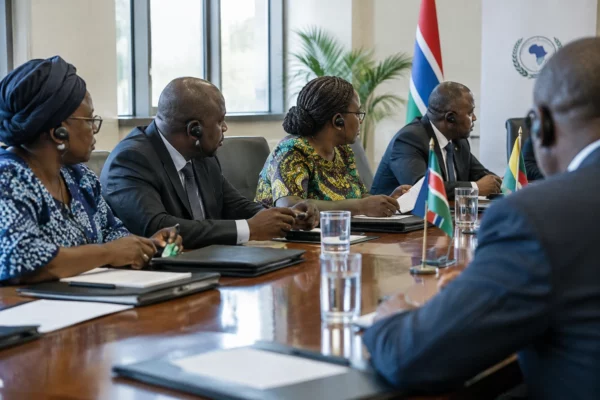
The case’s significance extends beyond Banjul. Across the subregion, The Gambia is often seen as a quiet testing ground for transitional justice. The principle of universal jurisdiction has already been applied abroad in Gambian cases, with proceedings in Germany, Switzerland and the United States against former Jammeh associates. This matters because these cases make one simple point: the political crimes of a small state can no longer disappear behind its borders. ECOWAS, which played a decisive role in preventing Jammeh from forcibly remaining in power, remains in the background of this institutional normalisation. What The Gambia succeeds or fails in doing with its own cases will therefore shape the very idea of accountability in West Africa.
What happens next will show whether the desertion trial remains a technical matter or becomes a useful step in a much broader undertaking. In The Gambia, justice can no longer simply open the files. It must also connect the cases, without rushing, but without evading the task. Only then can Banjul turn a barracks case into an enduring political signal for the country and the region.