
 Algeria
 Egypt
 Libya
 Morocco
 Sudan
 Tunisia
 Benin
 Burkina Faso
 Cabo Verde
 Côte d'Ivoire
 Ghana
 Guinea
 Guinea-Bissau
 Liberia
 Mali
 Mauritania
 Niger
 Senegal
 Sierra Leone
 The Gambia
 Togo
 Cameroon
 Central African Republic
 Chad
 DR Congo
 Equatorial Guinea
 Gabon
 Republic of the Congo
 São Tomé and Príncipe
 Burundi
 Comoros
 Djibouti
 Eritrea
 Ethiopia
 Kenya
 Madagascar
 Malawi
 Mauritius
 Mozambique
 Rwanda
 Seychelles
 Somalia
 South Sudan
 Tanzania
 Uganda
 Angola
 Botswana
 Eswatini
 Lesotho
 Namibia
 South Africa
 Zambia
 Zimbabwe
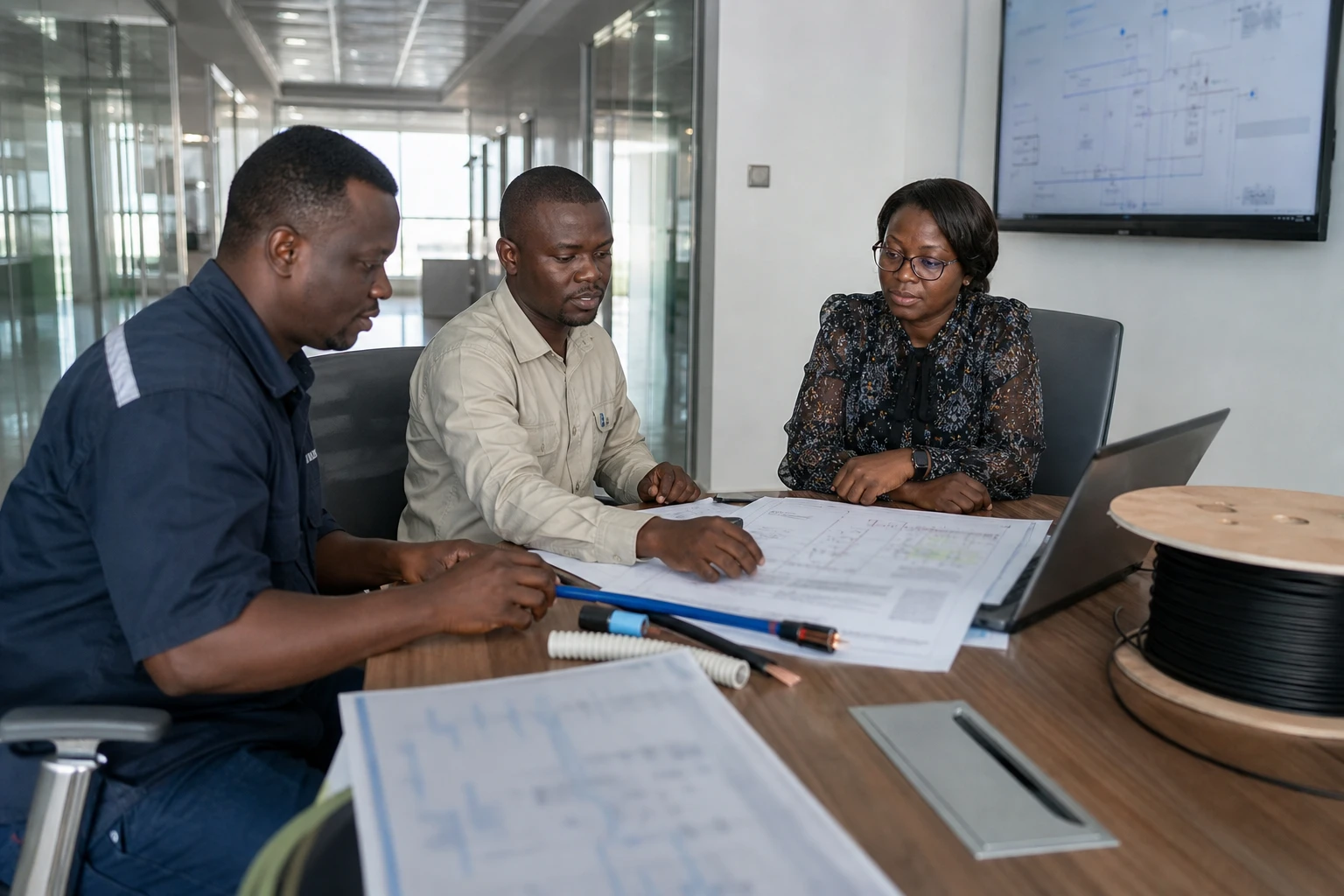
A cable, but above all a bridge between two neighbouring economies
In N’Djamena, fibre optics are no longer just a matter of bandwidth or engineering. They are becoming a tool for closer economic ties between Nigeria and Chad, two neighbours whose trade is still hampered by high connectivity costs and fragmented networks.
On a continent where digital routes matter as much as physical ones, the issue is straightforward: whoever controls the links also controls a share of services, data and opportunities. For a landlocked country such as Chad, the stakes are even clearer. Every new international route reduces dependence on a single corridor and makes the network more resilient. Chad has incorporated this approach into its national plan, Chad Connection 2030, which puts connectivity at the heart of the country’s modernisation.
Nigeria is backing a broader, more open backbone
The BRIDGE project, led by the Nigerian government in Abuja, is set to add at least 90,000 kilometres of fibre-optic cable to the national network. Nigeria’s Ministry of Communications, Innovation and Digital Economy describes the project as foundational infrastructure to cover all 36 states and the Federal Capital Territory, Abuja, and connect more than 770 local government areas.
The project is not limited to Nigeria. It also provides for cross-border links with Benin, Cameroon, Niger and Chad. The aim is to open up Nigeria’s network to its neighbours and turn a national backbone into a regional platform. The African Development Bank confirmed this direction in its statement on BRIDGE, referring to an expansion of the fibre network from 30,000 to about 120,000 kilometres and connections with neighbouring countries.
The financing follows the same logic of scaling up. The Nigerian government says it has secured $800 million, from the World Bank, the AfDB and the EBRD. The World Bank has approved $500 million in support, while the EBRD has announced a sovereign loan of up to $100 million. The AfDB has added $200 million.
Chad is seeking several digital gateways
For Chad, the interest goes beyond laying a single section of cable. The country is seeking to increase its international access routes so that it does not depend on one corridor. Its development plan already mentions a connection via Niger, including a 509-kilometre section between N’Djamena and the Nigerien border, as well as other regional links. The Chad-Niger interconnection project, supported by the AfDB and the European Union, also provides for 1,510 kilometres of fibre along the Trans-Saharan backbone.
In other words, Chad’s strategy does not rely on a single gateway. It aims for a multi-route architecture, with several links to neighbouring countries. This is a way to secure traffic, diversify providers and limit disruptions. The approach is consistent with the goals set out in Chad Connection 2030, which aims to reduce telecoms service costs and improve digital coverage.
The meeting between the two countries’ ministers responsible for digital affairs in N’Djamena on 16 September 2026 therefore served to frame this ambition. The two sides signed a joint statement and announced further technical work on the route, the terms of interconnection and operating conditions. A local source reported that the ministers concerned were Haliki Choua Mahamat for Chad and Bosun Tijani for Nigeria. The important point here is not the formal photo opportunity. It is the shift from political intent to an infrastructure project.
What these links mean for operators, governments and users
For telecoms operators, a well-designed regional interconnection can reduce some transit costs, improve network redundancy and make more international capacity available. For governments, it can also strengthen digital sovereignty, provided management rules are clear and access remains open. The BRIDGE model is designed as a public-private partnership with a project company, which should help mobilise capital while retaining public oversight.
For households and small businesses, the stakes are even more tangible: a denser, better-connected network can bring down prices, improve service quality and make possible uses that are currently unevenly available across regions. In capitals, the impact is first seen in more stable connections and digital services. In rural areas, it will depend above all on the actual pace of deployment and on how benefits are shared between commercially viable areas and those left behind. Chad’s plan explicitly refers to the need to strengthen fibre in both urban and rural areas.
Nigeria, for its part, is seeking to turn its size into a regional asset. With a population of more than 200 million, it could become a traffic hub for West Africa and, beyond that, for landlocked Sahelian countries. Chad, meanwhile, is seeking to turn its landlocked position into that of a land-based crossroads between West Africa, Central Africa and the Sahel. This is where the project takes on a regional dimension: it links ECOWAS, of which Nigeria is a member, with the Central African region where Chad is located, with potential effects on data flows, mobile financial services and e-government.
Another building block in Africa’s digital realignment
The project also goes beyond the bilateral framework. It is part of a broader trend: African countries are seeking to connect their networks to reduce external dependencies and better serve their domestic markets. The Trans-Saharan backbone, which already links or aims to link Algeria, Niger, Nigeria, Chad, Mali and Mauritania, shows that fibre optics are becoming a tool of continental integration, on a par with roads, rail corridors and electricity interconnectors.
What remains is the next step, more decisive than the announcement itself: technical studies, the route’s final design, funding phases and governance of the future network. The project’s substance will be determined at this stage. If commitments translate into construction, Nigeria and Chad could lay another building block in West-Central African digital integration. If decisions are delayed, the project will join the long list of announced but still incomplete corridors. The technical timetable will therefore be a key indicator to watch.



