Algeria
 Egypt
 Libya
 Morocco
 Sudan
 Tunisia
 Benin
 Burkina Faso
 Cabo Verde
 Côte d'Ivoire
 Ghana
 Guinea
 Guinea-Bissau
 Liberia
 Mali
 Mauritania
 Niger
 Nigeria
 Senegal
 Sierra Leone
 The Gambia
 Togo
 Cameroon
 Central African Republic
 Chad
 DR Congo
 Equatorial Guinea
 Gabon
 Republic of the Congo
 São Tomé and Príncipe
 Burundi
 Comoros
 Djibouti
 Eritrea
 Ethiopia
 Kenya
 Madagascar
 Malawi
 Mauritius
 Mozambique
 Rwanda
 Seychelles
 Somalia
 South Sudan
 Tanzania
 Uganda
 Angola
 Botswana
 Eswatini
 Lesotho
 Namibia
 Zambia
 Zimbabwe
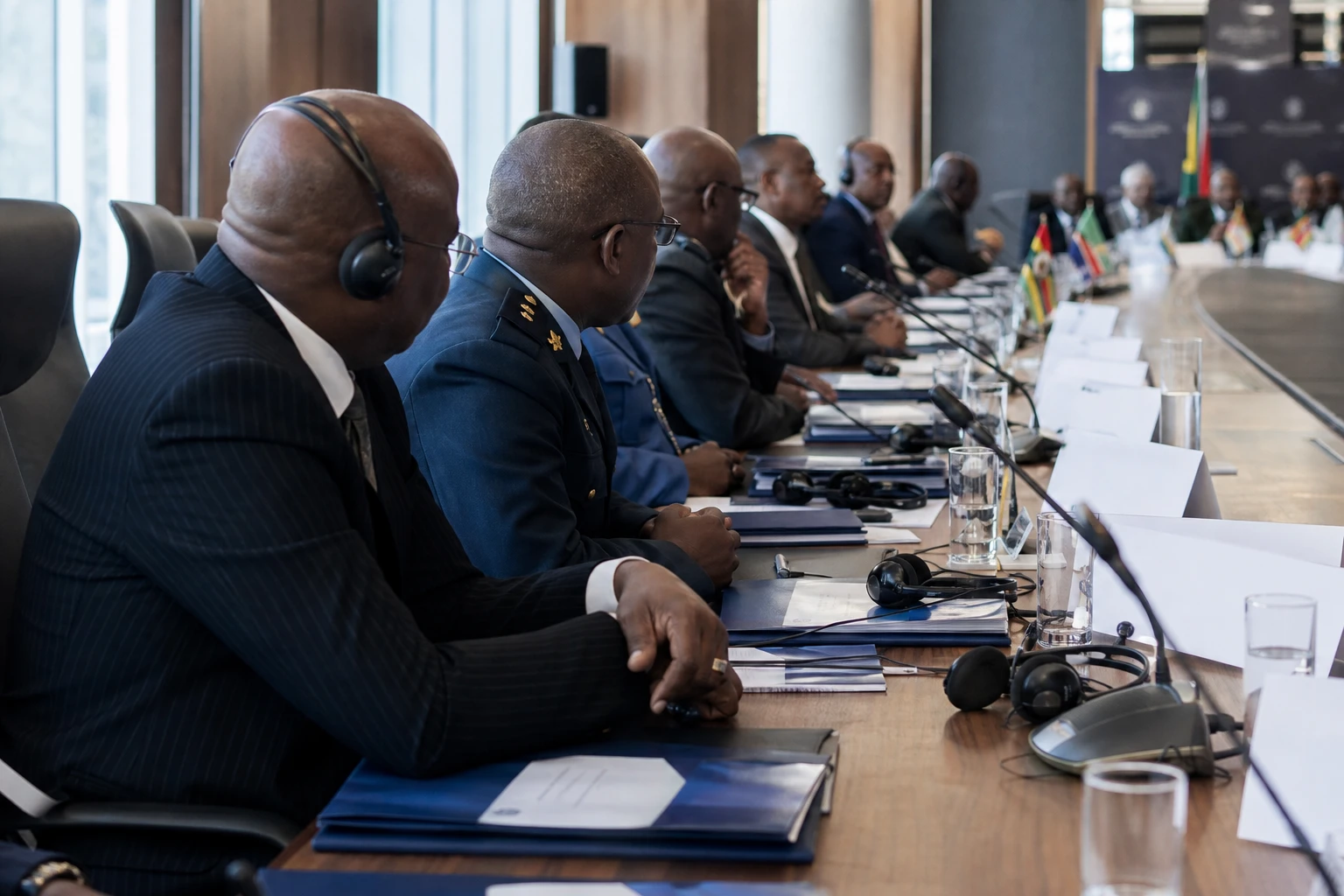
At Tshwane, South Africa’s defence industry is as much on show as it is for sale
At Tshwane, the Africa Aerospace and Defence show highlighted a reality that is often underestimated: in South Africa, arms are about more than pageantry. They are linked to industry, skilled employment and the country’s ability to retain control of sensitive technologies. With public budgets still constrained, every aerial display also says something about the survival of a local industrial ecosystem.
The 13th edition of the show, held at Waterkloof Air Force Base in the city of Tshwane, ran from 16 to 20 September 2026. Organisers describe it as Africa’s only major event combining a trade exhibition with an air show, with more than 30 countries represented and over 30,000 visitors expected. Pretoria, the country’s administrative capital, and its municipality of Tshwane play a central role, at the intersection of diplomacy, industry and defence.
The show comes at a time when southern Africa is seeking to consolidate its industrial value chains. In South Africa, the Department of Trade and Industry describes aerospace and defence as globally competitive sectors, but ones held back by public budgets and the weight of industrial policy. The CSIR, meanwhile, emphasises its role in sovereign technology for the air, land, sea and cyberspace.
Spectacular displays, but an industrial message above all
At Waterkloof, helicopters and fighter jets performed repeated manoeuvres above the spectators. Organisers and attending media also showed armoured vehicles, simulated combat scenarios and several locally developed technologies, including mobile surveillance systems. This was not just entertainment for families and aviation enthusiasts. It was a showcase for industrial capabilities that South Africa is seeking to preserve in a highly competitive continental market.
This staging is no mere sideshow. In South Africa’s defence industry, value added depends precisely on the ability to turn military requirements into locally designed products. That is the message from the country’s public institutions: the sector must serve national interests while also positioning itself as an African supplier of aerospace and defence solutions. In other words, the challenge is not simply to display machines. It is to convince clients, partners and armed forces that local production remains credible despite budgetary pressure.
Surveillance radars and mobile systems feature prominently among the technologies on display. This is unsurprising. The CSIR says its defence work includes radar and electronic warfare, while South African companies such as Reutech have for years showcased mobile radars designed for early warning and tactical surveillance. The show thus becomes both a demonstration platform and a marketplace where local engineering is seeking to retain business in the face of foreign competition.
A constrained local industry faces regional ambitions and budget limits
At the heart of the issue is finance. Engineer Kopano Lebelo, cited by the original source, sums up a familiar tension in the sector: South African teams are able to turn operational requirements into locally manufactured technologies, but budget constraints are holding back expansion. This view echoes that of the Department of Trade and Industry, which explicitly acknowledges that sector revenues remain limited by political trade-offs and government budgets.
In practical terms, this has an impact at several levels. For major companies, the show is a chance to secure contracts, establish partnerships and keep assembly lines running. For subcontractors, it offers rare visibility. For the military, it provides an opportunity to test how well operational requirements match available capabilities. For the public, finally, it offers a glimpse of an industry that remains one of the few in Africa capable of producing complex systems locally, from radar to attack helicopters.
The state’s role is decisive. Pretoria supports the ecosystem through initiatives such as the Aerospace Industry Support Initiative, a government-funded mechanism supporting aerospace, defence, space and advanced manufacturing. This approach shows that defence is seen not only as a budgetary burden, but also as an industrial and technological lever. It is a familiar approach in South Africa, where the scientific and manufacturing base remains one of the country’s strongest assets.
The other challenge is regional. South Africa is a member of SADC, the Southern African Development Community, and is a supplier, trainer and, at times, logistics integration partner in the region. A show such as AAD therefore speaks as much to the domestic market as to buyers across the continent. As African armed forces modernise their surveillance, interception and mobility capabilities, South African expertise remains an important industrial reference point.
What Tshwane says about southern Africa
The show’s continental significance extends beyond South Africa. It demonstrates that parts of southern Africa are not content merely to import equipment. They also design radars, sensors, vehicles and aircraft platforms capable of meeting local needs. On a continent where technological sovereignty is once again at the centre of debate, the ability to manufacture and integrate systems locally matters as much as aerial displays.
What happens next will depend above all on the country’s ability to turn the exhibition into orders, orders into production, and production into lasting jobs. The schedule is already set: AAD takes place every two years, and the 2026 edition served as a full-scale test for South Africa’s industry. If Pretoria wants to remain an African leader in aerospace and defence, it will have to strike a delicate balance between prestige, innovation and funding.