Algeria
 Egypt
 Libya
 Morocco
 Sudan
 Tunisia
 Benin
 Burkina Faso
 Cabo Verde
 Côte d'Ivoire
 Ghana
 Guinea
 Guinea-Bissau
 Liberia
 Mali
 Mauritania
 Niger
 Nigeria
 Senegal
 The Gambia
 Togo
 Cameroon
 Central African Republic
 Chad
 DR Congo
 Equatorial Guinea
 Gabon
 Republic of the Congo
 São Tomé and Príncipe
 Burundi
 Comoros
 Djibouti
 Eritrea
 Ethiopia
 Kenya
 Madagascar
 Malawi
 Mauritius
 Mozambique
 Rwanda
 Seychelles
 Somalia
 South Sudan
 Tanzania
 Uganda
 Angola
 Botswana
 Eswatini
 Lesotho
 Namibia
 South Africa
 Zambia
 Zimbabwe
A long-awaited reform, still subject to legal scrutiny
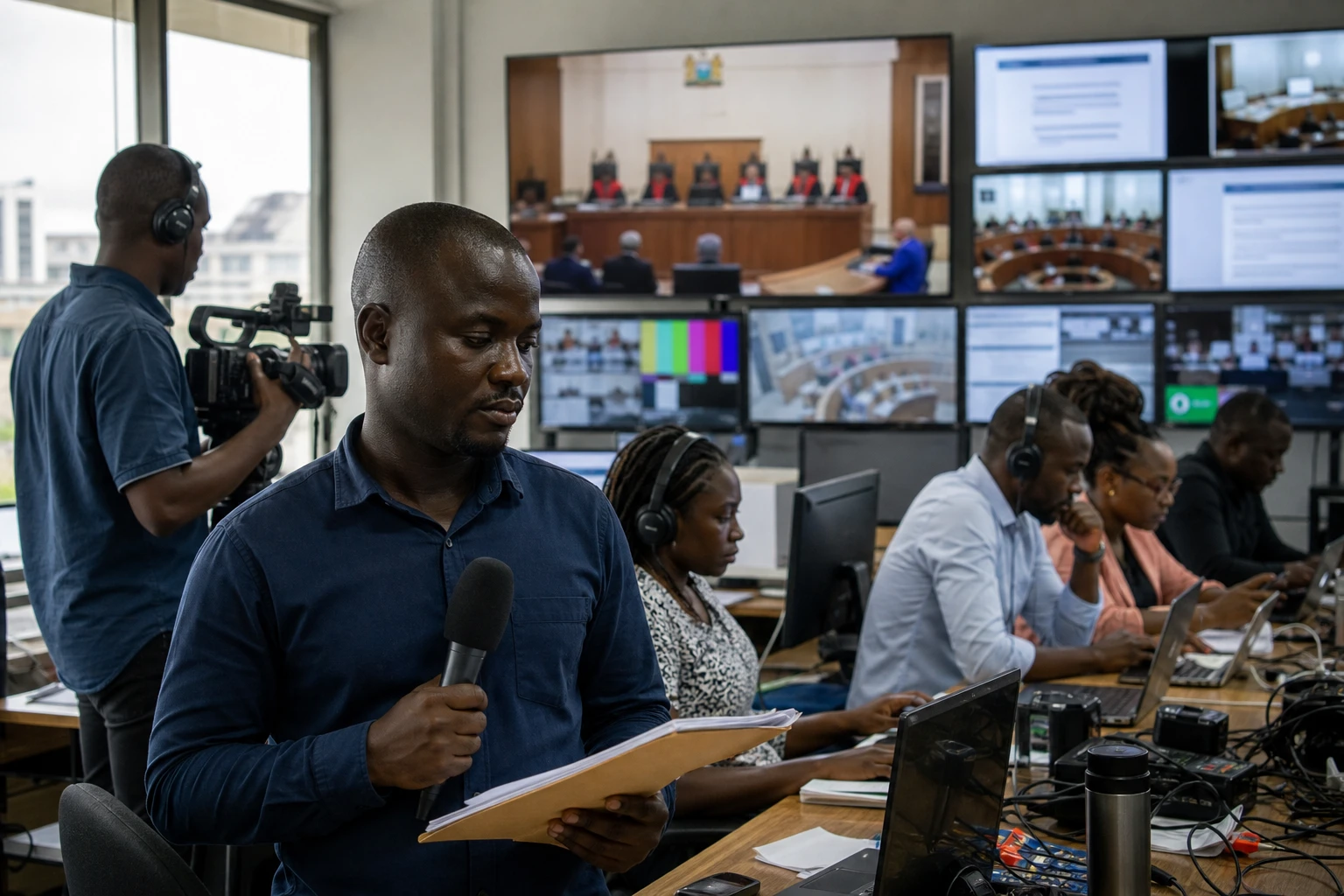
In Freetown, constitutional reform is no longer being decided only in parliament. The courts are also involved. In Sierra Leone, a bill affecting voting rules, women’s representation and access to public office for dual nationals has triggered an institutional standoff. The political authorities are seeking to revise the rules, while the Supreme Court must determine whether the process complied with the Constitution.
This debate is not taking place in a political vacuum. Since the electoral reform that followed the 2023 election, Sierra Leone’s authorities have put overhauling the rules of the game at the centre of their agenda. President Julius Maada Bio, re-elected in 2023 for a second term, also has particular regional influence: he is currently chair of the Authority of Heads of State and Government of ECOWAS, the Economic Community of West African States.
What parliament adopted
Sierra Leone’s parliament adopted the constitutional amendment bill on 10 September 2026 and sent it to the head of state, according to the timetable made public by the presidency and reported by the local press. The bill has a straightforward name, but its potential effects are far-reaching: it changes the thresholds for winning the presidency, consolidates proportional representation, sets a minimum quota of 30% women among candidates and opens up the political sphere further to citizens with dual nationality.
Among the most hotly debated provisions is the change from a threshold of 55% to 50% plus one vote to win in the first round, while retaining a requirement for the geographical distribution of votes. The bill also seeks to enshrine the proportional representation system for parliamentary elections. At the same time, it introduces a minimum quota of 30% female candidates in national and local elections.
Another significant change concerns dual nationals. The text would allow them to stand for parliament and hold certain public offices. In a country where the diaspora carries economic weight through remittances and sometimes plays a role in political life, this opening goes beyond constitutional technicalities. It touches on the very definition of political citizenship.
Why the Supreme Court has been asked to rule
The controversy is primarily about procedure. Article 108 of the 1991 Constitution provides that an amendment must be supported by at least two-thirds of the members of parliament at the second and third readings. The question before the Supreme Court is whether this threshold is calculated against all MPs or only those present and voting. It is a technical point, but a decisive one. It could validate or undermine the entire reform.
President Julius Maada Bio has chosen to defer his final decision and seek a judicial opinion. The presidency says this caution reflects the importance of the text, which concerns the Republic’s “constitutional and democratic foundations”, and the need for a clear interpretation before it is signed into law. The move reflects a common reality in West Africa: when the rules of the electoral game change, the battle quickly shifts to constitutional courts.
The case follows a petition filed in early September by the Institute for Governance Reform, a civil society organisation. Separate challenges have also been reported from the opposition and members of the legal profession, showing that the dispute is not merely partisan. It also concerns how the law was made and the scope of qualified-majority requirements.
A political test ahead of the 2028 elections
The significance of the case goes beyond the date on which the bill may be signed into law. The next general elections are expected in 2028. If the reform is upheld, it could change how the president is elected, how candidate lists are drawn up and how women secure party nominations. It could also influence parties’ strategies, particularly their territorial presence, since the bill retains a requirement for the geographical distribution of votes.
For the governing majority, the challenge is to modernise a framework inherited from 1991 and make the rules more inclusive. The opposition is focused on the integrity of the process and compliance with constitutional thresholds. For voters, the question is more concrete: who will be able to stand, under which party label, and with what chance of turning a vote into meaningful representation?
The 30% quota for women is also an important signal in a country where the gap between social presence and political representation remains pronounced. If properly enforced, the rule could change the composition of national and local candidate lists. But its effectiveness will depend on political parties, oversight bodies and the electoral timetable. A reform written into the Constitution has force only if institutions translate it into visible practice.
The question of dual nationals opens another front. In many West African countries, the diaspora is encouraged to fund, vote, invest or take part in public debate, but is often kept at a distance from elected office. In Sierra Leone, the bill under discussion seeks to address this tension. However, the exceptions for the highest executive offices, which remain a sensitive matter of sovereignty, will need to be watched closely.
A Sierra Leonean case with wider West African significance
What is unfolding in Freetown matters beyond Sierra Leone. ECOWAS closely follows constitutional transitions and electoral disputes because they affect regional stability. In a West African region marked in recent years by difficult transfers of power, coups and tensions over the legitimacy of elections, every reform of the electoral framework sends a signal.
Sierra Leone’s Supreme Court, which has exclusive jurisdiction to rule on questions of constitutional interpretation, must now decide whether the process complied with the letter of the 1991 Constitution. Its answer will be seen as a test of the balance between parliament, the presidency and the judiciary. It will also indicate whether Sierra Leone can carry out far-reaching reform without undermining trust between the parties involved.
7 October 2026, the date announced for the judicial hearing, will therefore be more than a routine court session. It will be a moment of institutional clarification for Freetown, as well as a reference point for West African capitals seeking to update their political rules without weakening their constitutional foundations.