Algeria
 Egypt
 Libya
 Morocco
 Sudan
 Tunisia
 Benin
 Burkina Faso
 Cabo Verde
 Côte d'Ivoire
 Ghana
 Guinea
 Guinea-Bissau
 Liberia
 Mali
 Mauritania
 Niger
 Nigeria
 Senegal
 Sierra Leone
 The Gambia
 Togo
 Central African Republic
 Chad
 DR Congo
 Equatorial Guinea
 Gabon
 Republic of the Congo
 São Tomé and Príncipe
 Burundi
 Comoros
 Djibouti
 Eritrea
 Ethiopia
 Kenya
 Madagascar
 Malawi
 Mauritius
 Mozambique
 Rwanda
 Seychelles
 Somalia
 South Sudan
 Tanzania
 Uganda
 Angola
 Botswana
 Eswatini
 Lesotho
 Namibia
 South Africa
 Zambia
 Zimbabwe
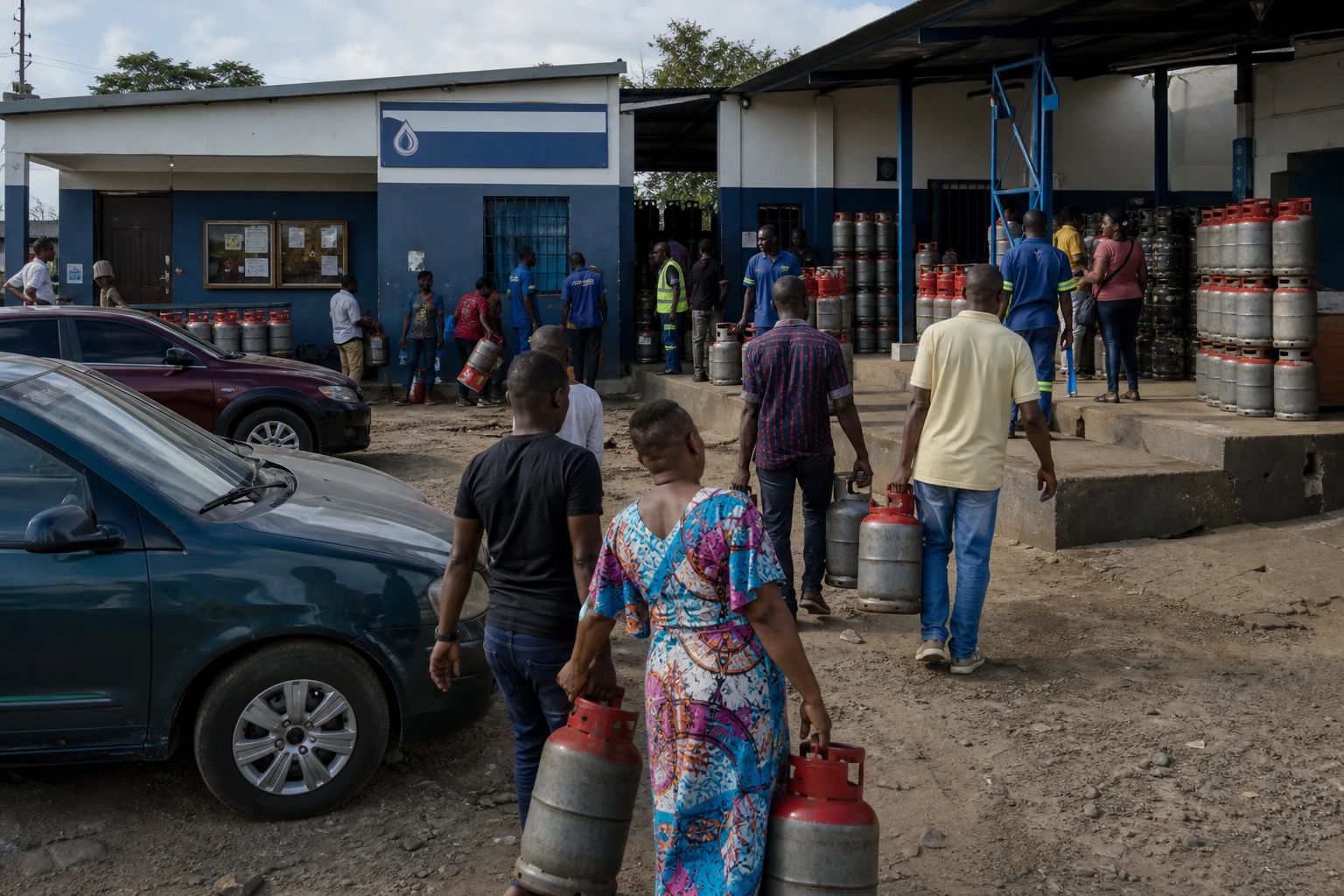
When an empty gas cylinder becomes a daily headache
In several districts of Yaoundé, the same scenario has been unfolding for days: households go from one depot to another, sometimes without finding a full cylinder. Domestic gas, an everyday feature of urban kitchens, has once again become a matter of searching, prices and waiting. For many Cameroonians, the difficulty is not just buying the fuel. It is also knowing where to exchange a cylinder, at what price and which brand is still available.
The situation is weighing first on households, but also on small restaurants, beignet sellers, neighbourhood workshops and businesses that rely on the cheapest energy to use. When cylinders are unavailable, households turn to charcoal or wood. This step backwards comes at a financial cost, as well as a health and environmental one. In the country’s political capital, the strain is a reminder that a household product still depends on a fragile supply chain.
A supply chain under pressure
Cameroon relies heavily on imports of liquefied petroleum gas, or LPG, commonly known as domestic gas. The Cameroon Petroleum Depots Company, SCDP, says the current difficulties are not due to a single factor, but to a combination of bottlenecks: falling local production, logistical disruptions and commercial problems at some operators. In its situation report of 17 September 2026, the company described localised pressure rather than a widespread shortage, while acknowledging a real imbalance in the market.
One factor has weighed heavily. The Hilli Episeyo floating production vessel, which liquefied gas off Kribi for many years, left Cameroon in the summer of 2026 after eight years in service. Industry and port sources place its departure in late July or early August, before it was taken to Singapore for work and a new assignment. The Kribi Autonomous Port did record the vessel’s final call, with departure scheduled for 27 July 2026, while specialist publications confirmed that it left the country in August.
The vessel’s withdrawal is more than symbolic. For years, the Hilli Episeyo supplied a significant share of Cameroon’s gas. SNH documents recall that from 2018 it put the country on the liquefied natural gas map, while also supplying the local market with LPG from the Bipaga site near Kribi. Figures published by SNH also show that significant cargoes were delivered to the local market over the years, confirming the infrastructure’s role in maintaining the national balance.
Struggling operators and soaring prices
Adding to this dependence are the difficulties facing a major distributor, SCTM Gaz, known to the public for its orange-red cylinders. Several media outlets and local sources describe a company struggling with cash flow, with unpaid debts to importers and a supply capacity that has stalled. On the ground, this means cylinders cannot be exchanged, shelves are empty and pressure is mounting on other available brands.
The most visible consequence is rising prices. In Buea, reports from August 2026 said 12-kilogram cylinders were selling for between 12,000 and 20,000 CFA francs, while the regulated price is 6,500 CFA francs. In Yaoundé, too, consumers and traders say opportunistic speculation is taking hold. The phenomenon is not unusual: when a mass-market product becomes scarce, a parallel market quickly emerges, especially in large cities where demand is high and daily.
The authorities, for their part, point to sustained growth in demand. SCDP and the Ministry of Water and Energy have cited an annual increase of 15%, with national consumption estimated at around 160,000 tonnes a year. Other official figures show that 132,902 tonnes of LPG were consumed between January and July 2026, compared with 125,085 tonnes over the same period in 2025. The difference may appear modest, but it is enough to throw off balance a sector that already has little room to manoeuvre.
In response to the pressure, the state has begun strengthening the storage link in the chain. On 21 August 2026, the Minister of Water and Energy inaugurated new SCDP facilities in Douala to improve the availability of domestic gas. The message is clear: without sufficient storage, deliveries by ship remain vulnerable to delays, costs and occasional interruptions. In a country where imports are now making up for local production, logistics are becoming almost as strategic as extraction itself.
What the crisis says about Cameroon and Central Africa
The issue goes beyond household gas. It touches on energy sovereignty, price stability and the credibility of public policy. For households, the impact is immediate: higher spending, more time lost and a forced return to more cumbersome fuels. For restaurant owners and small businesses, margins are squeezed further. For the state, the cost of subsidies and logistical adjustments is rising. SNH itself has stressed that Cameroon’s gas strategy is not limited to the withdrawal of one floating unit, and that other contracts and industrial uses remain in place.
The situation also exposes a common weakness in Central Africa: a key piece of infrastructure, a dominant operator, and then pressure that spreads quickly as soon as one of the two falters. Cameroon, a member of CEMAC, shares the same fundamental question as its neighbours: how can supply chains be secured, more storage built up and operators diversified without waiting for a crisis to act? The Cameroonian case shows that a country producing natural gas can nevertheless remain vulnerable in the domestic market if it lacks sufficient storage reserves or sustainable processing capacity.
What happens next will depend on how quickly the announced imports arrive, whether depots are upgraded and whether operators can restore cylinder exchanges. In the short term, the real question is not whether gas will return to depots in Yaoundé or Douala. It is whether the country can prevent such an ordinary product from becoming a contested commodity again at the next logistical shock.