Algeria
 Egypt
 Libya
 Morocco
 Sudan
 Tunisia
 Benin
 Burkina Faso
 Cabo Verde
 Côte d'Ivoire
 Ghana
 Guinea
 Guinea-Bissau
 Liberia
 Mali
 Mauritania
 Niger
 Nigeria
 Sierra Leone
 The Gambia
 Togo
 Cameroon
 Central African Republic
 Chad
 DR Congo
 Equatorial Guinea
 Gabon
 Republic of the Congo
 São Tomé and Príncipe
 Burundi
 Comoros
 Djibouti
 Eritrea
 Ethiopia
 Kenya
 Madagascar
 Malawi
 Mauritius
 Mozambique
 Rwanda
 Seychelles
 Somalia
 South Sudan
 Tanzania
 Uganda
 Angola
 Botswana
 Eswatini
 Lesotho
 Namibia
 South Africa
 Zambia
 Zimbabwe
In Dakar, a new cycle begins with clear choices already emerging
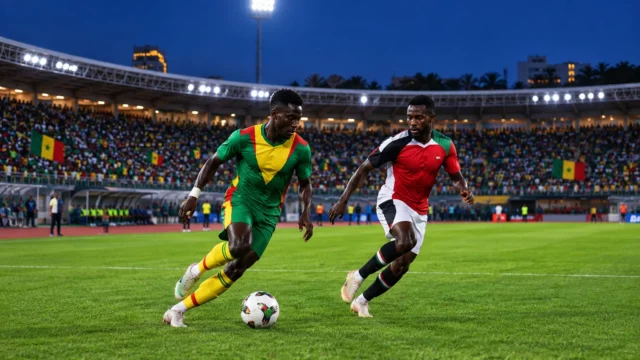
Senegal is entering a short but decisive period. In Dakar, new head coach Patrick Vieira has set out his first markers by naming a 29-man squad for the September 2026 international window. The message is clear: keep the Lions’ backbone while opening the door to a new generation already established in several major leagues.
This first announcement comes at a particular moment for Senegalese football. The Senegalese Football Federation confirmed a change of cycle in July 2026 after the 2026 World Cup, then officially presented Patrick Vieira at the Léopold Sédar Senghor Stadium in Dakar on 18 September 2026. At the same time, the national team had already lost an important figure with Édouard Mendy’s international retirement, announced a few days earlier.
The regional context also matters. Senegal have been placed in Group J of the qualifying campaign for the 2027 Africa Cup of Nations, alongside Mozambique, Sudan and Ethiopia. The Confederation of African Football has set the campaign’s kick-off for September 2026, with matchdays scheduled between 21 September and 6 October.
A strong squad, balancing continuity and renewal
Vieira has selected four goalkeepers, nine defenders, six midfielders and ten forwards. This very attacking balance shows a desire to have several options up front without sacrificing experience in the other lines. Kalidou Koulibaly, Idrissa Gana Gueye, Nicolas Jackson, Ismaila Sarr, Iliman Ndiaye and Boulaye Dia are among the expected names.
Two absences weigh more heavily than the others. Sadio Mané is not in this first squad, while Édouard Mendy has ended his international career. These two names have long shaped the Lions’ identity. Their absence does not close the chapter, but it requires the coaching staff to accelerate the integration of a younger generation, already represented by players such as Lamine Camara, El Hadji Malick Diouf, Mamadou Sarr and Ibrahim Mbaye.
Vieira’s choice is therefore part of a carefully managed transition. The coach is keeping senior players who can lead the dressing room and steer the team through key moments in matches. But he is also broadening the pool, with players from different European clubs, making it possible to consider several game plans. For a national team, this diversity can be a strength. It also takes time, especially when fixtures come quickly.
The schedule leaves him little room to manoeuvre. Senegal must face Mozambique on 25 September 2026, then Ethiopia on 29 September 2026 in Bahir Dar, before a friendly against Comoros on 4 October 2026. The FSF has also clarified the order of the matches, noting that the Senegal-Mozambique fixture has been reversed during this window. For the coaching staff, this run of games will serve both to earn points and to test combinations.
What this first squad says about Senegal today
On the pitch, the challenge goes beyond the squad list. Senegal remain under scrutiny after several years of consistency at the highest level of African football. The Lions have established high expectations around their national team. In this context, every new coach inherits a dual imperative: maintain results and renew the squad without disrupting its momentum.
For the players, the significance is different. The senior players must continue to lead the team in tight matches and difficult away fixtures. The younger players, meanwhile, have a window in which to gain playing time and establish themselves in the squad for the longer term. It is often during these periods of transition that a national team’s future regular starters emerge.
Expectations among the Senegalese public are also twofold. In Dakar and across the regions, supporters want results, but they also care about how they are achieved. The national team remains a symbol of cohesion and sporting pride. In a country where football plays a major role in the collective imagination, the appointment of a French-Senegalese coach such as Patrick Vieira adds a symbolic dimension: an acknowledged connection between international experience and national roots.
This first squad also says something about contemporary African football. The continent’s national teams increasingly rely on players trained or based in Europe, but they must build collective understanding in very short periods. The 2027 Africa Cup of Nations, whose final tournament will be held in Kenya, Tanzania and Uganda from 19 June to 17 July 2027, will also test the stability of several African coaching benches. Senegal will be seeking less a headline-making statement than confirmation: that it is a team capable of moving from one generation to the next without losing its ambition.