Algeria
 Egypt
 Libya
 Morocco
 Sudan
 Tunisia
 Benin
 Burkina Faso
 Cabo Verde
 Côte d'Ivoire
 Ghana
 Guinea
 Guinea-Bissau
 Liberia
 Mali
 Mauritania
 Niger
 Nigeria
 Senegal
 Sierra Leone
 The Gambia
 Togo
 Cameroon
 Central African Republic
 Chad
 DR Congo
 Equatorial Guinea
 Gabon
 Republic of the Congo
 São Tomé and Príncipe
 Burundi
 Comoros
 Djibouti
 Eritrea
 Ethiopia
 Kenya
 Madagascar
 Malawi
 Mauritius
 Mozambique
 Rwanda
 Seychelles
 Somalia
 South Sudan
 Tanzania
 Uganda
 Angola
 Botswana
 Eswatini
 Lesotho
 Namibia
 South Africa
 Zimbabwe
A solar shift that goes beyond political signalling
In Zambia, the question is no longer simply how to generate more electricity. It is now whether the country can turn large-scale announcements into megawatts that are properly connected, in a system still marked by dependence on hydropower and supply pressures. The current momentum says much about a state seeking to secure its grid without relying solely on dams, while retaining control of a sector long exposed to the vagaries of the weather.
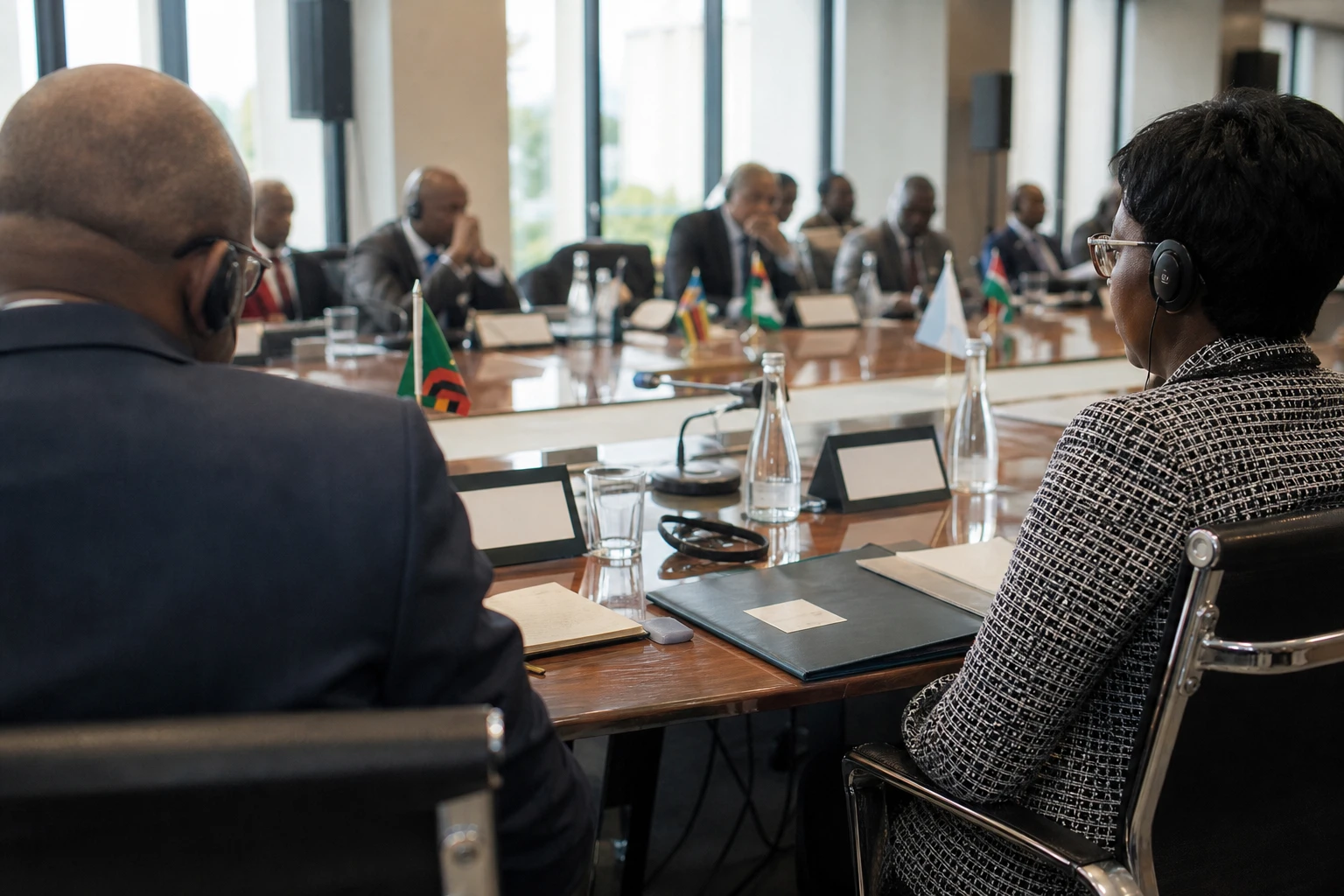
The move also fits within a clear regional framework. Zambia is part of the SADC region, where the Southern African Power Pool organises electricity exchanges between member countries and seeks to make a more competitive market work more smoothly. In this context, the country is not merely trying to close a domestic shortfall: it is also seeking to consolidate its position as a future electricity hub in southern Africa.
Two 500 MW deals that take things to a new scale
On 15 September 2026, Zambia’s state-owned utility ZESCO signed a 25-year power purchase agreement with Hungarian group EnerSynk for a 500 MW solar project in Copperbelt Province. The project still has several stages to clear: technical studies, environmental and regulatory procedures, financing, and then implementation planning. The agreement therefore establishes a commercial framework, but it does not yet amount to an operational power plant.
The deal follows shortly after another agreement of the same size. In June 2026, ZESCO signed another power purchase agreement with South Korean company KS Eco Solutions Holdings for a 500 MW solar project paired with storage. The authorities presented the transaction as a milestone in the strategy to diversify Zambia’s energy mix and strengthen security of supply.
Together, the two projects represent 1 GW of contracted capacity. That is a notable leap for a country which, according to the Ministry of Energy, had around 841 MW of installed solar capacity in 2026, up from 88 MW in 2021. In other words, ZESCO’s recent contracts alone already outweigh the entire operational solar fleet recorded by the authorities.
What the government is seeking to address
Zambia is not turning to solar simply because it is in fashion. The country is emerging from a period in which the electricity system was heavily affected by its dependence on hydropower, which has become more vulnerable to drought. The authorities have said that recent reforms were intended to accelerate solar deployment, simplify licensing and broaden access for private investors.
The country’s National Energy Compact sets a target of 10,000 MW of installed capacity by 2030 and estimates that $11.9 billion in investment will be needed, including $9.5 billion expected from the private sector. The document explicitly places ZESCO’s viability, tariff reforms, a one-stop licensing office and grid reinforcement at the heart of the equation. In other words, solar will only be useful if it is financed, connected and absorbed by the system.
The figures help gauge the scale of the challenge. The Ministry of Energy says total installed capacity rose from 3,100 MW in 2021 to 4,576 MW in 2026, while solar capacity increased from 88 MW to 841 MW over the same period. This growth remains rapid, but it does not remove the need for new capacity to meet demand from cities, industry and, above all, the mining sector, which remains a pillar of Zambia’s economy.
The context also explains the choice of large-scale projects backed by power purchase agreements. This mechanism gives developers and ZESCO greater visibility, while reducing some of the commercial risk. But it does not eliminate construction risk, financing risk or administrative delays. That is why the real battle often begins after the signing.
An industrial, social and regional issue
For Zambian households, the expected benefit is straightforward: fewer power cuts, less dependence on emergency imports, and greater stability for essential services. For businesses, particularly in the Copperbelt and industrial zones, the stakes are even more direct. A more reliable power supply reduces production stoppages and improves investment conditions.
The structure of the two projects also illustrates a shift in the country’s energy geography. The Copperbelt, long associated with copper and industry, is becoming a key area in the solar transition. This location is no accident: it brings generation closer to some large consumers and offers a more tangible response to the needs of the northern section of the mining corridor.
At the same time, Zambia is seeking to improve its position in regional trade. The Energy Compact explicitly mentions the ambition to make the country an electricity trading hub by improving interconnections and participation in regional markets. Within SADC, where the SAPP structures some of the exchanges, this strategy could increase the value of a Zambian kilowatt-hour that is generated, stored and transported more effectively.
One simple point nevertheless deserves attention: a signature does not resolve the question of financing. The authorities and developers speak of an extensive preparation phase, involving studies, permits and financial close. The timetable announced for the South Korean project envisaged a phased rollout, with the first tranche due in 16 months, followed by the next ones at 22 and 28 months. These deadlines are a reminder that the electricity transition is shaped as much on construction sites as in negotiating rooms.
What to watch in the coming months
What happens next will show whether Zambia is building a credible pipeline of large-scale solar projects or merely accumulating ambitious announcements. The next milestones will be financing, the start of construction, the first projects coming online and ZESCO’s ability to integrate these volumes without further undermining its financial position.
Across Africa, this story matters beyond Lusaka. It shows that a country rich in hydropower resources can, under climate pressure, seek to diversify rapidly towards solar on a large scale. It also shows that private capital remains indispensable, provided the rules are clear and the grids keep pace. For Zambia, as for other southern African economies, the real question is no longer whether the sun is there. It is how quickly it can become available, reliable and paid-for electricity.