Algeria
 Egypt
 Libya
 Morocco
 Sudan
 Tunisia
 Benin
 Burkina Faso
 Cabo Verde
 Côte d'Ivoire
 Ghana
 Guinea
 Guinea-Bissau
 Liberia
 Mali
 Mauritania
 Niger
 Nigeria
 Senegal
 Sierra Leone
 The Gambia
 Togo
 Cameroon
 Central African Republic
 Chad
 DR Congo
 Equatorial Guinea
 Gabon
 Republic of the Congo
 São Tomé and Príncipe
 Burundi
 Comoros
 Djibouti
 Eritrea
 Ethiopia
 Kenya
 Madagascar
 Malawi
 Mozambique
 Rwanda
 Seychelles
 Somalia
 South Sudan
 Tanzania
 Uganda
 Angola
 Botswana
 Eswatini
 Lesotho
 Namibia
 South Africa
 Zambia
 Zimbabwe
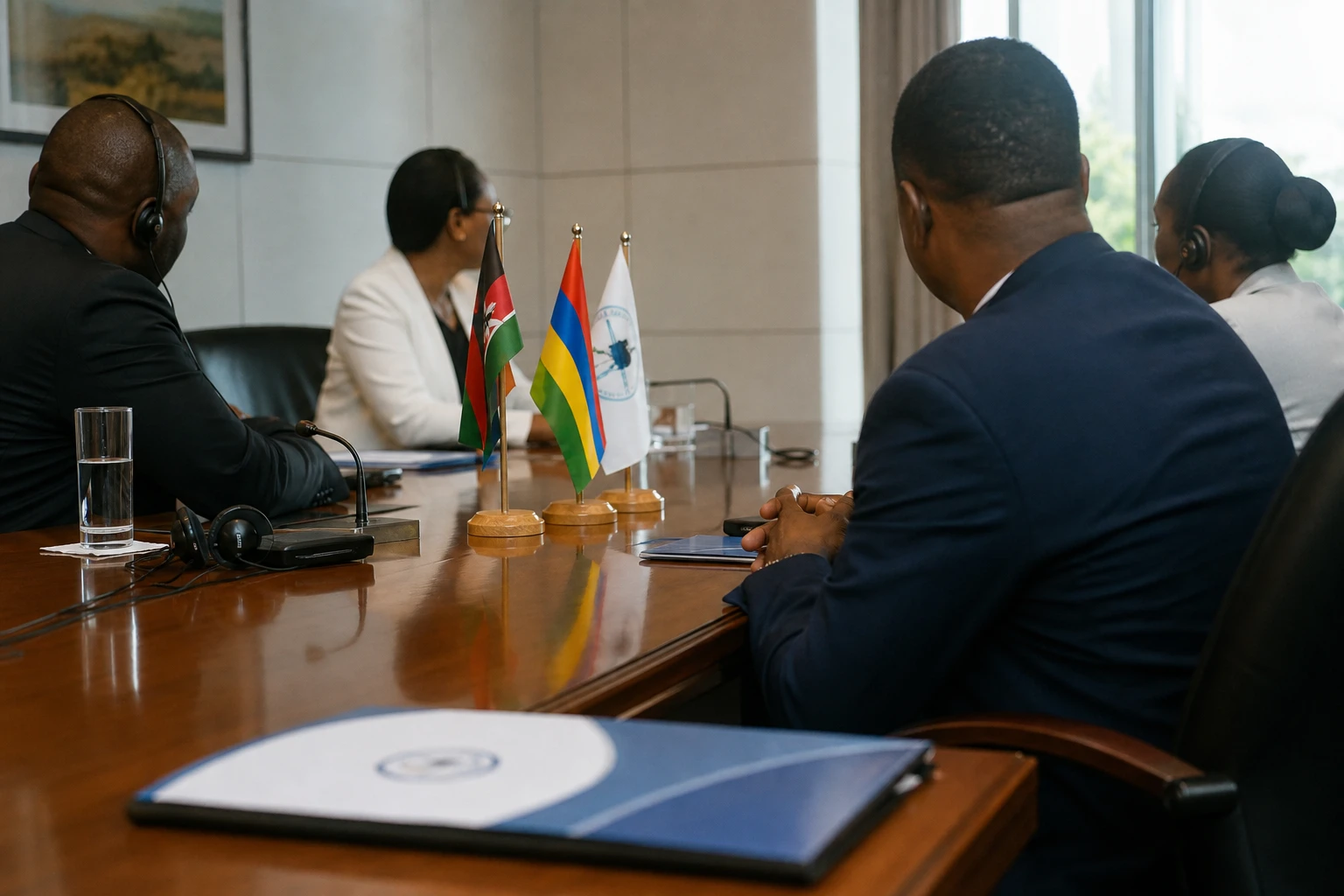
In Port Louis, a legal case that goes beyond Ravatomanga
In Mauritius, an investigation by the Financial Crimes Commission (FCC) has revived a sensitive question: how far can networks of influence weigh on an ongoing judicial process? In this case, attention is focused not only on the allegations against Malagasy businessman Mamy Ravatomanga, but also on suspected attempts to bribe those handling his case in Port Louis.
The case goes to the heart of the credibility of Mauritian institutions. It involves the FCC, the body responsible for financial crime, the Prime Minister’s Office in Port Louis and several figures already named at earlier stages of the investigation. Mauritius is a member of SADC, the Southern African Development Community, a bloc whose mandate places good governance and the rule of law at its core.
What the evidence submitted to the inquiry says
The FCC has opened a new investigation following a complaint lodged by Nasser Bheekhy, a Mauritian businessman already named in the Ravatomanga case. Local media report that he submitted to the commission an audio recording said to be a WhatsApp conversation. The commission must verify its authenticity.
According to the reported evidence, Nasser Bheekhy says that 350 million Mauritian rupees, or around €6.4 million, were allegedly requested to secure favourable intervention in the handling of Mamy Ravatomanga’s case. The same sources say that Jean Carl Elysée, then a senior adviser attached to the Prime Minister’s Office, was the target of the allegations. He denies them.
The adviser later left his post, according to the Mauritian press, while a departure notice was reportedly sent to the relevant authorities to regulate his movements. Navin Ramgoolam, for his part, responded publicly, saying that those who had done wrong must face the consequences and denouncing what he described as attempts to destabilise the investigation.
Why the case carries such weight in Mauritius
The issue is not solely judicial; it is institutional. If investigators confirm that an intermediary sought to monetise access to circles of power, the case would raise a direct question of transparency at the highest level of the state. In a country such as Mauritius, often described as an important financial and legal centre in the Indian Ocean, confidence in anti-corruption mechanisms is an economic asset as much as a political one.
The Mauritian context adds to the sensitivity. The country has recently emerged from an electoral and political period in which public integrity, ministerial accountability and institutional oversight remained prominent themes. The fact that someone close to the government is named in a case linked to a Malagasy businessman already detained in Mauritius therefore invites a broader reading: that of a system of influence extending beyond national borders.
For the Mauritian public, the stakes are tangible. On the one hand is the need to shed light on possible illegal manoeuvres. On the other is the need to preserve the presumption of innocence and the integrity of the proceedings. This is precisely what distinguishes a sound legal case from a battle of images and audio clips on social media. Investigators must therefore separate usable evidence from digital noise.
A Mauritian case with regional reach
The Ravatomanga case is not confined to Port Louis. It also points to Madagascar, where Mamy Ravatomanga is a major business figure and a close associate of former president Andry Rajoelina, according to several Mauritian media outlets. In the SADC region, where Mauritius, Madagascar and Seychelles operate within the same cooperation frameworks, such a case is a reminder that capital flows, business networks and channels of influence extend well beyond administrative borders.
The issue also matters across the Indian Ocean. Mauritius, Madagascar and neighbouring islands share closely connected economic, maritime and financial spaces. When an investigation targets a Malagasy businessman held in Mauritius, amid allegations of money laundering, influence peddling and suspected corruption, the region’s image as a destination for investment, a hub for trade and a partner in judicial cooperation is also at stake.
What happens next will depend on specific evidence: analysis of the audio, interviews with the people named and the FCC’s ability to establish a clear timeline of events. For now, the case is a reminder of a simple reality: in a regional environment where capital moves quickly, strong institutions remain the best test of sovereignty.