Algeria
 Egypt
 Libya
 Morocco
 Sudan
 Tunisia
 Benin
 Burkina Faso
 Cabo Verde
 Côte d'Ivoire
 Ghana
 Guinea
 Guinea-Bissau
 Liberia
 Mali
 Mauritania
 Niger
 Nigeria
 Senegal
 Sierra Leone
 Togo
 Cameroon
 Central African Republic
 Chad
 DR Congo
 Equatorial Guinea
 Gabon
 Republic of the Congo
 São Tomé and Príncipe
 Burundi
 Comoros
 Djibouti
 Eritrea
 Ethiopia
 Kenya
 Madagascar
 Malawi
 Mauritius
 Mozambique
 Rwanda
 Seychelles
 Somalia
 South Sudan
 Tanzania
 Uganda
 Angola
 Botswana
 Eswatini
 Lesotho
 Namibia
 South Africa
 Zambia
 Zimbabwe
In Banjul, electricity is no longer just a technical issue
In The Gambia, power cuts have ceased to be a mere domestic inconvenience. They affect businesses, markets, workshops and hospitals, and ultimately weigh on political stability itself. In Banjul, the capital, anger over power cuts spilled onto the streets, with protests and barricades in several parts of the urban area. The episode is a reminder of a simple reality: when the grid falters, the entire day-to-day economy slows down.
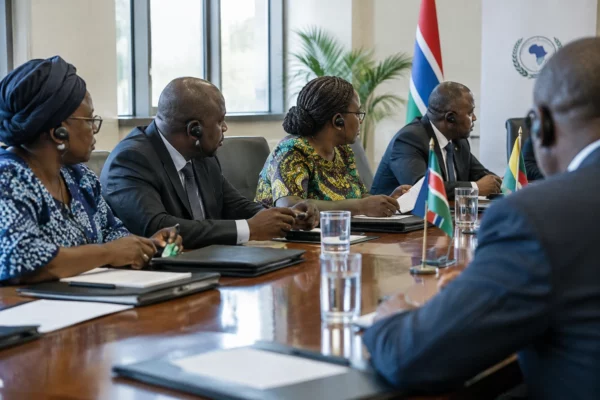
The country is part of a regional framework in which electricity interconnection is intended to reduce precisely this kind of vulnerability. The Gambia depends on the Gambia River Basin Development Organization, or OMVG, which links the country to Senegal, Guinea and Guinea-Bissau, and on the West African electricity market managed by ECOWAS through the West African Power Pool, or WAPP. On paper, this framework should secure supplies and bring costs down. In practice, it remains exposed to climate-related risks, imbalances in generation and delays to investment.
The choice made in 2025, and its limits a year later
The turning point came on 2 May 2025, when the National Water and Electricity Company, NAWEC, and Karpowership officially ended their contract. The Turkish company had been supplying around 30 MW to The Gambia. The government and the state-owned utility defended the decision on cost grounds, saying the contract was too great a burden on national finances. Gambian media reported at the time that the cumulative bill had exceeded $200 million over seven years, fuelling debate over dependence on costly imported generation.
The replacement strategy was based on a different bet: buying more electricity through the OMVG, at a lower cost, and relying on the regional grid. The World Bank says the OMVG loop cut NAWEC’s costs by 42%, while returning the company to profitability in 2025. The International Monetary Fund also confirms that the gradual withdrawal from the Karpowership contract, combined with a shift to cheaper imports from Guinea via the OMVG, brought down the average cost of electricity.
But a lower unit cost does not mean complete security. The Gambian system remains dependent on external conditions it cannot fully control. When hydroelectric generation in Guinea falls because of lower rainfall, the volumes available to The Gambia also decline. The World Bank has already noted that in 2024 low rainfall caused hydroelectric generation in the OMVG area to fall by more than 10%, forcing emergency imports and more costly thermal power. In other words, The Gambia has reduced its dependence on Karpowership, but not its vulnerability to a regional supply shock.
Generation promises, but a crisis already affecting society
Tensions became visible in early September 2026. On 7 and 8 September, protesters erected barricades in Banjul and several neighbouring towns to denounce prolonged outages, sometimes said to last up to 48 hours. Witnesses and Reuters and AFP reports described large demonstrations, burning tyres and police use of tear gas. On 11 September, police even announced that no demonstration would be permitted without a permit, a sign that the energy crisis had begun to turn into a public-order issue.
As pressure mounted, President Adama Barrow promised improved electricity supplies by the end of October. The Gambian presidency said on 8 September that an additional 24 MW unit was to be installed at Brikama, on the west coast, and that a 50 MW solar plant had been awarded for Soma, in the country’s interior. These announcements add to another important fact: since October 2024, NAWEC has already been sourcing electricity from Guinea-Conakry via the OMVG, showing that the regional solution is well under way, but still unable to absorb every shock.
The contrast is clear. On the one hand, the reform has improved the state-owned utility’s accounts. On the other, it has yet to guarantee regular electricity for households, small businesses and urban services. In The Gambia, where the informal economy remains essential, a prolonged outage immediately affects street vendors, mechanics, fishmongers, hairdressers, cold stores and small agricultural processors. The economic cost is therefore diffuse, but very tangible. That also explains how quickly an energy issue can become a question of trust in institutions.
The crisis must also be seen against the country’s political trajectory. The Gambia is entering a sensitive election period, with a presidential vote expected in December 2026, while Adama Barrow is seeking a third term, according to international news reports. In this context, power cuts are no longer judged solely in technical terms. They have become a test of governance, credibility and the ability to deliver on a public-service promise over time.
A Gambian issue, but a signal for all of West Africa
The Gambian case extends beyond its borders. It says something about West Africa as ECOWAS seeks to make a more integrated regional electricity market a reality, through the WAPP and ARREC, the regional regulatory authority. In July 2026, ECOWAS was still announcing progress towards making the regional market operational. This framework is strategic because it allows surpluses to be pooled, costs to be reduced and reliance on emergency thermal power plants to be limited. But it requires stable technical governance, reliable transmission lines and less erratic water resources.
For The Gambia, the challenge in the coming months is therefore twofold. First, it must restore regular service in Banjul and in the urban regions most exposed to outages. Then it must consolidate a less fragile strategy, combining regional imports, solar power, local generation and grid maintenance. The country has not missed the regional shift. It still needs to turn that advantage into real security for consumers. That is where the credibility of the transition model launched after Karpowership’s departure will be tested, far beyond the electricity sector alone.