Algeria
 Egypt
 Libya
 Morocco
 Sudan
 Tunisia
 Benin
 Burkina Faso
 Cabo Verde
 Côte d'Ivoire
 Ghana
 Guinea
 Guinea-Bissau
 Liberia
 Mali
 Mauritania
 Niger
 Nigeria
 Senegal
 Sierra Leone
 The Gambia
 Togo
 Central African Republic
 Chad
 DR Congo
 Equatorial Guinea
 Gabon
 Republic of the Congo
 São Tomé and Príncipe
 Burundi
 Comoros
 Djibouti
 Eritrea
 Ethiopia
 Kenya
 Madagascar
 Malawi
 Mauritius
 Mozambique
 Rwanda
 Seychelles
 Somalia
 South Sudan
 Tanzania
 Uganda
 Angola
 Botswana
 Eswatini
 Lesotho
 Namibia
 South Africa
 Zambia
 Zimbabwe
In Cameroon, mobile coverage has become an infrastructure issue as much as a public service one
In a country where the telephone is often the first route to digital access, the question is no longer simply whether people can get a signal. It is now about the network’s ability to perform everywhere, at a cost households and businesses can afford. That is the central issue in talks held in Yaoundé between the regulator and the market’s two main private operators, as demand for data grows faster than the perceived quality of services.
Cameroon is part of CEMAC, the Economic and Monetary Community of Central Africa, where digital transformation is advancing at uneven rates across countries and regions. In this context, mobile coverage is not merely a technical indicator. It determines access to payments, administrative services, information and, increasingly, everyday economic activity. In recent months, the Cameroonian authorities have repeatedly reminded operators of their obligations on service quality.
Yaoundé meeting urges operators to go further
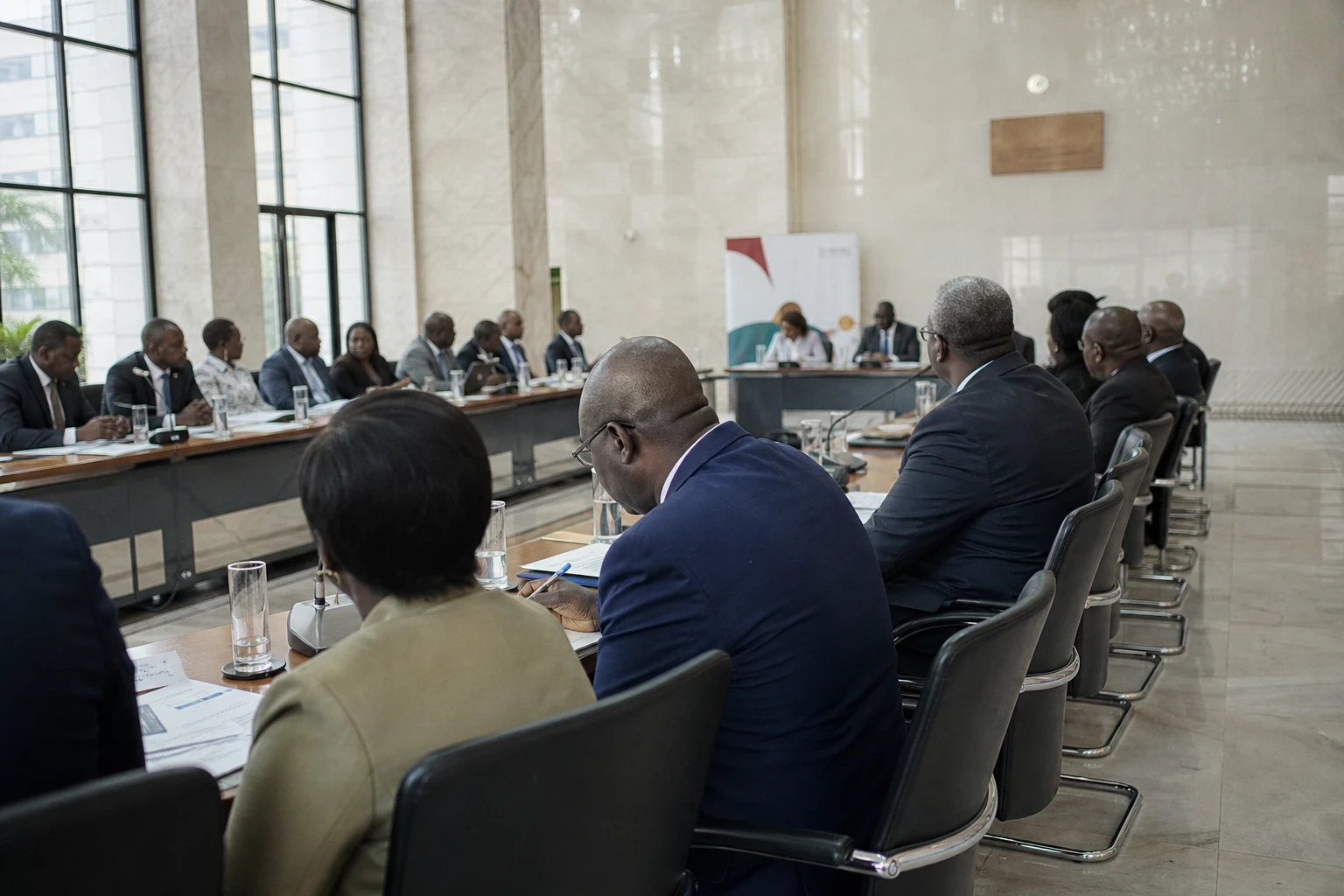
On Thursday 10 September 2026, the director-general of the Telecommunications Regulatory Agency, Professor Philémon Zoo Zame, chaired a meeting at the Immeuble Platinum in Yaoundé with the heads of MTN Cameroon and Orange Cameroon, Wanda Matandela and Patrick Benon. According to the regulator, discussions covered coverage, service quality, network security and equitable access to electronic communications across the country.
The message is clear: network expansion is still expected in areas that remain poorly served. The regulator wants to reduce the digital divide, or the gap in access between connected areas and those that remain poorly connected. This echoes findings repeatedly made by the ART itself, which has already sanctioned MTN Cameroon and Orange Cameroon for breaches related to coverage, service quality and pricing, based on checks carried out in 2024.
Real progress, but coverage remains incomplete
Available figures show progress, without concealing the gaps. DataReportal says that at the end of 2025 Cameroon had 29.0 million active mobile connections, equivalent to 96.4% of the population, and 12.6 million internet users, for a penetration rate of 41.9%. The same source notes that the data draw, among other sources, on the ITU and GSMA Intelligence. The report also points out that one person may hold several SIM cards, so the number of connections does not measure the actual number of users.
The latest estimates available in the ITU database show that Cameroon had 3G population coverage of 80.5% in 2024, and LTE/4G coverage of 75.4%. 5G coverage remains absent from Cameroon’s commercial landscape, while the ITU notes that these indicators measure access to a signal, not actual use of the service. In other words, being covered does not necessarily mean being able to use a stable and affordable service.
The consequence is straightforward. In major cities, the challenge is primarily traffic density, call stability and data speeds. In rural and peri-urban areas, more sites often need to be built and connected, with power supplies and maintenance then provided. The GSMA notes that the final areas to be covered are the most expensive to reach, as they are often the least profitable to serve.
Why service quality remains the real test
In Cameroon, the debate is no longer limited to whether a municipality is covered on paper. Subscribers are above all calling for fewer outages, calls that connect, more consistent speeds and greater continuity of service. The ART itself recently acknowledged that mobile services provided by MTN Cameroon, Orange Cameroon and CAMTEL continued to suffer from deteriorating quality, showing that coverage must now be matched by investment in capacity, monitoring and maintenance.
This requirement also affects the real economy. For a trader, driver, student or small business, an unstable network slows payments, blocks online procedures and limits the use of digital services. Operators, however, face pressure on two fronts: they must invest more in sparsely populated areas while meeting the rising expectations of subscribers in urban centres. The debate is therefore as much about the network’s economic model as its geography.
A Cameroonian issue with regional resonance
The situation in Cameroon goes beyond the national context. In Central Africa, CEMAC member states are seeking to accelerate the flow of information, payments and digital services, but infrastructure remains highly uneven from one country to another. Cameroon, given its population size and economic weight, often serves as a regional barometer. When Yaoundé pushes operators to expand the network, the message resonates well beyond its borders.
The continental significance is the same. The African Union and technical institutions such as the ITU have for several years stressed that coverage is only a first step. The real challenge is digital inclusion: turning the presence of a signal into useful, reliable and affordable access. In Cameroon, the next developments to watch will therefore be the operators’ concrete commitments, the regulator’s checks and the market’s ability to improve both the reach and quality of service at the same time.