Algeria
 Egypt
 Libya
 Morocco
 Sudan
 Tunisia
 Benin
 Burkina Faso
 Cabo Verde
 Côte d'Ivoire
 Ghana
 Guinea
 Guinea-Bissau
 Liberia
 Mali
 Mauritania
 Niger
 Nigeria
 Senegal
 Sierra Leone
 Togo
 Cameroon
 Central African Republic
 Chad
 DR Congo
 Equatorial Guinea
 Gabon
 Republic of the Congo
 São Tomé and Príncipe
 Burundi
 Comoros
 Djibouti
 Eritrea
 Ethiopia
 Kenya
 Madagascar
 Malawi
 Mauritius
 Mozambique
 Rwanda
 Seychelles
 Somalia
 South Sudan
 Tanzania
 Uganda
 Angola
 Botswana
 Eswatini
 Lesotho
 Namibia
 South Africa
 Zambia
 Zimbabwe
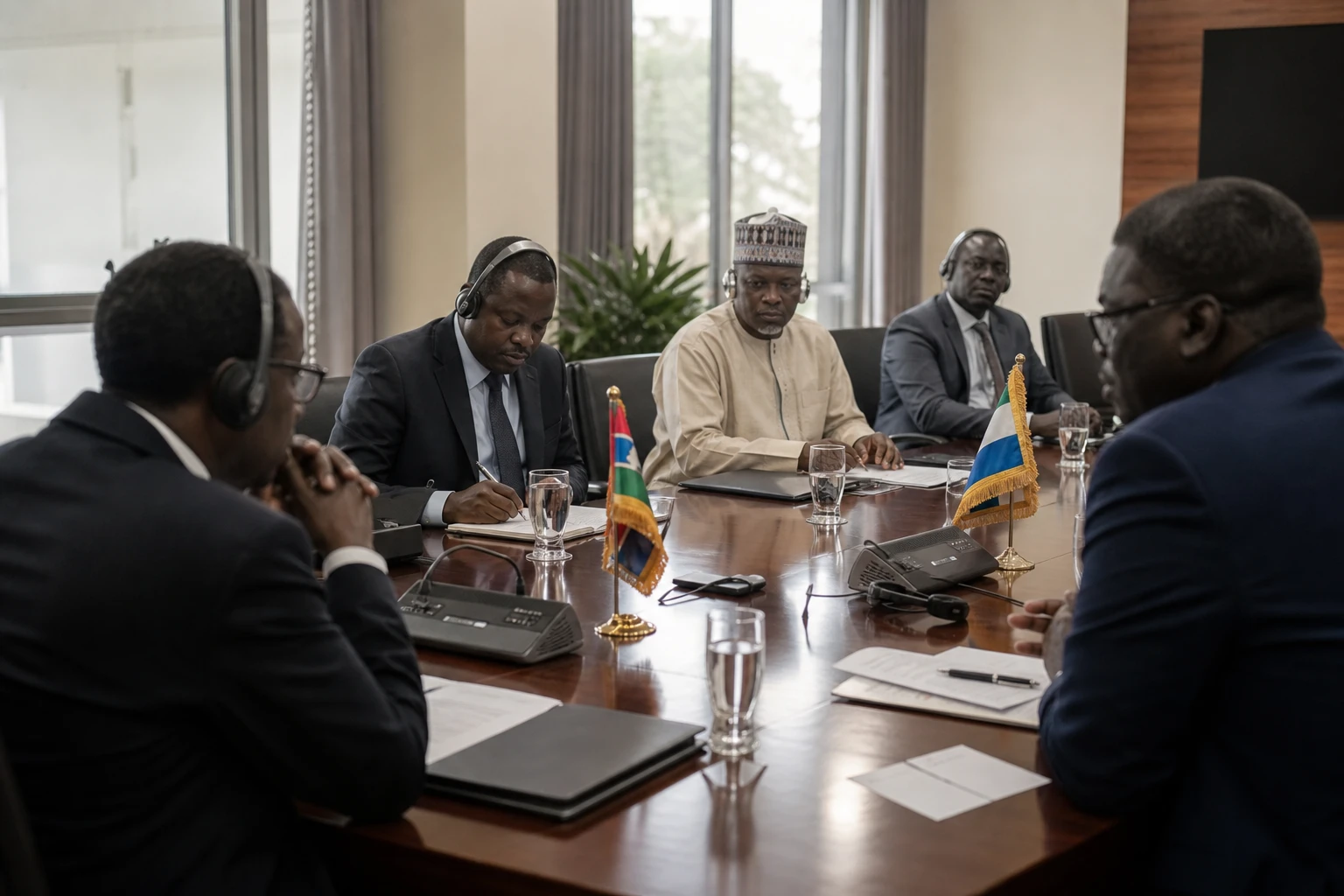
A military handover that goes beyond ceremony
In Banjul, stability is not measured only by official statements. It also takes shape in command posts, joint patrols and the quiet gestures of regional cooperation that has become routine. In The Gambia, a country surrounded by Senegal on almost all sides, each rotation of the West African mission is a reminder that a short border can generate an intensive security effort.
Against this backdrop, Senegal handed the national flag to its 10th detachment for the ECOWAS Mission in The Gambia, often called ECOMIG. The ceremony took place on 9 September 2026 at the Captain Abdoulaye Ngom Tactical Training Centre in Toubacouta, after 45 days of operational preparation. The contingent comprises 618 military personnel, including 14 women, and is commanded by Colonel Balla Moussa Mané.
A regional presence born of The Gambia’s 2017 crisis
The ECOWAS mission in The Gambia is not just another administrative creation. It emerged from the 2016–2017 post-election crisis, when the West African bloc supported a peaceful resolution to the political deadlock and the securing of Banjul, the Gambian capital. ECOWAS later praised ECOMIG’s central role in stabilising the country and supporting democratic governance.
Since then, the regional presence has remained one of the defining features of The Gambia’s transition. ECOWAS authorities have regularly presented the mission as a tool for peace, support for Gambian forces and the prevention of security crises. In May 2026, the Chief of the General Staff of the Senegalese Armed Forces, Admiral Oumar Wade, travelled to The Gambia to meet the 618 troops in the previous detachment and review with them the civil-military activities carried out among local communities.
Senegal is not acting alone. The country operates within the framework of ECOWAS, the regional organisation that continues to treat The Gambia as a priority area for stabilisation in West Africa. In 2026, the ECOWAS Commission again announced a pre-election information-gathering mission in The Gambia, a sign that security remains linked to the country’s institutional life and political balance.
What Senegal’s 10th detachment reveals
The new contingent follows a tried-and-tested structure. It comprises a headquarters, a command, support and services company, a mechanised company and two motorised companies. This structure is not merely decorative. It reflects a mission involving mobility, protection, logistics and a presence on the ground, in a country where internal security remains closely tied to roads, border areas and routes connecting with Senegal.
The presence of 14 women in the contingent also matters. It reflects the slow but real progress in integrating women into West African armed forces’ overseas operations. In a stabilisation mission, this diversity of personnel is more than symbolic. It can also help build links with certain communities, support control duties and humanitarian assistance, and facilitate close engagement.
In Toubacouta, the Chief of Staff of the Army also stressed digital discipline and the restraint expected of soldiers when using social media. This reminder is not incidental. In overseas missions, a contingent’s reputation can be quickly undermined by poorly managed images, public comments or misconduct. The message to the detachment is therefore twofold: hold the ground, but also manage communications.
For The Gambia, security support with political and economic dimensions
For the Gambian authorities, the mission remains a safety net. ECOWAS itself says that ECOMIG helps maintain peace and create an environment conducive to economic growth. This addresses a concrete challenge: The Gambia remains a small market, highly exposed to institutional shocks, cross-border trafficking and political tensions that can disrupt business in Banjul and the inland regions alike.
Senegal’s presence also carries weight in relations between Dakar and Banjul. The two capitals share a geography, human exchanges and an economic space that extends well beyond conventional diplomacy. Securing The Gambia therefore has a direct impact on the movement of people and goods, border communities and towns that depend on informal trade between the two countries.
At the same time, this cooperation is shaped by political constraints. The Gambia of 2026 is not the Gambia of 2017, but it has not fully closed the chapter of the transition that began after Yahya Jammeh’s departure. Gambian institutions seek to consolidate their autonomy, while ECOWAS continues to play a supporting role. It is precisely this tension between regained sovereignty and regional support that explains the mission’s duration.
For the population, the issue is less abstract. A stabilisation mission is judged by its visible effects: secure routes, calm in sensitive areas, cooperation with local forces, occasional assistance and continuity of services. The figures cited by ECOWAS for the outgoing command’s work — more than 8,000 people given medical assistance, more than 100 security missions and more than 40 joint patrols — give an idea of what a regional presence can achieve when sustained over time.
A period to watch beyond September 2026
This deployment comes at a time when ECOWAS is still seeking a balance between security crises, partial withdrawals by some member states and the maintenance of its common mechanisms. The Gambia remains one of the places where the organisation can still demonstrate that collective West African security works, despite its limitations and debates. For the African Union and the sub-region, the Gambian issue therefore remains a test of credibility: that of an African solution conceived, funded and adapted over time by Africans themselves.
What happens next will depend on the new detachment’s ability to maintain continuity without falling into excessive routine. The coming months will show whether this 10th Senegalese rotation consolidates a regional achievement or merely sustains, through inertia, a mission that has become indispensable by lasting so long. In The Gambia, stability cannot be decreed. It is built, rotation after rotation, between Banjul, local garrisons and ECOWAS diplomatic corridors.