Algeria
 Egypt
 Libya
 Morocco
 Sudan
 Tunisia
 Benin
 Burkina Faso
 Cabo Verde
 Côte d'Ivoire
 Ghana
 Guinea
 Guinea-Bissau
 Liberia
 Mauritania
 Niger
 Nigeria
 Senegal
 Sierra Leone
 The Gambia
 Togo
 Cameroon
 Central African Republic
 Chad
 DR Congo
 Equatorial Guinea
 Gabon
 Republic of the Congo
 São Tomé and Príncipe
 Burundi
 Comoros
 Djibouti
 Eritrea
 Ethiopia
 Kenya
 Madagascar
 Malawi
 Mauritius
 Mozambique
 Rwanda
 Seychelles
 Somalia
 South Sudan
 Tanzania
 Uganda
 Angola
 Botswana
 Eswatini
 Lesotho
 Namibia
 South Africa
 Zambia
 Zimbabwe
A battle also fought on screens
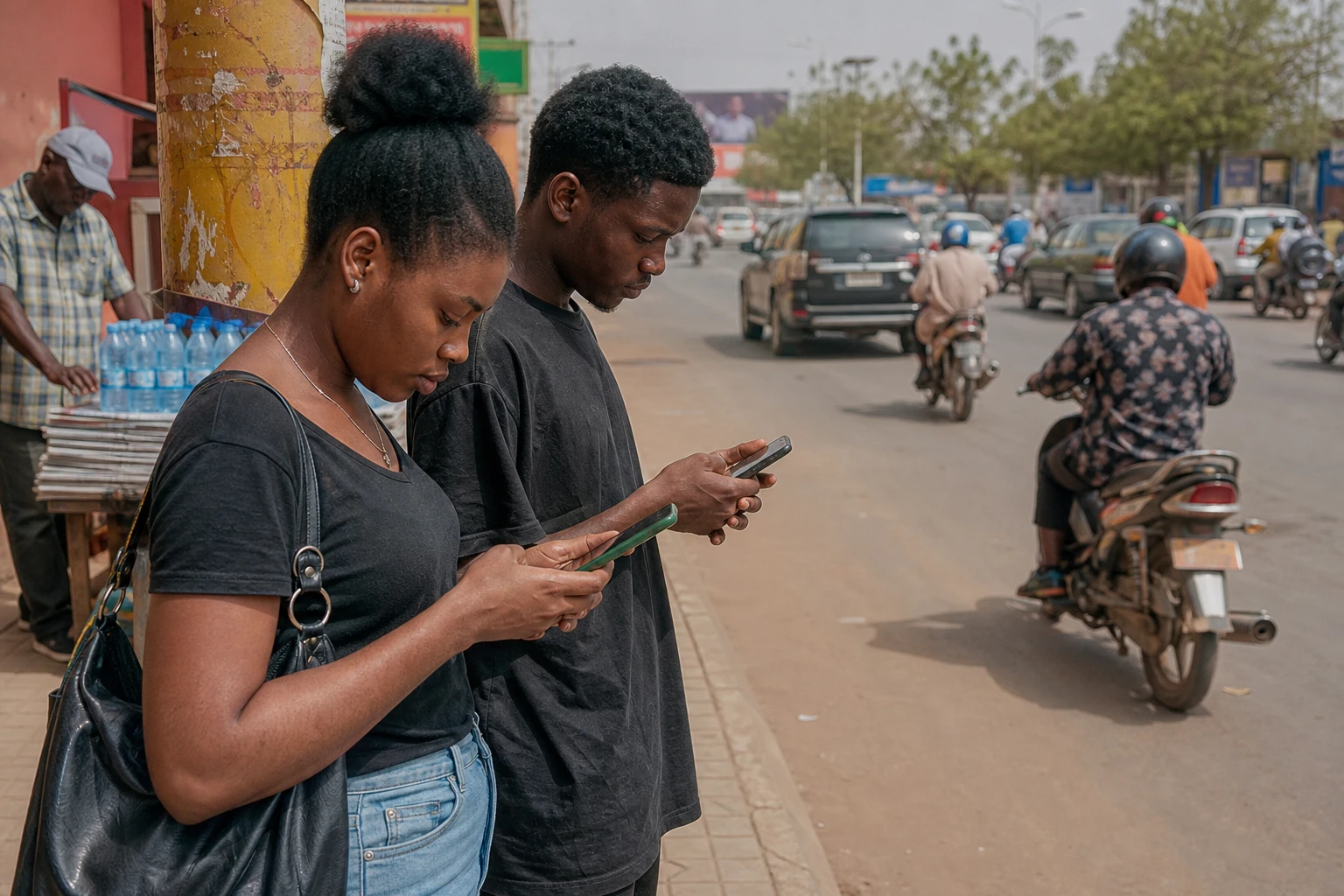
In Mali, the war is no longer confined to blocked roads, ambushes or military communiqués. It is playing out on phones, in shared images, false narratives and messages designed to spread quickly. In a conflict where every side is seeking to impose its version of events, generative artificial intelligence is adding speed and confusion to an already saturated information space.
This shift comes as Mali remains at the heart of security tensions in the Sahel. The African Union convened its Peace and Security Council on the Mali situation again on 28 April 2026, reaffirming its commitment to the country’s sovereignty, unity and territorial integrity. A few weeks later, the organisation again expressed solidarity following deadly attacks against Mali and Niger.
At the same time, Bamako continues to maintain close ties with its Russian security partners, while the military situation remains fluid in the north and centre of the country. The Malian state regularly says that its forces and their partners are taking the initiative, notably after the fighting in Anéfis from 4 to 9 July 2026.
What the study published in Dakar says
A report by the Timbuktu Institute, a research centre based in Dakar, describes a conflict in Mali where weapons alone are no longer enough to gain ground. The authors explain that generative AI is beginning to change the rules of the game in the information war. The document describes use that remains uneven among the various actors, but is already structured enough to matter in the balance of power.
According to the study, Az-Zallaqa, the media arm linked to JNIM, circulated AI-generated visuals in June 2026. The jihadist group is still making limited use of the tool, but a turning point has been reached: content can be produced more quickly, at lower cost and more easily adapted for different audiences. The report also suggests that AI could be used for automated translation, targeted recruitment and the anonymisation of some messages.
The same report looks further afield at Russia. It refers to documented operations involving African Initiative and “AI-Freak”, presented as structured campaigns combining generated content, fake accounts and optimised distribution. The aim is not merely to produce falsehoods. Above all, it is to make the real, the fabricated and the manipulated harder to tell apart.
Why Mali is becoming a testing ground
Mali offers fertile ground for this kind of operation. The conflict is long-running, fragmented and shaped by shifting alliances. In 2026, the tactical alliance between JNIM and the Azawad Liberation Front (FLA) has already shown that groups with different agendas can co-ordinate attacks against Bamako. This gives the battle of narratives immediate strategic value.
The Timbuktu Institute report reflects a broader trend observed internationally. In 2024, Meta said it had dismantled a Russian-linked influence network targeting sub-Saharan Africa that used AI-generated content to make its accounts more credible. OpenAI, for its part, confirmed that it had disrupted several covert operations seeking to exploit its models to produce comments, articles, biographies for fake profiles or translations.
In other words, Mali is not the only place facing this threat. But it is absorbing it in a more fragile context than others. When the authorities, armed groups, pro-government voices and influence networks clash online, the effects are quickly felt on the ground. Rumours fuel panic. Manipulated footage muddies the picture of casualties and events. Misleading videos shape perceptions of strength, control and fear.
What this means for Malians
For leaders, the stakes are political and military. Whoever controls the narrative also partly controls how the war is interpreted. For the population, the issue is even more immediate: knowing whether a route is really open, whether a town is under threat, whether fighting has taken place, or whether information has been fabricated to sow confusion. In a country where transport, the informal economy and people’s movements depend heavily on local trust, a rumour can have an immediate impact on daily life.
The report also makes a point that is useful beyond Mali: AI is no magic wand. It acts as a force multiplier. It speeds up, adapts and industrialises what already existed. In the hands of actors that already have a media apparatus, social media networks or propaganda teams, it can make disinformation more flexible and harder to detect.
The challenge is therefore also institutional. The African Union calls for stability, sovereignty and restraint, but Sahelian states must now factor the digital dimension into their security responses. Mali, like its neighbours in the Alliance of Sahel States, faces a simple question: how can the public sphere be protected when war narratives can be manufactured at high speed, sometimes without it being immediately clear who created them, why, or where?
A Sahel-wide warning, not just a Malian one
The implications extend beyond Bamako. Across the Sahel, armed conflicts, military transitions and rivalries for influence give generative technologies a potential role in political and security competition. The Malian case shows that the battle of narratives is becoming an integral part of modern warfare. It affects capitals, but also regions, trade routes, border areas and the communities living there.
What needs watching now is not only the next military confrontation. It is also the evolution of communication campaigns by armed groups, foreign actors and the authorities, as AI tools become more accessible. In Mali, the information war is no longer merely commenting on the crisis: it is now shaping how it is perceived, its pace and, at times, its course.