Algeria
 Egypt
 Libya
 Morocco
 Sudan
 Tunisia
 Benin
 Burkina Faso
 Cabo Verde
 Côte d'Ivoire
 Ghana
 Guinea
 Guinea-Bissau
 Liberia
 Mali
 Mauritania
 Niger
 Nigeria
 Senegal
 Sierra Leone
 The Gambia
 Togo
 Cameroon
 Central African Republic
 Chad
 DR Congo
 Equatorial Guinea
 Gabon
 Republic of the Congo
 São Tomé and Príncipe
 Burundi
 Comoros
 Djibouti
 Eritrea
 Ethiopia
 Kenya
 Madagascar
 Malawi
 Mauritius
 Mozambique
 Rwanda
 Seychelles
 Somalia
 South Sudan
 Tanzania
 Uganda
 Angola
 Botswana
 Eswatini
 Lesotho
 Namibia
 Zambia
 Zimbabwe
In Durban, the street has become an improvised immigration office
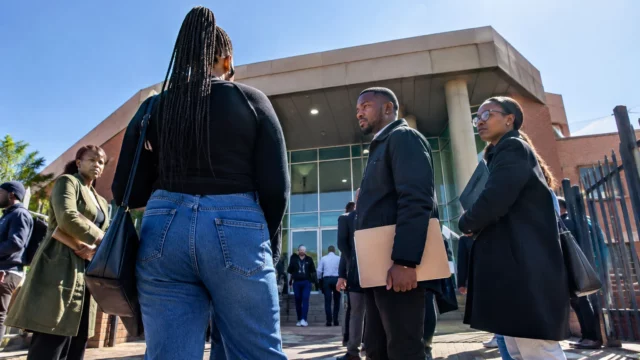
In Durban, South Africa, an administrative crisis has spilled onto the streets. Foreign families have been living for weeks outside the refugee office on Che Guevara Road, with only intermittent police presence and makeshift shelters for protection. In this context, anger over irregular immigration is no longer a political abstraction: it can be seen and heard, and it is directed at people who are already vulnerable.
The issue touches on a sensitive point in South Africa’s trajectory: refugee and asylum seeker affairs are handled by the Department of Home Affairs, which has five specialised offices, including the one in Durban, in KwaZulu-Natal province. Pretoria also says it frames its migration policy within the SADC, the African Union and the continental protocol on the free movement of people, while pledging to improve control of borders and irregular flows. The balance between regional openness and domestic tightening remains unstable.
What happened on 3 September on Che Guevara Road
On Thursday 3 September 2026, members of the anti-immigration movement March and March demonstrated near Durban’s refugee reception centre. Police had to use stun grenades, tear gas, rubber bullets and pepper spray to separate the two sides. Clashes broke out between the protesters and a group of refugees and asylum seekers who had been living there for about 15 weeks, after fleeing violence, evictions and intimidation in several Durban neighbourhoods. Local sources put the number affected at around 250 to 400, according to estimates published that day.
The people identified by the local press are mainly nationals of the Democratic Republic of the Congo, Burundi and Rwanda. KwaZulu-Natal police said a case had been opened after an officer was struck by a stone, and said they had restored order. At the same time, refugee representatives said they accepted the idea of temporary accommodation at Lindela, in Gauteng province, while others rejected the option. The episode is therefore not just a street confrontation. It also exposes a deadlock over relocation and support.
Longstanding tensions, but very current dynamics
The underlying problem is well known. In South Africa, immigration debates are regularly bound up with unemployment, insecurity, the cost of living and pressure on public services. The March and March movement says it targets people without papers, not foreigners in general. But on the ground, the line between rhetoric about irregular migration and the stigmatisation of migrants quickly becomes blurred. In Durban, human rights organisations, for their part, decry months of exposure to life on the street, cold, inadequate food and repeated pressure.
The South African government has acknowledged that it relocated thousands of people as part of its response to this year’s migration crisis. Pretoria says it processed 68,138 foreign nationals between 14 June and 24 July 2026, the majority after passing through the temporary centre in Musina, Limpopo. These figures show the scale of the administrative machinery, but also its limits: when procedures are delayed or families are sent from one place to another, public spaces become zones of constant tension.
In Durban, the impact varies. For traders in the city centre, the prolonged presence of camps on public roads has fuelled complaints about business activity and the use of public space. For refugees, it means insecurity, humiliation and difficulty accessing school, healthcare and stable accommodation. For eThekwini municipality and provincial services, it highlights a simple but weighty question: how can the law be upheld without allowing makeshift arrangements to take hold and ultimately trigger new clashes?
What Durban says about southern Africa
The significance extends far beyond the city. In southern Africa, migration is longstanding, extensive and interconnected. South Africa remains a major destination for work, asylum and trade for people from across the region. When a Durban neighbourhood becomes the scene of a standoff over migrants, the broader question of how regional movement is governed comes to the fore. SADC speaks of integration; the African Union advocates free movement; on the ground, implementation depends on local authorities, the police, courts and social services.
This episode must also be viewed in the light of recent events in South Africa. The violence of 2026 has already led to displacement, temporary relocations and voluntary or forced returns to processing centres such as Lindela. The next question is therefore not just whether there will be another protest. It is whether Pretoria, KwaZulu-Natal and eThekwini can move beyond crisis-by-crisis management. Until that issue is resolved, Durban will remain a highly sensitive barometer of South Africa’s approach to immigration, security and the promise of an Africa that is more mobile, but also better protected.